

generate the catalytically active four-coordinate 16 e
À complexes, which are
needed to coordinate alkene or H 2 to start and/or finish the hydroformylation
catalytic cycle. The fact that our bimetallic catalyst is dicationic and has the
rhodium centers in the +2 oxidation state compensates for the strongly donating,
mainly alkylated et,ph-P4 ligand.
The +2 oxidation state and d
7 electronic configuration enables Rh–Rh covalent
bonding, which is supported by the DFT calculations (Rh–Rh ¼ 2.886 Å for 11r,
2.969 Å for 11r*, and 2.892 Å for 11r**). The Rh–Rh bond, in turn, keeps the Rh
centers in close proximity supporting the bridging ligands that are important for the
cooperativity and intramolecular transfers between metal centers. The combination
of the Rh–Rh bonding and bridging ligands creates a well-defined binding site that
produces the high aldehyde regioselectivity. Key aspects of this are discussed in the
binding site section.
The weakness of our dicationic bimetallic catalyst is the fact that it readily
fragments in acetone or other polar organic solvents into inactive monometallic
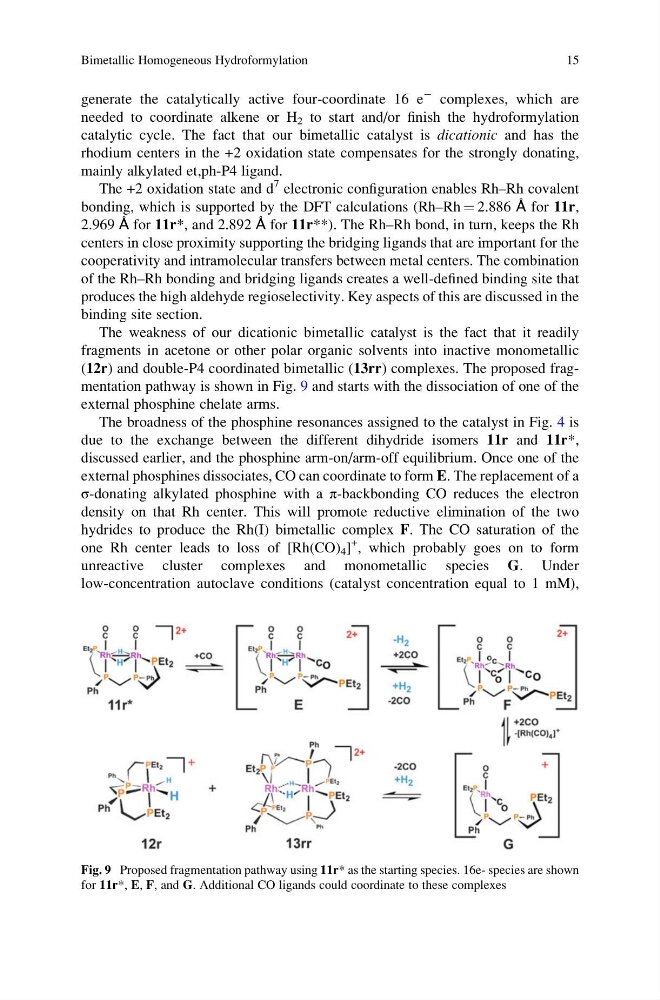
(12r) and double-P4 coordinated bimetallic (13rr) complexes. The proposed fragmentation pathway is shown in Fig. 9 and starts with the dissociation of one of the
external phosphine chelate arms.
The broadness of the phosphine resonances assigned to the catalyst in Fig. 4 is
due to the exchange between the different dihydride isomers 11r and 11r*,
discussed earlier, and the phosphine arm-on/arm-off equilibrium. Once one of the
external phosphines dissociates, CO can coordinate to form E. The replacement of a
σ-donating alkylated phosphine with a π-backbonding CO reduces the electron
density on that Rh center. This will promote reductive elimination of the two
hydrides to produce the Rh(I) bimetallic complex F. The CO saturation of the
one Rh center leads to loss of [Rh(CO) 4 ]
+ , which probably goes on to form
unreactive cluster complexes and monometallic species G. Under
low-concentration autoclave conditions (catalyst concentration equal to 1 mM),
Fig. 9 Proposed fragmentation pathway using 11r* as the starting species. 16e- species are shown
for 11r*, E, F, and G. Additional CO ligands could coordinate to these complexes
Bimetallic Homogeneous Hydroformylation
15
À complexes, which are
needed to coordinate alkene or H 2 to start and/or finish the hydroformylation
catalytic cycle. The fact that our bimetallic catalyst is dicationic and has the
rhodium centers in the +2 oxidation state compensates for the strongly donating,
mainly alkylated et,ph-P4 ligand.
The +2 oxidation state and d
7 electronic configuration enables Rh–Rh covalent
bonding, which is supported by the DFT calculations (Rh–Rh ¼ 2.886 Å for 11r,
2.969 Å for 11r*, and 2.892 Å for 11r**). The Rh–Rh bond, in turn, keeps the Rh
centers in close proximity supporting the bridging ligands that are important for the
cooperativity and intramolecular transfers between metal centers. The combination
of the Rh–Rh bonding and bridging ligands creates a well-defined binding site that
produces the high aldehyde regioselectivity. Key aspects of this are discussed in the
binding site section.
The weakness of our dicationic bimetallic catalyst is the fact that it readily
fragments in acetone or other polar organic solvents into inactive monometallic
(12r) and double-P4 coordinated bimetallic (13rr) complexes. The proposed fragmentation pathway is shown in Fig. 9 and starts with the dissociation of one of the
external phosphine chelate arms.
The broadness of the phosphine resonances assigned to the catalyst in Fig. 4 is
due to the exchange between the different dihydride isomers 11r and 11r*,
discussed earlier, and the phosphine arm-on/arm-off equilibrium. Once one of the
external phosphines dissociates, CO can coordinate to form E. The replacement of a
σ-donating alkylated phosphine with a π-backbonding CO reduces the electron
density on that Rh center. This will promote reductive elimination of the two
hydrides to produce the Rh(I) bimetallic complex F. The CO saturation of the
one Rh center leads to loss of [Rh(CO) 4 ]
+ , which probably goes on to form
unreactive cluster complexes and monometallic species G. Under
low-concentration autoclave conditions (catalyst concentration equal to 1 mM),
Fig. 9 Proposed fragmentation pathway using 11r* as the starting species. 16e- species are shown
for 11r*, E, F, and G. Additional CO ligands could coordinate to these complexes
Bimetallic Homogeneous Hydroformylation
15