

The presence of two bridging carbonyl peaks in the IR spectra at higher
temperatures and the apparent activity dependence on these bridging bands, however, would seem to argue for the terminal dihydride species 11r** as the main
catalyst. But we are quite sure that there is facile phosphine arm dissociation
occurring for species 11r, 11r*, and 11r** if it exists, based on the broad resonances in the
31
P and
1 H NMR at room temperature and above. The equilibrium
between 11r and 11r with an external phosphine dissociated should show up in the
IR as two separate species. DFT calculations show 11r has one long Rh–P external
distance of 2.51 Å indicating weaker Rh–P bonding. Calculations for the phosphine
arm-on and arm-off complexes of 11r show that the bridging CO bands have
different stretching frequencies and should lead to the two bridging IR bands
observed experimentally.
The dicationic charge and unusual Rh(+2) oxidation state offers an ideal explanation for the remarkable hydroformylation activity and regioselectivity of 11r/
11r*. There are, for example, no other examples of active and highly regioselective
hydroformylation catalysts that have mainly alkylated, strongly donating phosphine
ligands (like et,ph-P4). The reason for this is well understood. The presence of two
electron-donating alkylated phosphine ligands increases the electron density on the
rhodium atom leading to increased π-back-donation and stronger Rh–CO bonding.
This stronger Rh–CO bonding stabilizes the unreactive 18 e
À five-coordinate
complexes [RhH(CO) 2 (P 2 )] or [Rh(acyl)(CO) 2 (P 2 )] (P 2 ¼ two monodentate or one
chelating bisphosphine). Facile CO (or phosphine) dissociation is needed to
Rh
Rh
P
P
Et 2 P
PEt2
H
H
Ph
Ph
C
O
C
O
CO
Rh
Rh
P
P
Et 2 P
PEt2
H
C
O
Ph
Ph
2+
C
O
C
O
Rh
Rh
P
P
Et 2 P
PEt2
H
C
O
Ph
Ph
2+
C
O
O
Rh
Rh
P
P
Et 2 P
PEt2
H
C
O
Ph
Ph
2+
C
O
O
CO
OC
Rh
Rh
P
P
Et 2 P
PEt2
C
O
Ph
Ph
2+
C
O
CO
OC
2+
Rh
Rh
P
P
Et 2 P
PEt2
H
H
Ph
Ph
C
O
C
O
CO
2+
Rh
Rh
P
P
Et 2 P
PEt2
H
C
O
Ph
Ph
2+
C
O
O
CO
OC
7.97 kcal
13.4 kcal
9r*-closed
Rh
Rh
P
P
Et 2 P
PEt2
H
Ph
Ph
2+
C
O
C
O
CO
Rh
Rh
P
P
Et 2 P
PEt2
H
C
O
Ph
Ph
2+
C
O
C
O
13.2 kcal
B
C
C*
D
H
O
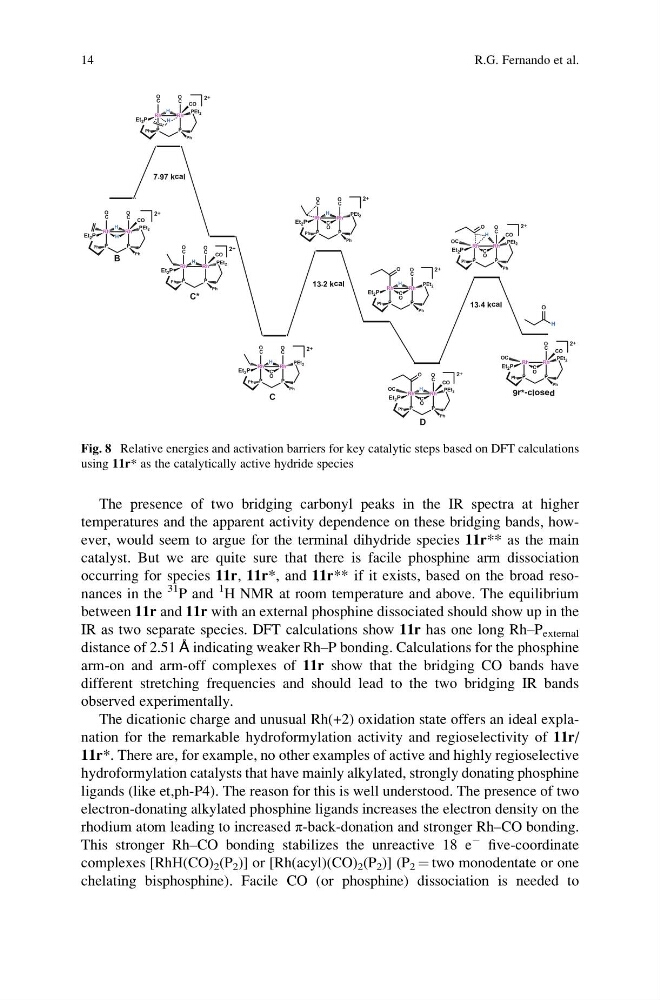
Fig. 8 Relative energies and activation barriers for key catalytic steps based on DFT calculations
using 11r* as the catalytically active hydride species
14
R.G. Fernando et al.
temperatures and the apparent activity dependence on these bridging bands, however, would seem to argue for the terminal dihydride species 11r** as the main
catalyst. But we are quite sure that there is facile phosphine arm dissociation
occurring for species 11r, 11r*, and 11r** if it exists, based on the broad resonances in the
31
P and
1 H NMR at room temperature and above. The equilibrium
between 11r and 11r with an external phosphine dissociated should show up in the
IR as two separate species. DFT calculations show 11r has one long Rh–P external
distance of 2.51 Å indicating weaker Rh–P bonding. Calculations for the phosphine
arm-on and arm-off complexes of 11r show that the bridging CO bands have
different stretching frequencies and should lead to the two bridging IR bands
observed experimentally.
The dicationic charge and unusual Rh(+2) oxidation state offers an ideal explanation for the remarkable hydroformylation activity and regioselectivity of 11r/
11r*. There are, for example, no other examples of active and highly regioselective
hydroformylation catalysts that have mainly alkylated, strongly donating phosphine
ligands (like et,ph-P4). The reason for this is well understood. The presence of two
electron-donating alkylated phosphine ligands increases the electron density on the
rhodium atom leading to increased π-back-donation and stronger Rh–CO bonding.
This stronger Rh–CO bonding stabilizes the unreactive 18 e
À five-coordinate
complexes [RhH(CO) 2 (P 2 )] or [Rh(acyl)(CO) 2 (P 2 )] (P 2 ¼ two monodentate or one
chelating bisphosphine). Facile CO (or phosphine) dissociation is needed to
Rh
Rh
P
P
Et 2 P
PEt2
H
H
Ph
Ph
C
O
C
O
CO
Rh
Rh
P
P
Et 2 P
PEt2
H
C
O
Ph
Ph
2+
C
O
C
O
Rh
Rh
P
P
Et 2 P
PEt2
H
C
O
Ph
Ph
2+
C
O
O
Rh
Rh
P
P
Et 2 P
PEt2
H
C
O
Ph
Ph
2+
C
O
O
CO
OC
Rh
Rh
P
P
Et 2 P
PEt2
C
O
Ph
Ph
2+
C
O
CO
OC
2+
Rh
Rh
P
P
Et 2 P
PEt2
H
H
Ph
Ph
C
O
C
O
CO
2+
Rh
Rh
P
P
Et 2 P
PEt2
H
C
O
Ph
Ph
2+
C
O
O
CO
OC
7.97 kcal
13.4 kcal
9r*-closed
Rh
Rh
P
P
Et 2 P
PEt2
H
Ph
Ph
2+
C
O
C
O
CO
Rh
Rh
P
P
Et 2 P
PEt2
H
C
O
Ph
Ph
2+
C
O
C
O
13.2 kcal
B
C
C*
D
H
O
Fig. 8 Relative energies and activation barriers for key catalytic steps based on DFT calculations
using 11r* as the catalytically active hydride species
14
R.G. Fernando et al.