

experimentally observed low-energy structure at À55
C in our NMR studies.
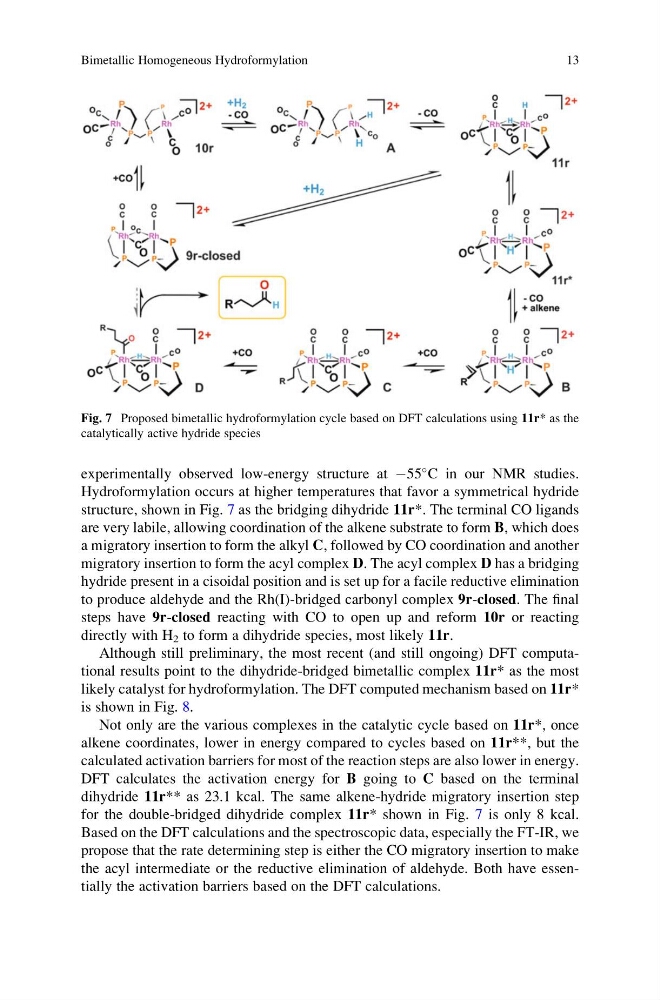
Hydroformylation occurs at higher temperatures that favor a symmetrical hydride
structure, shown in Fig. 7 as the bridging dihydride 11r*. The terminal CO ligands
are very labile, allowing coordination of the alkene substrate to form B, which does
a migratory insertion to form the alkyl C, followed by CO coordination and another
migratory insertion to form the acyl complex D. The acyl complex D has a bridging
hydride present in a cisoidal position and is set up for a facile reductive elimination
to produce aldehyde and the Rh(I)-bridged carbonyl complex 9r-closed. The final
steps have 9r-closed reacting with CO to open up and reform 10r or reacting
directly with H 2 to form a dihydride species, most likely 11r.
Although still preliminary, the most recent (and still ongoing) DFT computational results point to the dihydride-bridged bimetallic complex 11r* as the most
likely catalyst for hydroformylation. The DFT computed mechanism based on 11r*
is shown in Fig. 8.
Not only are the various complexes in the catalytic cycle based on 11r*, once
alkene coordinates, lower in energy compared to cycles based on 11r**, but the
calculated activation barriers for most of the reaction steps are also lower in energy.
DFT calculates the activation energy for B going to C based on the terminal
dihydride 11r** as 23.1 kcal. The same alkene-hydride migratory insertion step
for the double-bridged dihydride complex 11r* shown in Fig. 7 is only 8 kcal.
Based on the DFT calculations and the spectroscopic data, especially the FT-IR, we
propose that the rate determining step is either the CO migratory insertion to make
the acyl intermediate or the reductive elimination of aldehyde. Both have essentially the activation barriers based on the DFT calculations.
Fig. 7 Proposed bimetallic hydroformylation cycle based on DFT calculations using 11r* as the
catalytically active hydride species
Bimetallic Homogeneous Hydroformylation
13
C in our NMR studies.
Hydroformylation occurs at higher temperatures that favor a symmetrical hydride
structure, shown in Fig. 7 as the bridging dihydride 11r*. The terminal CO ligands
are very labile, allowing coordination of the alkene substrate to form B, which does
a migratory insertion to form the alkyl C, followed by CO coordination and another
migratory insertion to form the acyl complex D. The acyl complex D has a bridging
hydride present in a cisoidal position and is set up for a facile reductive elimination
to produce aldehyde and the Rh(I)-bridged carbonyl complex 9r-closed. The final
steps have 9r-closed reacting with CO to open up and reform 10r or reacting
directly with H 2 to form a dihydride species, most likely 11r.
Although still preliminary, the most recent (and still ongoing) DFT computational results point to the dihydride-bridged bimetallic complex 11r* as the most
likely catalyst for hydroformylation. The DFT computed mechanism based on 11r*
is shown in Fig. 8.
Not only are the various complexes in the catalytic cycle based on 11r*, once
alkene coordinates, lower in energy compared to cycles based on 11r**, but the
calculated activation barriers for most of the reaction steps are also lower in energy.
DFT calculates the activation energy for B going to C based on the terminal
dihydride 11r** as 23.1 kcal. The same alkene-hydride migratory insertion step
for the double-bridged dihydride complex 11r* shown in Fig. 7 is only 8 kcal.
Based on the DFT calculations and the spectroscopic data, especially the FT-IR, we
propose that the rate determining step is either the CO migratory insertion to make
the acyl intermediate or the reductive elimination of aldehyde. Both have essentially the activation barriers based on the DFT calculations.
Fig. 7 Proposed bimetallic hydroformylation cycle based on DFT calculations using 11r* as the
catalytically active hydride species
Bimetallic Homogeneous Hydroformylation
13