

The terminal carbonyls that are oriented approximately opposite the Rh–Rh bond
are considered to be exceptionally labile due to the dicationic charge that contracts
the Rh d-orbitals and reduces π-backbonding.
As the temperature is increased from À55
C to 60
C, these two resonances
broaden and coalesce to form a new single hydride resonance at À7.5 ppm. This
can be assigned to one of two symmetrical bimetallic dihydride isomers of 11r, either
the bridged species, [Rh 2 (μ-H) 2 (CO) x (rac-et,ph-P4)]
2+
, 11r*, where x ¼ 2–4, or the
terminal dihydride with bridging carbonyls, [Rh 2 H 2 (μ-CO) 2 (CO) x (rac-et,ph-P4)]
2+
,
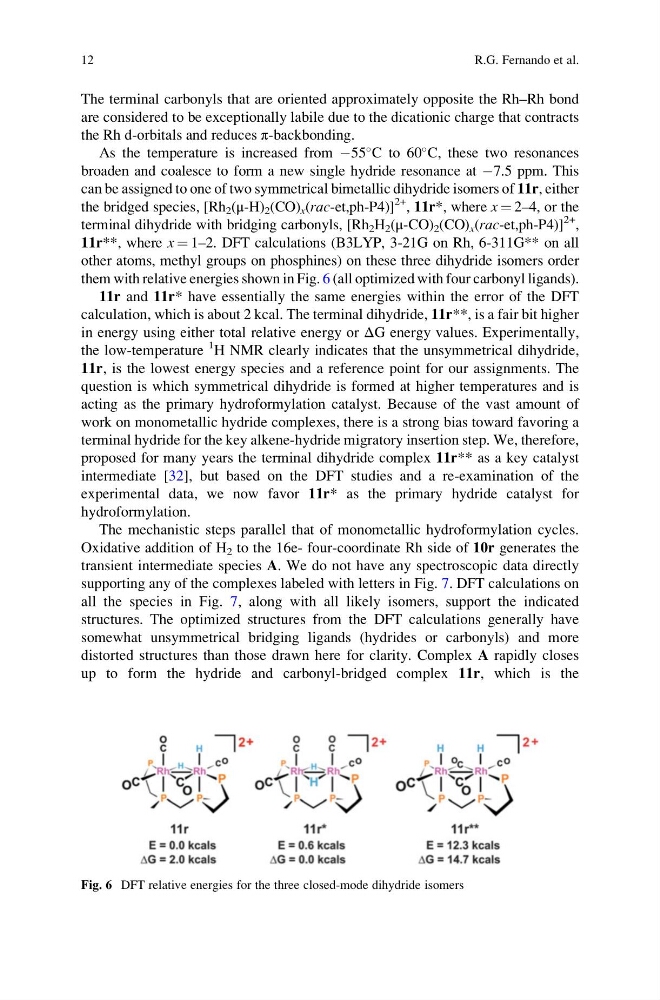
11r**, where x ¼ 1–2. DFT calculations (B3LYP, 3-21G on Rh, 6-311G** on all
other atoms, methyl groups on phosphines) on these three dihydride isomers order
them with relative energies shown in Fig. 6 (all optimized with four carbonyl ligands).
11r and 11r* have essentially the same energies within the error of the DFT
calculation, which is about 2 kcal. The terminal dihydride, 11r**, is a fair bit higher
in energy using either total relative energy or ΔG energy values. Experimentally,
the low-temperature
1 H NMR clearly indicates that the unsymmetrical dihydride,
11r, is the lowest energy species and a reference point for our assignments. The
question is which symmetrical dihydride is formed at higher temperatures and is
acting as the primary hydroformylation catalyst. Because of the vast amount of
work on monometallic hydride complexes, there is a strong bias toward favoring a
terminal hydride for the key alkene-hydride migratory insertion step. We, therefore,
proposed for many years the terminal dihydride complex 11r** as a key catalyst
intermediate [32], but based on the DFT studies and a re-examination of the
experimental data, we now favor 11r* as the primary hydride catalyst for
hydroformylation.
The mechanistic steps parallel that of monometallic hydroformylation cycles.
Oxidative addition of H 2 to the 16e- four-coordinate Rh side of 10r generates the
transient intermediate species A. We do not have any spectroscopic data directly
supporting any of the complexes labeled with letters in Fig. 7. DFT calculations on
all the species in Fig. 7, along with all likely isomers, support the indicated
structures. The optimized structures from the DFT calculations generally have
somewhat unsymmetrical bridging ligands (hydrides or carbonyls) and more
distorted structures than those drawn here for clarity. Complex A rapidly closes
up to form the hydride and carbonyl-bridged complex 11r, which is the
Fig. 6 DFT relative energies for the three closed-mode dihydride isomers
12
R.G. Fernando et al.
are considered to be exceptionally labile due to the dicationic charge that contracts
the Rh d-orbitals and reduces π-backbonding.
As the temperature is increased from À55
C to 60
C, these two resonances
broaden and coalesce to form a new single hydride resonance at À7.5 ppm. This
can be assigned to one of two symmetrical bimetallic dihydride isomers of 11r, either
the bridged species, [Rh 2 (μ-H) 2 (CO) x (rac-et,ph-P4)]
2+
, 11r*, where x ¼ 2–4, or the
terminal dihydride with bridging carbonyls, [Rh 2 H 2 (μ-CO) 2 (CO) x (rac-et,ph-P4)]
2+
,
11r**, where x ¼ 1–2. DFT calculations (B3LYP, 3-21G on Rh, 6-311G** on all
other atoms, methyl groups on phosphines) on these three dihydride isomers order
them with relative energies shown in Fig. 6 (all optimized with four carbonyl ligands).
11r and 11r* have essentially the same energies within the error of the DFT
calculation, which is about 2 kcal. The terminal dihydride, 11r**, is a fair bit higher
in energy using either total relative energy or ΔG energy values. Experimentally,
the low-temperature
1 H NMR clearly indicates that the unsymmetrical dihydride,
11r, is the lowest energy species and a reference point for our assignments. The
question is which symmetrical dihydride is formed at higher temperatures and is
acting as the primary hydroformylation catalyst. Because of the vast amount of
work on monometallic hydride complexes, there is a strong bias toward favoring a
terminal hydride for the key alkene-hydride migratory insertion step. We, therefore,
proposed for many years the terminal dihydride complex 11r** as a key catalyst
intermediate [32], but based on the DFT studies and a re-examination of the
experimental data, we now favor 11r* as the primary hydride catalyst for
hydroformylation.
The mechanistic steps parallel that of monometallic hydroformylation cycles.
Oxidative addition of H 2 to the 16e- four-coordinate Rh side of 10r generates the
transient intermediate species A. We do not have any spectroscopic data directly
supporting any of the complexes labeled with letters in Fig. 7. DFT calculations on
all the species in Fig. 7, along with all likely isomers, support the indicated
structures. The optimized structures from the DFT calculations generally have
somewhat unsymmetrical bridging ligands (hydrides or carbonyls) and more
distorted structures than those drawn here for clarity. Complex A rapidly closes
up to form the hydride and carbonyl-bridged complex 11r, which is the
Fig. 6 DFT relative energies for the three closed-mode dihydride isomers
12
R.G. Fernando et al.