

60, and 75 ppm, but not the resonance at 21 ppm, which we assign to the ciscoordinated chemically equivalent phosphines.
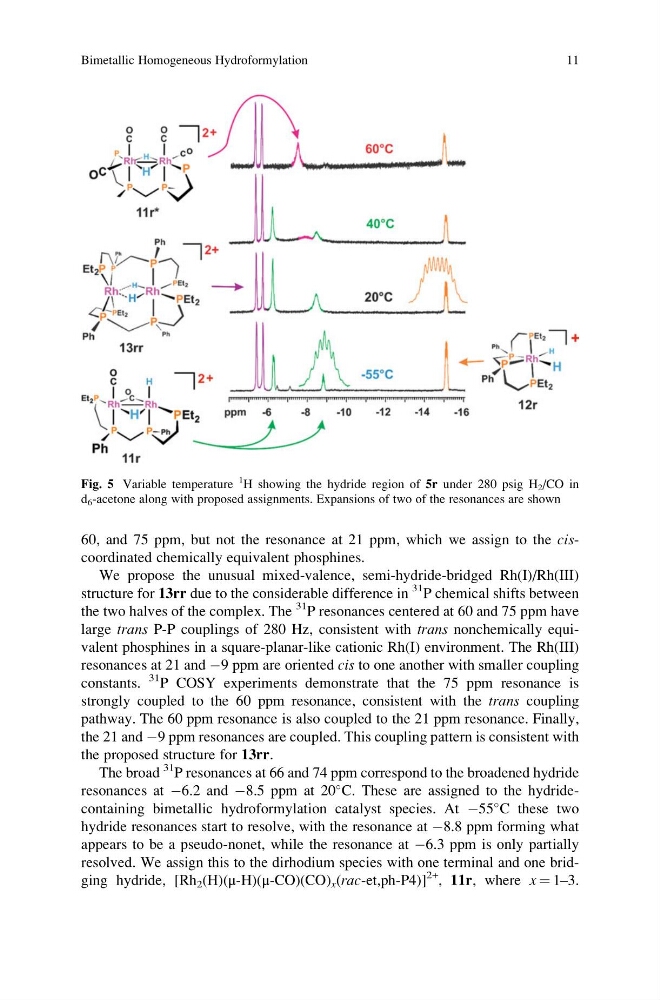
We propose the unusual mixed-valence, semi-hydride-bridged Rh(I)/Rh(III)
structure for 13rr due to the considerable difference in
31 P chemical shifts between
the two halves of the complex. The
31 P resonances centered at 60 and 75 ppm have
large trans P-P couplings of 280 Hz, consistent with trans nonchemically equivalent phosphines in a square-planar-like cationic Rh(I) environment. The Rh(III)
resonances at 21 and À9 ppm are oriented cis to one another with smaller coupling
constants.
31
P COSY experiments demonstrate that the 75 ppm resonance is
strongly coupled to the 60 ppm resonance, consistent with the trans coupling
pathway. The 60 ppm resonance is also coupled to the 21 ppm resonance. Finally,
the 21 and À9 ppm resonances are coupled. This coupling pattern is consistent with
the proposed structure for 13rr.
The broad
31 P resonances at 66 and 74 ppm correspond to the broadened hydride
resonances at À6.2 and À8.5 ppm at 20
C. These are assigned to the hydridecontaining bimetallic hydroformylation catalyst species. At À55
C these two
hydride resonances start to resolve, with the resonance at À8.8 ppm forming what
appears to be a pseudo-nonet, while the resonance at À6.3 ppm is only partially
resolved. We assign this to the dirhodium species with one terminal and one bridging hydride, [Rh 2 (H)(μ-H)(μ-CO)(CO) x (rac-et,ph-P4)]
2+ , 11r, where x ¼ 1–3.
Fig. 5 Variable temperature
1
H showing the hydride region of 5r under 280 psig H 2 /CO in
d 6 -acetone along with proposed assignments. Expansions of two of the resonances are shown
Bimetallic Homogeneous Hydroformylation
11
We propose the unusual mixed-valence, semi-hydride-bridged Rh(I)/Rh(III)
structure for 13rr due to the considerable difference in
31 P chemical shifts between
the two halves of the complex. The
31 P resonances centered at 60 and 75 ppm have
large trans P-P couplings of 280 Hz, consistent with trans nonchemically equivalent phosphines in a square-planar-like cationic Rh(I) environment. The Rh(III)
resonances at 21 and À9 ppm are oriented cis to one another with smaller coupling
constants.
31
P COSY experiments demonstrate that the 75 ppm resonance is
strongly coupled to the 60 ppm resonance, consistent with the trans coupling
pathway. The 60 ppm resonance is also coupled to the 21 ppm resonance. Finally,
the 21 and À9 ppm resonances are coupled. This coupling pattern is consistent with
the proposed structure for 13rr.
The broad
31 P resonances at 66 and 74 ppm correspond to the broadened hydride
resonances at À6.2 and À8.5 ppm at 20
C. These are assigned to the hydridecontaining bimetallic hydroformylation catalyst species. At À55
C these two
hydride resonances start to resolve, with the resonance at À8.8 ppm forming what
appears to be a pseudo-nonet, while the resonance at À6.3 ppm is only partially
resolved. We assign this to the dirhodium species with one terminal and one bridging hydride, [Rh 2 (H)(μ-H)(μ-CO)(CO) x (rac-et,ph-P4)]
2+ , 11r, where x ¼ 1–3.
Fig. 5 Variable temperature
1
H showing the hydride region of 5r under 280 psig H 2 /CO in
d 6 -acetone along with proposed assignments. Expansions of two of the resonances are shown
Bimetallic Homogeneous Hydroformylation
11