

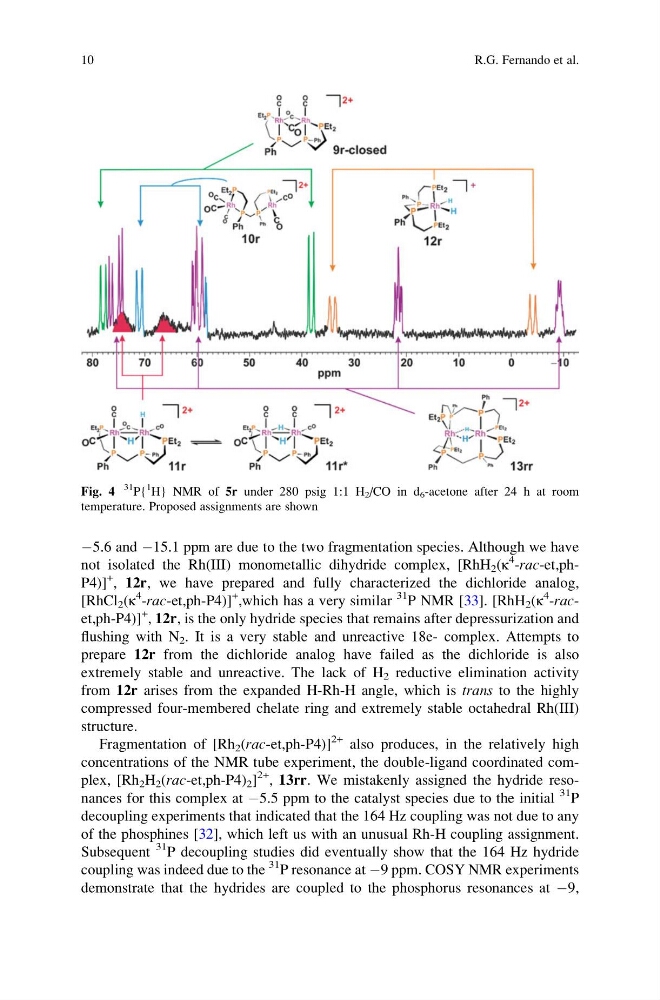
À5.6 and À15.1 ppm are due to the two fragmentation species. Although we have
not isolated the Rh(III) monometallic dihydride complex, [RhH 2 (κ
4 -rac-et,phP4)]
+
, 12r, we have prepared and fully characterized the dichloride analog,
[RhCl 2 (κ
4 -rac-et,ph-P4)]
+
,which has a very similar
31 P NMR [33]. [RhH 2 (κ
4 -racet,ph-P4)]
+
, 12r, is the only hydride species that remains after depressurization and
flushing with N 2 . It is a very stable and unreactive 18e- complex. Attempts to
prepare 12r from the dichloride analog have failed as the dichloride is also
extremely stable and unreactive. The lack of H 2 reductive elimination activity
from 12r arises from the expanded H-Rh-H angle, which is trans to the highly
compressed four-membered chelate ring and extremely stable octahedral Rh(III)
structure.
Fragmentation of [Rh 2 (rac-et,ph-P4)]
2+ also produces, in the relatively high
concentrations of the NMR tube experiment, the double-ligand coordinated complex, [Rh 2 H 2 (rac-et,ph-P4) 2 ]
2+ , 13rr. We mistakenly assigned the hydride resonances for this complex at À5.5 ppm to the catalyst species due to the initial
31 P
decoupling experiments that indicated that the 164 Hz coupling was not due to any
of the phosphines [32], which left us with an unusual Rh-H coupling assignment.
Subsequent
31 P decoupling studies did eventually show that the 164 Hz hydride
coupling was indeed due to the
31 P resonance at À9 ppm. COSY NMR experiments
demonstrate that the hydrides are coupled to the phosphorus resonances at À9,
Fig. 4
31
P{
1
H} NMR of 5r under 280 psig 1:1 H 2 /CO in d 6 -acetone after 24 h at room
temperature. Proposed assignments are shown
10
R.G. Fernando et al.
not isolated the Rh(III) monometallic dihydride complex, [RhH 2 (κ
4 -rac-et,phP4)]
+
, 12r, we have prepared and fully characterized the dichloride analog,
[RhCl 2 (κ
4 -rac-et,ph-P4)]
+
,which has a very similar
31 P NMR [33]. [RhH 2 (κ
4 -racet,ph-P4)]
+
, 12r, is the only hydride species that remains after depressurization and
flushing with N 2 . It is a very stable and unreactive 18e- complex. Attempts to
prepare 12r from the dichloride analog have failed as the dichloride is also
extremely stable and unreactive. The lack of H 2 reductive elimination activity
from 12r arises from the expanded H-Rh-H angle, which is trans to the highly
compressed four-membered chelate ring and extremely stable octahedral Rh(III)
structure.
Fragmentation of [Rh 2 (rac-et,ph-P4)]
2+ also produces, in the relatively high
concentrations of the NMR tube experiment, the double-ligand coordinated complex, [Rh 2 H 2 (rac-et,ph-P4) 2 ]
2+ , 13rr. We mistakenly assigned the hydride resonances for this complex at À5.5 ppm to the catalyst species due to the initial
31 P
decoupling experiments that indicated that the 164 Hz coupling was not due to any
of the phosphines [32], which left us with an unusual Rh-H coupling assignment.
Subsequent
31 P decoupling studies did eventually show that the 164 Hz hydride
coupling was indeed due to the
31 P resonance at À9 ppm. COSY NMR experiments
demonstrate that the hydrides are coupled to the phosphorus resonances at À9,
Fig. 4
31
P{
1
H} NMR of 5r under 280 psig 1:1 H 2 /CO in d 6 -acetone after 24 h at room
temperature. Proposed assignments are shown
10
R.G. Fernando et al.