

Surprisingly, the pentacarbonyl 10r does not seem to react with more CO to form
the hexacarbonyl complex, [Rh 2 (CO) 6 (rac-et,ph-P4)]
2+ , at pressures less than
90 psig.
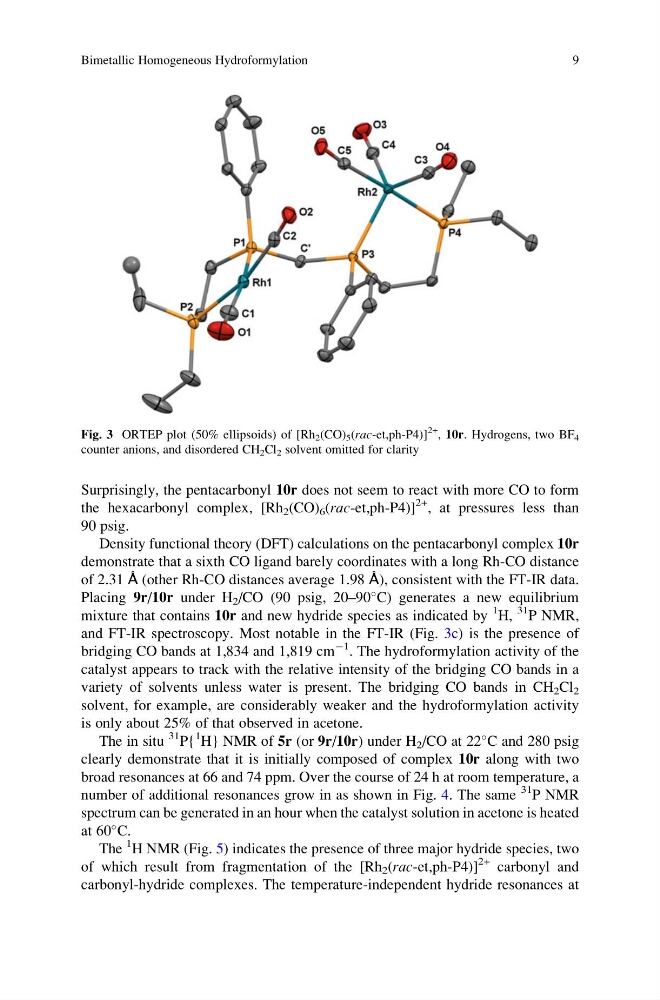
Density functional theory (DFT) calculations on the pentacarbonyl complex 10r
demonstrate that a sixth CO ligand barely coordinates with a long Rh-CO distance
of 2.31 Å (other Rh-CO distances average 1.98 Å), consistent with the FT-IR data.
Placing 9r/10r under H 2 /CO (90 psig, 20–90
C) generates a new equilibrium
mixture that contains 10r and new hydride species as indicated by
1 H,
31 P NMR,
and FT-IR spectroscopy. Most notable in the FT-IR (Fig. 3c) is the presence of
bridging CO bands at 1,834 and 1,819 cm
À1 . The hydroformylation activity of the
catalyst appears to track with the relative intensity of the bridging CO bands in a
variety of solvents unless water is present. The bridging CO bands in CH 2 Cl 2
solvent, for example, are considerably weaker and the hydroformylation activity
is only about 25% of that observed in acetone.
The in situ
31 P{
1 H} NMR of 5r (or 9r/10r) under H 2 /CO at 22
C and 280 psig
clearly demonstrate that it is initially composed of complex 10r along with two
broad resonances at 66 and 74 ppm. Over the course of 24 h at room temperature, a
number of additional resonances grow in as shown in Fig. 4. The same
31
P NMR
spectrum can be generated in an hour when the catalyst solution in acetone is heated
at 60
C.
The
1 H NMR (Fig. 5) indicates the presence of three major hydride species, two
of which result from fragmentation of the [Rh 2 (rac-et,ph-P4)]
2+ carbonyl and
carbonyl-hydride complexes. The temperature-independent hydride resonances at
Fig. 3 ORTEP plot (50% ellipsoids) of [Rh 2 (CO) 5 (rac-et,ph-P4)]
2+ , 10r. Hydrogens, two BF 4
counter anions, and disordered CH 2 Cl 2 solvent omitted for clarity
Bimetallic Homogeneous Hydroformylation
9
the hexacarbonyl complex, [Rh 2 (CO) 6 (rac-et,ph-P4)]
2+ , at pressures less than
90 psig.
Density functional theory (DFT) calculations on the pentacarbonyl complex 10r
demonstrate that a sixth CO ligand barely coordinates with a long Rh-CO distance
of 2.31 Å (other Rh-CO distances average 1.98 Å), consistent with the FT-IR data.
Placing 9r/10r under H 2 /CO (90 psig, 20–90
C) generates a new equilibrium
mixture that contains 10r and new hydride species as indicated by
1 H,
31 P NMR,
and FT-IR spectroscopy. Most notable in the FT-IR (Fig. 3c) is the presence of
bridging CO bands at 1,834 and 1,819 cm
À1 . The hydroformylation activity of the
catalyst appears to track with the relative intensity of the bridging CO bands in a
variety of solvents unless water is present. The bridging CO bands in CH 2 Cl 2
solvent, for example, are considerably weaker and the hydroformylation activity
is only about 25% of that observed in acetone.
The in situ
31 P{
1 H} NMR of 5r (or 9r/10r) under H 2 /CO at 22
C and 280 psig
clearly demonstrate that it is initially composed of complex 10r along with two
broad resonances at 66 and 74 ppm. Over the course of 24 h at room temperature, a
number of additional resonances grow in as shown in Fig. 4. The same
31
P NMR
spectrum can be generated in an hour when the catalyst solution in acetone is heated
at 60
C.
The
1 H NMR (Fig. 5) indicates the presence of three major hydride species, two
of which result from fragmentation of the [Rh 2 (rac-et,ph-P4)]
2+ carbonyl and
carbonyl-hydride complexes. The temperature-independent hydride resonances at
Fig. 3 ORTEP plot (50% ellipsoids) of [Rh 2 (CO) 5 (rac-et,ph-P4)]
2+ , 10r. Hydrogens, two BF 4
counter anions, and disordered CH 2 Cl 2 solvent omitted for clarity
Bimetallic Homogeneous Hydroformylation
9