

Figure 1 quite clearly demonstrates that the bimetallic complexes generated
from the dicationic precursor 5r have considerably lower electron densities on
the rhodium atoms, as indicated by the ~100 cm
À1 higher ν CO stretching frequencies, relative to the electron-rich neutral bimetallic hydrido-carbonyl species
formed from the reaction of 8r with H 2 /CO.
The nature of the active catalyst species was studied by in situ FT-IR using the
dicationic precursors 5r and [Rh 2 (CO) 4 (rac-et,ph-P4)](BF 4 ) 2 , 9r, which generate
the same catalytically active species and give identical spectroscopic results
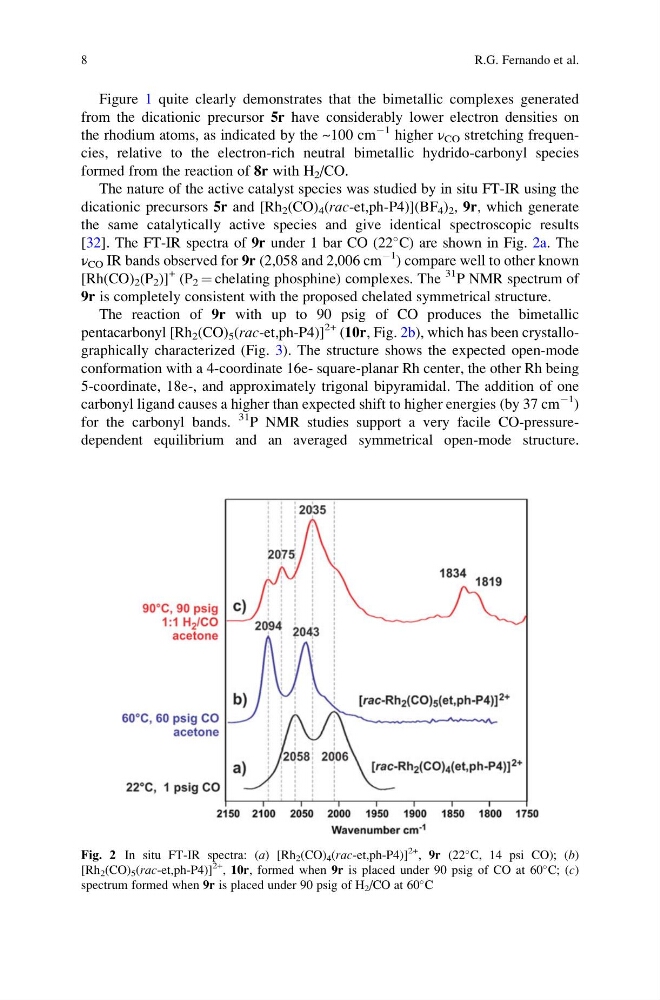
[32]. The FT-IR spectra of 9r under 1 bar CO (22
C) are shown in Fig. 2a. The
ν CO IR bands observed for 9r (2,058 and 2,006 cm
À1 ) compare well to other known
[Rh(CO) 2 (P 2 )]
+ (P 2 ¼ chelating phosphine) complexes. The
31 P NMR spectrum of
9r is completely consistent with the proposed chelated symmetrical structure.
The reaction of 9r with up to 90 psig of CO produces the bimetallic
pentacarbonyl [Rh 2 (CO) 5 (rac-et,ph-P4)]
2+ (10r, Fig. 2b), which has been crystallographically characterized (Fig. 3). The structure shows the expected open-mode
conformation with a 4-coordinate 16e- square-planar Rh center, the other Rh being
5-coordinate, 18e-, and approximately trigonal bipyramidal. The addition of one
carbonyl ligand causes a higher than expected shift to higher energies (by 37 cm
À1 )
for the carbonyl bands.
31 P NMR studies support a very facile CO-pressuredependent equilibrium and an averaged symmetrical open-mode structure.
Fig. 2 In situ FT-IR spectra: (a) [Rh 2 (CO) 4 (rac-et,ph-P4)]
2+ , 9r (22
C, 14 psi CO); (b)
[Rh 2 (CO) 5 (rac-et,ph-P4)]
2+ , 10r, formed when 9r is placed under 90 psig of CO at 60
C; (c)
spectrum formed when 9r is placed under 90 psig of H 2 /CO at 60
C
8
R.G. Fernando et al.
from the dicationic precursor 5r have considerably lower electron densities on
the rhodium atoms, as indicated by the ~100 cm
À1 higher ν CO stretching frequencies, relative to the electron-rich neutral bimetallic hydrido-carbonyl species
formed from the reaction of 8r with H 2 /CO.
The nature of the active catalyst species was studied by in situ FT-IR using the
dicationic precursors 5r and [Rh 2 (CO) 4 (rac-et,ph-P4)](BF 4 ) 2 , 9r, which generate
the same catalytically active species and give identical spectroscopic results
[32]. The FT-IR spectra of 9r under 1 bar CO (22
C) are shown in Fig. 2a. The
ν CO IR bands observed for 9r (2,058 and 2,006 cm
À1 ) compare well to other known
[Rh(CO) 2 (P 2 )]
+ (P 2 ¼ chelating phosphine) complexes. The
31 P NMR spectrum of
9r is completely consistent with the proposed chelated symmetrical structure.
The reaction of 9r with up to 90 psig of CO produces the bimetallic
pentacarbonyl [Rh 2 (CO) 5 (rac-et,ph-P4)]
2+ (10r, Fig. 2b), which has been crystallographically characterized (Fig. 3). The structure shows the expected open-mode
conformation with a 4-coordinate 16e- square-planar Rh center, the other Rh being
5-coordinate, 18e-, and approximately trigonal bipyramidal. The addition of one
carbonyl ligand causes a higher than expected shift to higher energies (by 37 cm
À1 )
for the carbonyl bands.
31 P NMR studies support a very facile CO-pressuredependent equilibrium and an averaged symmetrical open-mode structure.
Fig. 2 In situ FT-IR spectra: (a) [Rh 2 (CO) 4 (rac-et,ph-P4)]
2+ , 9r (22
C, 14 psi CO); (b)
[Rh 2 (CO) 5 (rac-et,ph-P4)]
2+ , 10r, formed when 9r is placed under 90 psig of CO at 60
C; (c)
spectrum formed when 9r is placed under 90 psig of H 2 /CO at 60
C
8
R.G. Fernando et al.