

occurring in his Ph 2 P(CH 2 ) 4 PPh 2 /Rh hydroformylation catalysts [20]. Just as in
Sanger’s systems, 7 has very low regio- and chemoselectivity.
The most internally self-consistent check, however, is that the racemic bimetallic catalyst is 22 times faster for the hydroformylation of 1-hexene than the
mesocatalyst and gives higher product regioselectivity and far fewer side reactions.
The higher rate of the racemic system was proposed to arise from its ability to form
a double-bridged hydrido-carbonyl intermediate, which favors the intramolecular
hydride transfer step that leads to aldehyde elimination. The mesocatalyst can do an
intramolecular hydride transfer, but cannot make the lower energy double-bridged
edge-sharing bioctahedral structure.
3 Dicationic Dirhodium Catalyst in Acetone Solution
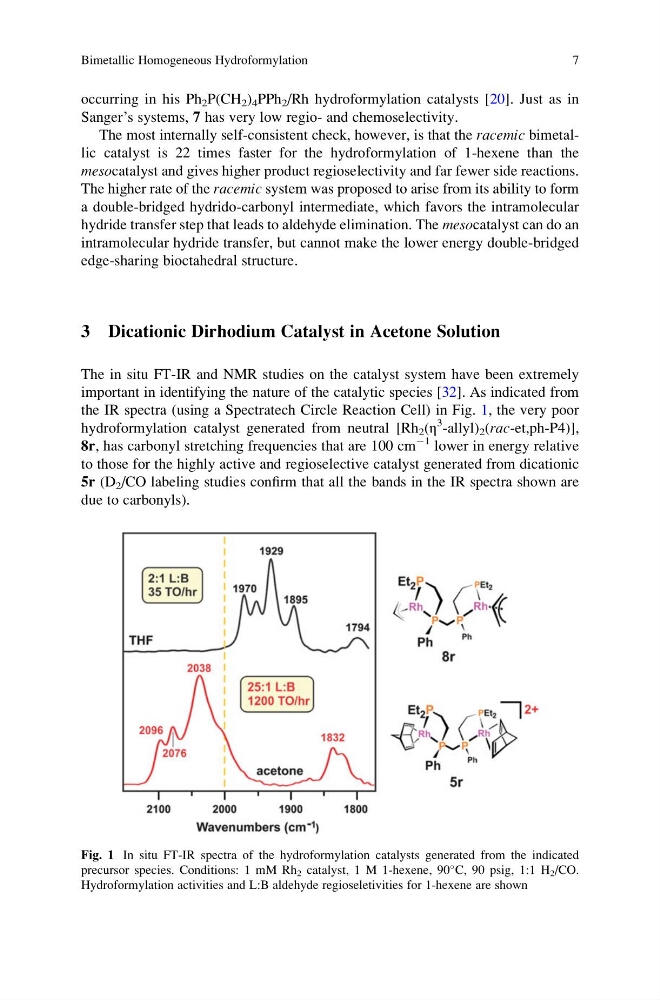
The in situ FT-IR and NMR studies on the catalyst system have been extremely
important in identifying the nature of the catalytic species [32]. As indicated from
the IR spectra (using a Spectratech Circle Reaction Cell) in Fig. 1, the very poor
hydroformylation catalyst generated from neutral [Rh 2 (η
3 -allyl) 2 (rac-et,ph-P4)],
8r, has carbonyl stretching frequencies that are 100 cm
À1 lower in energy relative
to those for the highly active and regioselective catalyst generated from dicationic
5r (D 2 /CO labeling studies confirm that all the bands in the IR spectra shown are
due to carbonyls).
Fig. 1 In situ FT-IR spectra of the hydroformylation catalysts generated from the indicated
precursor species. Conditions: 1 mM Rh 2 catalyst, 1 M 1-hexene, 90
C, 90 psig, 1:1 H 2 /CO.
Hydroformylation activities and L:B aldehyde regioseletivities for 1-hexene are shown
Bimetallic Homogeneous Hydroformylation
7
Sanger’s systems, 7 has very low regio- and chemoselectivity.
The most internally self-consistent check, however, is that the racemic bimetallic catalyst is 22 times faster for the hydroformylation of 1-hexene than the
mesocatalyst and gives higher product regioselectivity and far fewer side reactions.
The higher rate of the racemic system was proposed to arise from its ability to form
a double-bridged hydrido-carbonyl intermediate, which favors the intramolecular
hydride transfer step that leads to aldehyde elimination. The mesocatalyst can do an
intramolecular hydride transfer, but cannot make the lower energy double-bridged
edge-sharing bioctahedral structure.
3 Dicationic Dirhodium Catalyst in Acetone Solution
The in situ FT-IR and NMR studies on the catalyst system have been extremely
important in identifying the nature of the catalytic species [32]. As indicated from
the IR spectra (using a Spectratech Circle Reaction Cell) in Fig. 1, the very poor
hydroformylation catalyst generated from neutral [Rh 2 (η
3 -allyl) 2 (rac-et,ph-P4)],
8r, has carbonyl stretching frequencies that are 100 cm
À1 lower in energy relative
to those for the highly active and regioselective catalyst generated from dicationic
5r (D 2 /CO labeling studies confirm that all the bands in the IR spectra shown are
due to carbonyls).
Fig. 1 In situ FT-IR spectra of the hydroformylation catalysts generated from the indicated
precursor species. Conditions: 1 mM Rh 2 catalyst, 1 M 1-hexene, 90
C, 90 psig, 1:1 H 2 /CO.
Hydroformylation activities and L:B aldehyde regioseletivities for 1-hexene are shown
Bimetallic Homogeneous Hydroformylation
7