

catalyst and gives considerably higher overall product selectivities (Table 1),
particularly with respect to the undesirable alkene isomerization and hydrogenation
side reactions.
In contrast with virtually all other aryl phosphine or phosphite coordinated
rhodium hydroformylation catalysts, 5r does not require any excess phosphine
ligand in order to maintain its selectivity or stability. In fact, adding excess racP4 ligand deactivates the bimetallic catalyst. The need for excess phosphine in
monometallic rhodium catalysts arises from the relatively weak Rh–PPh 3
(or phosphite) bonding. In order to maintain the coordination of two phosphine
ligands, which are required for good regioselectivity, a large excess of PPh 3 is
required to force the dissociation equilibrium to favor [HRh(CO)(PPh 3 ) 2 ] [29–
31]. In 5r, the chelating and electron-donating et,ph-P4 phosphine ligand coordinates strongly enough to the rhodium centers so that excess phosphine is not
needed. But as we have subsequently found out, the chelate effect is not strong
enough to maintain stability of the bimetallic complex, which will be discussed
further below.
The following observations support the proposed bimetallic cooperativity.
Model
monometallic
[Rh(nbd)(P 2 )](BF 4 )
(P 2 ¼ Et 2 PCH 2 CH 2 PEt 2 ,
Et 2 PCH 2 CH 2 PMePh, Et 2 PCH 2 CH 2 PPh 2 , or Ph 2 PCH 2 CH 2 PPh 2 ) catalyst precursors
generate terrible hydroformylation catalysts for 1-hexene from both a rate and
regioselectivity viewpoint (1–2 turnovers/h, 3:1 linear to branched aldehyde
regioselectivity, 50–70% alkene isomerization and hydrogenation side reactions).
Tethering together two extremely poor monometallic hydroformylation catalysts
with our rac-et,ph-P4 ligand to form a highly active and selective hydroformylation
catalyst is strong evidence for the presence of effective bimetallic cooperativity in
this system.
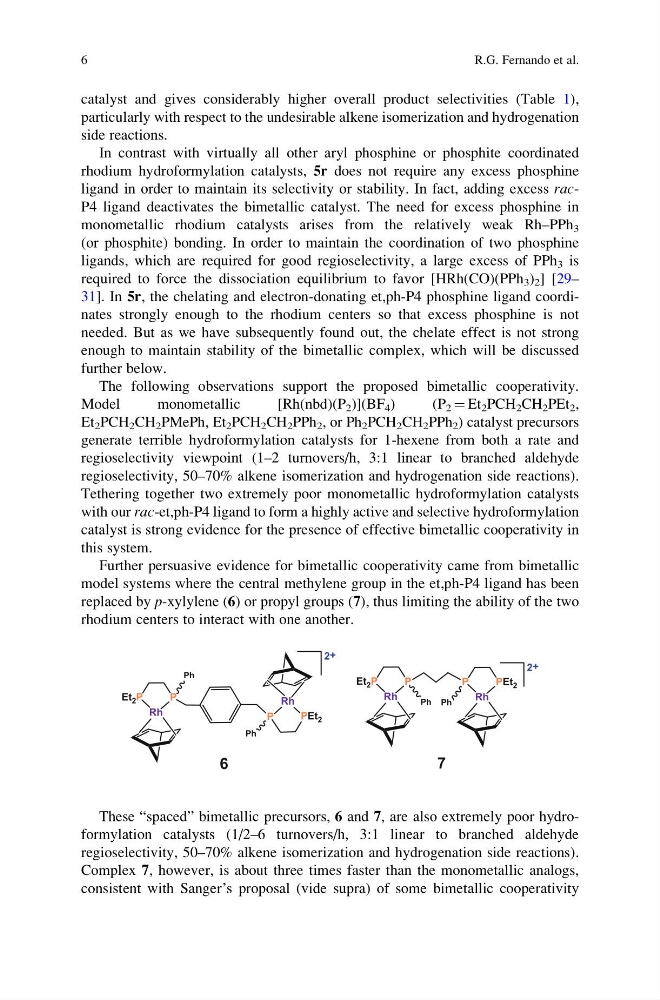
Further persuasive evidence for bimetallic cooperativity came from bimetallic
model systems where the central methylene group in the et,ph-P4 ligand has been
replaced by p-xylylene (6) or propyl groups (7), thus limiting the ability of the two
rhodium centers to interact with one another.
Et 2 P
Rh
P
PEt 2
Rh
P
2+
Et 2 P
Rh
P
2+
P
Rh
PEt 2
Ph
Ph
Ph Ph
6
7
These “spaced” bimetallic precursors, 6 and 7, are also extremely poor hydroformylation catalysts (1/2–6 turnovers/h, 3:1 linear to branched aldehyde
regioselectivity, 50–70% alkene isomerization and hydrogenation side reactions).
Complex 7, however, is about three times faster than the monometallic analogs,
consistent with Sanger’s proposal (vide supra) of some bimetallic cooperativity
6
R.G. Fernando et al.
particularly with respect to the undesirable alkene isomerization and hydrogenation
side reactions.
In contrast with virtually all other aryl phosphine or phosphite coordinated
rhodium hydroformylation catalysts, 5r does not require any excess phosphine
ligand in order to maintain its selectivity or stability. In fact, adding excess racP4 ligand deactivates the bimetallic catalyst. The need for excess phosphine in
monometallic rhodium catalysts arises from the relatively weak Rh–PPh 3
(or phosphite) bonding. In order to maintain the coordination of two phosphine
ligands, which are required for good regioselectivity, a large excess of PPh 3 is
required to force the dissociation equilibrium to favor [HRh(CO)(PPh 3 ) 2 ] [29–
31]. In 5r, the chelating and electron-donating et,ph-P4 phosphine ligand coordinates strongly enough to the rhodium centers so that excess phosphine is not
needed. But as we have subsequently found out, the chelate effect is not strong
enough to maintain stability of the bimetallic complex, which will be discussed
further below.
The following observations support the proposed bimetallic cooperativity.
Model
monometallic
[Rh(nbd)(P 2 )](BF 4 )
(P 2 ¼ Et 2 PCH 2 CH 2 PEt 2 ,
Et 2 PCH 2 CH 2 PMePh, Et 2 PCH 2 CH 2 PPh 2 , or Ph 2 PCH 2 CH 2 PPh 2 ) catalyst precursors
generate terrible hydroformylation catalysts for 1-hexene from both a rate and
regioselectivity viewpoint (1–2 turnovers/h, 3:1 linear to branched aldehyde
regioselectivity, 50–70% alkene isomerization and hydrogenation side reactions).
Tethering together two extremely poor monometallic hydroformylation catalysts
with our rac-et,ph-P4 ligand to form a highly active and selective hydroformylation
catalyst is strong evidence for the presence of effective bimetallic cooperativity in
this system.
Further persuasive evidence for bimetallic cooperativity came from bimetallic
model systems where the central methylene group in the et,ph-P4 ligand has been
replaced by p-xylylene (6) or propyl groups (7), thus limiting the ability of the two
rhodium centers to interact with one another.
Et 2 P
Rh
P
PEt 2
Rh
P
2+
Et 2 P
Rh
P
2+
P
Rh
PEt 2
Ph
Ph
Ph Ph
6
7
These “spaced” bimetallic precursors, 6 and 7, are also extremely poor hydroformylation catalysts (1/2–6 turnovers/h, 3:1 linear to branched aldehyde
regioselectivity, 50–70% alkene isomerization and hydrogenation side reactions).
Complex 7, however, is about three times faster than the monometallic analogs,
consistent with Sanger’s proposal (vide supra) of some bimetallic cooperativity
6
R.G. Fernando et al.