

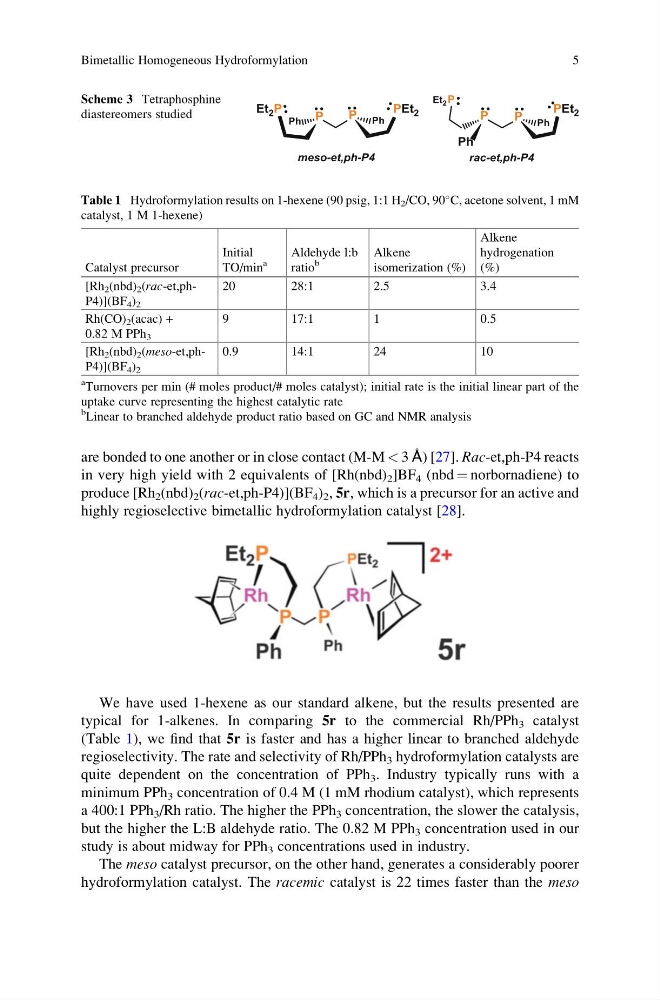
are bonded to one another or in close contact (M-M < 3 Å) [27]. Rac-et,ph-P4 reacts
in very high yield with 2 equivalents of [Rh(nbd) 2 ]BF 4 (nbd ¼ norbornadiene) to
produce [Rh 2 (nbd) 2 (rac-et,ph-P4)](BF 4 ) 2 , 5r, which is a precursor for an active and
highly regioselective bimetallic hydroformylation catalyst [28].
We have used 1-hexene as our standard alkene, but the results presented are
typical for 1-alkenes. In comparing 5r to the commercial Rh/PPh 3 catalyst
(Table 1), we find that 5r is faster and has a higher linear to branched aldehyde
regioselectivity. The rate and selectivity of Rh/PPh 3 hydroformylation catalysts are
quite dependent on the concentration of PPh 3 . Industry typically runs with a
minimum PPh 3 concentration of 0.4 M (1 mM rhodium catalyst), which represents
a 400:1 PPh 3 /Rh ratio. The higher the PPh 3 concentration, the slower the catalysis,
but the higher the L:B aldehyde ratio. The 0.82 M PPh 3 concentration used in our
study is about midway for PPh 3 concentrations used in industry.
The meso catalyst precursor, on the other hand, generates a considerably poorer
hydroformylation catalyst. The racemic catalyst is 22 times faster than the meso
P
P
Ph
Ph
P
PEt 2
rac-et,ph-P4
P
P
Ph
Ph
PEt 2
Et 2 P
meso-et,ph-P4
Et 2
Scheme 3 Tetraphosphine
diastereomers studied
Table 1 Hydroformylation results on 1-hexene (90 psig, 1:1 H 2 /CO, 90
C, acetone solvent, 1 mM
catalyst, 1 M 1-hexene)
Catalyst precursor
Initial
TO/min
a
Aldehyde l:b
ratio
b
Alkene
isomerization (%)
Alkene
hydrogenation
(%)
[Rh 2 (nbd) 2 (rac-et,phP4)](BF 4 ) 2
20
28:1
2.5
3.4
Rh(CO) 2 (acac) +
0.82 M PPh 3
9
17:1
1
0.5
[Rh 2 (nbd) 2 (meso-et,phP4)](BF 4 ) 2
0.9
14:1
24
10
a
Turnovers per min (# moles product/# moles catalyst); initial rate is the initial linear part of the
uptake curve representing the highest catalytic rate
b
Linear to branched aldehyde product ratio based on GC and NMR analysis
Bimetallic Homogeneous Hydroformylation
5
in very high yield with 2 equivalents of [Rh(nbd) 2 ]BF 4 (nbd ¼ norbornadiene) to
produce [Rh 2 (nbd) 2 (rac-et,ph-P4)](BF 4 ) 2 , 5r, which is a precursor for an active and
highly regioselective bimetallic hydroformylation catalyst [28].
We have used 1-hexene as our standard alkene, but the results presented are
typical for 1-alkenes. In comparing 5r to the commercial Rh/PPh 3 catalyst
(Table 1), we find that 5r is faster and has a higher linear to branched aldehyde
regioselectivity. The rate and selectivity of Rh/PPh 3 hydroformylation catalysts are
quite dependent on the concentration of PPh 3 . Industry typically runs with a
minimum PPh 3 concentration of 0.4 M (1 mM rhodium catalyst), which represents
a 400:1 PPh 3 /Rh ratio. The higher the PPh 3 concentration, the slower the catalysis,
but the higher the L:B aldehyde ratio. The 0.82 M PPh 3 concentration used in our
study is about midway for PPh 3 concentrations used in industry.
The meso catalyst precursor, on the other hand, generates a considerably poorer
hydroformylation catalyst. The racemic catalyst is 22 times faster than the meso
P
P
Ph
Ph
P
PEt 2
rac-et,ph-P4
P
P
Ph
Ph
PEt 2
Et 2 P
meso-et,ph-P4
Et 2
Scheme 3 Tetraphosphine
diastereomers studied
Table 1 Hydroformylation results on 1-hexene (90 psig, 1:1 H 2 /CO, 90
C, acetone solvent, 1 mM
catalyst, 1 M 1-hexene)
Catalyst precursor
Initial
TO/min
a
Aldehyde l:b
ratio
b
Alkene
isomerization (%)
Alkene
hydrogenation
(%)
[Rh 2 (nbd) 2 (rac-et,phP4)](BF 4 ) 2
20
28:1
2.5
3.4
Rh(CO) 2 (acac) +
0.82 M PPh 3
9
17:1
1
0.5
[Rh 2 (nbd) 2 (meso-et,phP4)](BF 4 ) 2
0.9
14:1
24
10
a
Turnovers per min (# moles product/# moles catalyst); initial rate is the initial linear part of the
uptake curve representing the highest catalytic rate
b
Linear to branched aldehyde product ratio based on GC and NMR analysis
Bimetallic Homogeneous Hydroformylation
5