

Sanger and coworkers also reported in 1977 the unusual effect of certain
diphosphine ligands, Ph 2 P(CH 2 ) n PPh 2 , on the activity of [HRh(CO)(PPh 3 ) 2 ]
hydroformylation catalysts [20]. The addition of 0.25 equivalents of Ph 2 P
(CH 2 ) n PPh 2 (n ¼ 2–4) per equivalent of [HRh(CO)(PPh 3 ) 2 ], for example, caused
an increase in the catalytic activity by 90–150%. Addition of more than 0.3
equivalents, however, caused a decrease in the activity relative to the starting
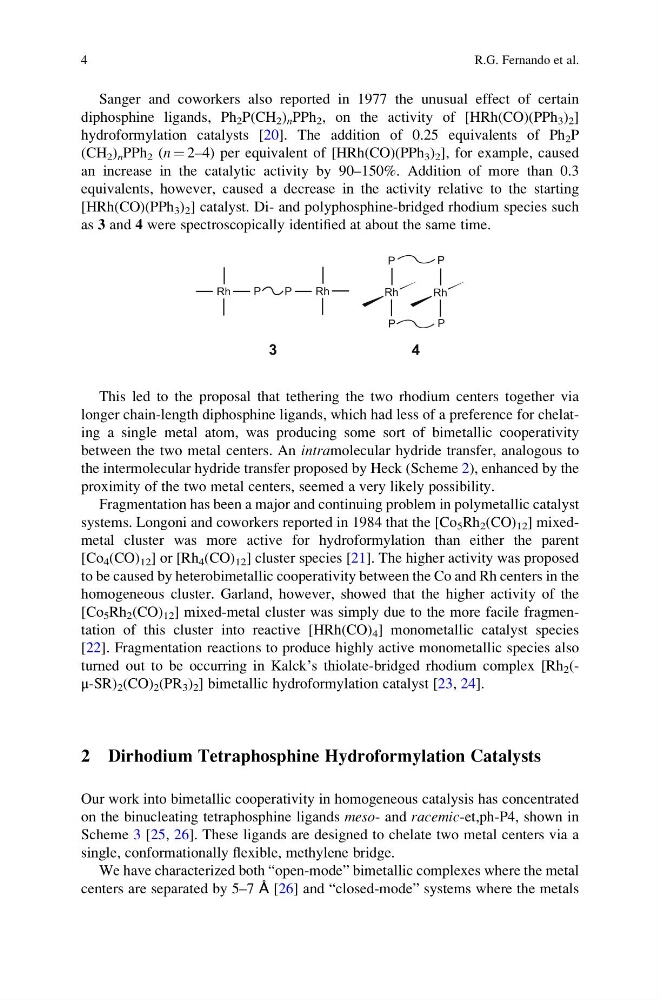
[HRh(CO)(PPh 3 ) 2 ] catalyst. Di- and polyphosphine-bridged rhodium species such
as 3 and 4 were spectroscopically identified at about the same time.
This led to the proposal that tethering the two rhodium centers together via
longer chain-length diphosphine ligands, which had less of a preference for chelating a single metal atom, was producing some sort of bimetallic cooperativity
between the two metal centers. An intramolecular hydride transfer, analogous to
the intermolecular hydride transfer proposed by Heck (Scheme 2), enhanced by the
proximity of the two metal centers, seemed a very likely possibility.
Fragmentation has been a major and continuing problem in polymetallic catalyst
systems. Longoni and coworkers reported in 1984 that the [Co 5 Rh 2 (CO) 12 ] mixedmetal cluster was more active for hydroformylation than either the parent
[Co 4 (CO) 12 ] or [Rh 4 (CO) 12 ] cluster species [21]. The higher activity was proposed
to be caused by heterobimetallic cooperativity between the Co and Rh centers in the
homogeneous cluster. Garland, however, showed that the higher activity of the
[Co 5 Rh 2 (CO) 12 ] mixed-metal cluster was simply due to the more facile fragmentation of this cluster into reactive [HRh(CO) 4 ] monometallic catalyst species
[22]. Fragmentation reactions to produce highly active monometallic species also
turned out to be occurring in Kalck’s thiolate-bridged rhodium complex [Rh 2 (μ-SR) 2 (CO) 2 (PR 3 ) 2 ] bimetallic hydroformylation catalyst [23, 24].
2 Dirhodium Tetraphosphine Hydroformylation Catalysts
Our work into bimetallic cooperativity in homogeneous catalysis has concentrated
on the binucleating tetraphosphine ligands meso- and racemic-et,ph-P4, shown in
Scheme 3 [25, 26]. These ligands are designed to chelate two metal centers via a
single, conformationally flexible, methylene bridge.
We have characterized both “open-mode” bimetallic complexes where the metal
centers are separated by 5–7 Å [26] and “closed-mode” systems where the metals
4
R.G. Fernando et al.
diphosphine ligands, Ph 2 P(CH 2 ) n PPh 2 , on the activity of [HRh(CO)(PPh 3 ) 2 ]
hydroformylation catalysts [20]. The addition of 0.25 equivalents of Ph 2 P
(CH 2 ) n PPh 2 (n ¼ 2–4) per equivalent of [HRh(CO)(PPh 3 ) 2 ], for example, caused
an increase in the catalytic activity by 90–150%. Addition of more than 0.3
equivalents, however, caused a decrease in the activity relative to the starting
[HRh(CO)(PPh 3 ) 2 ] catalyst. Di- and polyphosphine-bridged rhodium species such
as 3 and 4 were spectroscopically identified at about the same time.
This led to the proposal that tethering the two rhodium centers together via
longer chain-length diphosphine ligands, which had less of a preference for chelating a single metal atom, was producing some sort of bimetallic cooperativity
between the two metal centers. An intramolecular hydride transfer, analogous to
the intermolecular hydride transfer proposed by Heck (Scheme 2), enhanced by the
proximity of the two metal centers, seemed a very likely possibility.
Fragmentation has been a major and continuing problem in polymetallic catalyst
systems. Longoni and coworkers reported in 1984 that the [Co 5 Rh 2 (CO) 12 ] mixedmetal cluster was more active for hydroformylation than either the parent
[Co 4 (CO) 12 ] or [Rh 4 (CO) 12 ] cluster species [21]. The higher activity was proposed
to be caused by heterobimetallic cooperativity between the Co and Rh centers in the
homogeneous cluster. Garland, however, showed that the higher activity of the
[Co 5 Rh 2 (CO) 12 ] mixed-metal cluster was simply due to the more facile fragmentation of this cluster into reactive [HRh(CO) 4 ] monometallic catalyst species
[22]. Fragmentation reactions to produce highly active monometallic species also
turned out to be occurring in Kalck’s thiolate-bridged rhodium complex [Rh 2 (μ-SR) 2 (CO) 2 (PR 3 ) 2 ] bimetallic hydroformylation catalyst [23, 24].
2 Dirhodium Tetraphosphine Hydroformylation Catalysts
Our work into bimetallic cooperativity in homogeneous catalysis has concentrated
on the binucleating tetraphosphine ligands meso- and racemic-et,ph-P4, shown in
Scheme 3 [25, 26]. These ligands are designed to chelate two metal centers via a
single, conformationally flexible, methylene bridge.
We have characterized both “open-mode” bimetallic complexes where the metal
centers are separated by 5–7 Å [26] and “closed-mode” systems where the metals
4
R.G. Fernando et al.