

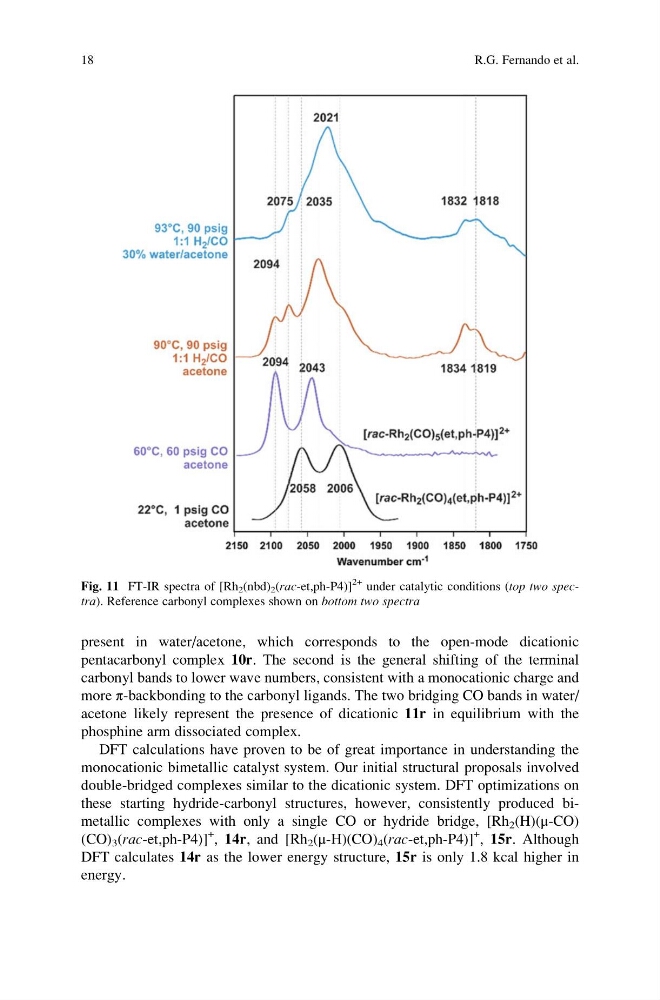
present in water/acetone, which corresponds to the open-mode dicationic
pentacarbonyl complex 10r. The second is the general shifting of the terminal
carbonyl bands to lower wave numbers, consistent with a monocationic charge and
more π-backbonding to the carbonyl ligands. The two bridging CO bands in water/
acetone likely represent the presence of dicationic 11r in equilibrium with the
phosphine arm dissociated complex.
DFT calculations have proven to be of great importance in understanding the
monocationic bimetallic catalyst system. Our initial structural proposals involved
double-bridged complexes similar to the dicationic system. DFT optimizations on
these starting hydride-carbonyl structures, however, consistently produced bimetallic complexes with only a single CO or hydride bridge, [Rh 2 (H)(μ-CO)
(CO) 3 (rac-et,ph-P4)]
+
, 14r, and [Rh 2 (μ-H)(CO) 4 (rac-et,ph-P4)]
+
, 15r. Although
DFT calculates 14r as the lower energy structure, 15r is only 1.8 kcal higher in
energy.
Fig. 11 FT-IR spectra of [Rh 2 (nbd) 2 (rac-et,ph-P4)]
2+ under catalytic conditions (top two spectra). Reference carbonyl complexes shown on bottom two spectra
18
R.G. Fernando et al.
pentacarbonyl complex 10r. The second is the general shifting of the terminal
carbonyl bands to lower wave numbers, consistent with a monocationic charge and
more π-backbonding to the carbonyl ligands. The two bridging CO bands in water/
acetone likely represent the presence of dicationic 11r in equilibrium with the
phosphine arm dissociated complex.
DFT calculations have proven to be of great importance in understanding the
monocationic bimetallic catalyst system. Our initial structural proposals involved
double-bridged complexes similar to the dicationic system. DFT optimizations on
these starting hydride-carbonyl structures, however, consistently produced bimetallic complexes with only a single CO or hydride bridge, [Rh 2 (H)(μ-CO)
(CO) 3 (rac-et,ph-P4)]
+
, 14r, and [Rh 2 (μ-H)(CO) 4 (rac-et,ph-P4)]
+
, 15r. Although
DFT calculates 14r as the lower energy structure, 15r is only 1.8 kcal higher in
energy.
Fig. 11 FT-IR spectra of [Rh 2 (nbd) 2 (rac-et,ph-P4)]
2+ under catalytic conditions (top two spectra). Reference carbonyl complexes shown on bottom two spectra
18
R.G. Fernando et al.