

3.3 Monometallic Proton Reduction Electrocatalysts
3.3.1 Mononuclear Iron Proton Reduction Catalysts
Several groups have sought to overcome the challenges of creating diiron complexes with rotated structures by instead constructing monoiron catalysts with an
open coordination site already present in the structure. Interestingly, Sellman and
coworkers prepared the 18-electron complex [Fe(bdt)(PMe 3 ) 2 (CO) 2 ] and noted that
it had an unexpected tendency to lose a CO to form a 16-electron complex
[70]. Rauchfuss and coworkers used the work as inspiration to create (Et 4 N) 2 [Fe
(bdt)(CN) 2 (CO)], a relatively good spectroscopic model of [FeFe]-hydrogenases
[71]. Ott and coworkers combined the use of bdt with chelating phosphine ligands
to generate catalytically active complexes of the type [Fe(X-bdt)(P
R
2 N
Ph
2 )(CO)]
for P
R N
Ph
2 ¼1,5-diaza-3,7-diphosphaoctane, and R¼Ph, Bn, Cyc, or tert-Bu and the
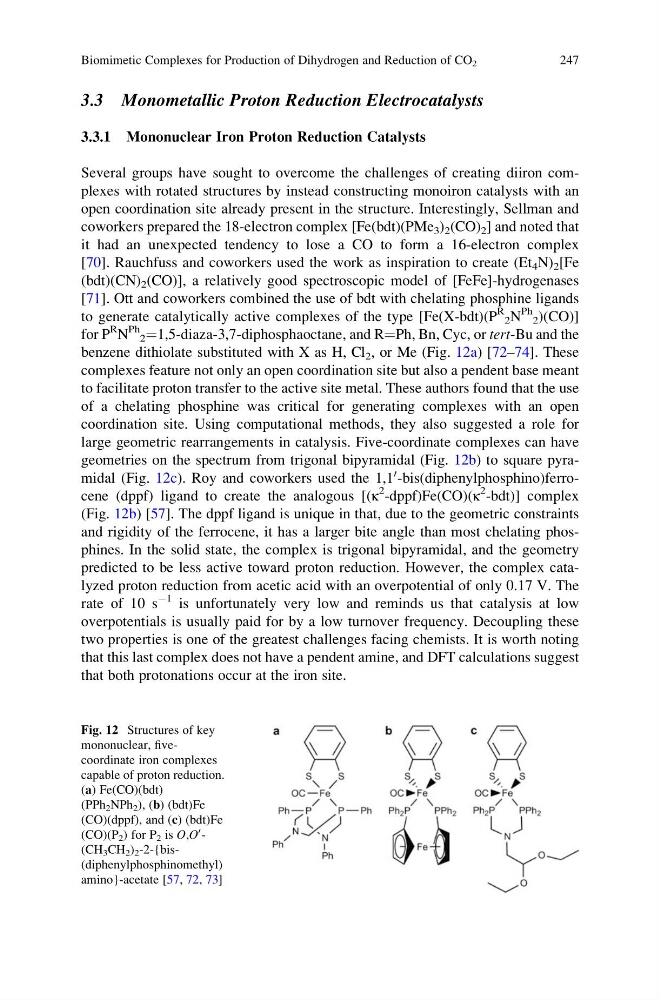
benzene dithiolate substituted with X as H, Cl 2 , or Me (Fig. 12a) [72–74]. These
complexes feature not only an open coordination site but also a pendent base meant
to facilitate proton transfer to the active site metal. These authors found that the use
of a chelating phosphine was critical for generating complexes with an open
coordination site. Using computational methods, they also suggested a role for
large geometric rearrangements in catalysis. Five-coordinate complexes can have
geometries on the spectrum from trigonal bipyramidal (Fig. 12b) to square pyramidal (Fig. 12c). Roy and coworkers used the 1,1
0 -bis(diphenylphosphino)ferrocene (dppf) ligand to create the analogous [(κ
2 -dppf)Fe(CO)(κ
2 -bdt)] complex
(Fig. 12b) [57]. The dppf ligand is unique in that, due to the geometric constraints
and rigidity of the ferrocene, it has a larger bite angle than most chelating phosphines. In the solid state, the complex is trigonal bipyramidal, and the geometry
predicted to be less active toward proton reduction. However, the complex catalyzed proton reduction from acetic acid with an overpotential of only 0.17 V. The
rate of 10 s
À1 is unfortunately very low and reminds us that catalysis at low
overpotentials is usually paid for by a low turnover frequency. Decoupling these
two properties is one of the greatest challenges facing chemists. It is worth noting
that this last complex does not have a pendent amine, and DFT calculations suggest
that both protonations occur at the iron site.
Fig. 12 Structures of key
mononuclear, fivecoordinate iron complexes
capable of proton reduction.
(a) Fe(CO)(bdt)
(PPh 2 NPh 2 ), (b) (bdt)Fe
(CO)(dppf), and (c) (bdt)Fe
(CO)(P 2 ) for P 2 is O,O
0 -
(CH 3 CH 2 ) 2 -2-{bis(diphenylphosphinomethyl)
amino}-acetate [57, 72, 73]
Biomimetic Complexes for Production of Dihydrogen and Reduction of CO 2
247
3.3.1 Mononuclear Iron Proton Reduction Catalysts
Several groups have sought to overcome the challenges of creating diiron complexes with rotated structures by instead constructing monoiron catalysts with an
open coordination site already present in the structure. Interestingly, Sellman and
coworkers prepared the 18-electron complex [Fe(bdt)(PMe 3 ) 2 (CO) 2 ] and noted that
it had an unexpected tendency to lose a CO to form a 16-electron complex
[70]. Rauchfuss and coworkers used the work as inspiration to create (Et 4 N) 2 [Fe
(bdt)(CN) 2 (CO)], a relatively good spectroscopic model of [FeFe]-hydrogenases
[71]. Ott and coworkers combined the use of bdt with chelating phosphine ligands
to generate catalytically active complexes of the type [Fe(X-bdt)(P
R
2 N
Ph
2 )(CO)]
for P
R N
Ph
2 ¼1,5-diaza-3,7-diphosphaoctane, and R¼Ph, Bn, Cyc, or tert-Bu and the
benzene dithiolate substituted with X as H, Cl 2 , or Me (Fig. 12a) [72–74]. These
complexes feature not only an open coordination site but also a pendent base meant
to facilitate proton transfer to the active site metal. These authors found that the use
of a chelating phosphine was critical for generating complexes with an open
coordination site. Using computational methods, they also suggested a role for
large geometric rearrangements in catalysis. Five-coordinate complexes can have
geometries on the spectrum from trigonal bipyramidal (Fig. 12b) to square pyramidal (Fig. 12c). Roy and coworkers used the 1,1
0 -bis(diphenylphosphino)ferrocene (dppf) ligand to create the analogous [(κ
2 -dppf)Fe(CO)(κ
2 -bdt)] complex
(Fig. 12b) [57]. The dppf ligand is unique in that, due to the geometric constraints
and rigidity of the ferrocene, it has a larger bite angle than most chelating phosphines. In the solid state, the complex is trigonal bipyramidal, and the geometry
predicted to be less active toward proton reduction. However, the complex catalyzed proton reduction from acetic acid with an overpotential of only 0.17 V. The
rate of 10 s
À1 is unfortunately very low and reminds us that catalysis at low
overpotentials is usually paid for by a low turnover frequency. Decoupling these
two properties is one of the greatest challenges facing chemists. It is worth noting
that this last complex does not have a pendent amine, and DFT calculations suggest
that both protonations occur at the iron site.
Fig. 12 Structures of key
mononuclear, fivecoordinate iron complexes
capable of proton reduction.
(a) Fe(CO)(bdt)
(PPh 2 NPh 2 ), (b) (bdt)Fe
(CO)(dppf), and (c) (bdt)Fe
(CO)(P 2 ) for P 2 is O,O
0 -
(CH 3 CH 2 ) 2 -2-{bis(diphenylphosphinomethyl)
amino}-acetate [57, 72, 73]
Biomimetic Complexes for Production of Dihydrogen and Reduction of CO 2
247