

3.3.2 Mononuclear Cobalt Proton Reduction Catalysts
Efforts to use cobalt complexes as homogeneous hydrogen production catalysts
started more than 30 years ago primarily with the work of Eisenberg and Sutin
[75, 76]. Although cobalt is not one of the metals employed in biological hydrogen
production, cobalt complexes with a wide variety of ligand sets have proven
exceptional in both electrocatalytic and photocatalytic systems. Herein, we describe
some of the most important types of compounds with an emphasis on recent,
biologically inspired work.
Multidentate phosphine and pyridyl ligands have garnered significant attention
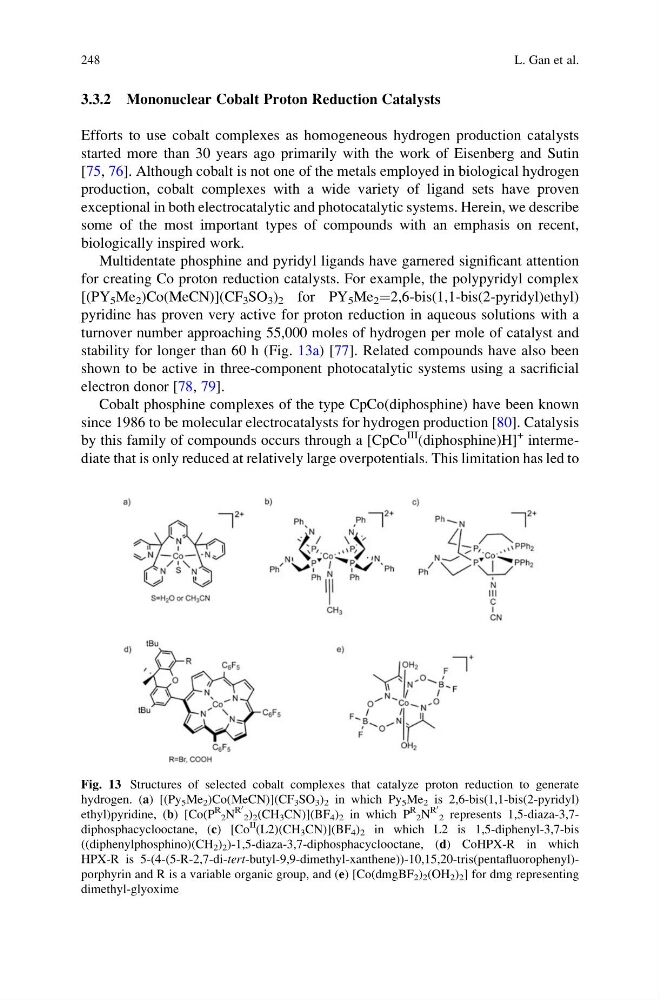
for creating Co proton reduction catalysts. For example, the polypyridyl complex
[(PY 5 Me 2 )Co(MeCN)](CF 3 SO 3 ) 2 for PY 5 Me 2 ¼2,6-bis(1,1-bis(2-pyridyl)ethyl)
pyridine has proven very active for proton reduction in aqueous solutions with a
turnover number approaching 55,000 moles of hydrogen per mole of catalyst and
stability for longer than 60 h (Fig. 13a) [77]. Related compounds have also been
shown to be active in three-component photocatalytic systems using a sacrificial
electron donor [78, 79].
Cobalt phosphine complexes of the type CpCo(diphosphine) have been known
since 1986 to be molecular electrocatalysts for hydrogen production [80]. Catalysis
by this family of compounds occurs through a [CpCo
III (diphosphine)H]
+ intermediate that is only reduced at relatively large overpotentials. This limitation has led to
Fig. 13 Structures of selected cobalt complexes that catalyze proton reduction to generate
hydrogen. (a) [(Py 5 Me 2 )Co(MeCN)](CF 3 SO 3 ) 2 in which Py 5 Me 2 is 2,6-bis(1,1-bis(2-pyridyl)
ethyl)pyridine, (b) [Co(P
R
2 N
R
0
2 ) 2 (CH 3 CN)](BF 4 ) 2 in which P
R
2 N
R
0
2 represents 1,5-diaza-3,7diphosphacyclooctane, (c) [Co
II (L2)(CH 3 CN)](BF 4 ) 2 in which L2 is 1,5-diphenyl-3,7-bis
((diphenylphosphino)(CH 2 ) 2 )-1,5-diaza-3,7-diphosphacyclooctane, (d) CoHPX-R in which
HPX-R is 5-(4-(5-R-2,7-di-tert-butyl-9,9-dimethyl-xanthene))-10,15,20-tris(pentafluorophenyl)porphyrin and R is a variable organic group, and (e) [Co(dmgBF 2 ) 2 (OH 2 ) 2 ] for dmg representing
dimethyl-glyoxime
248
L. Gan et al.
Efforts to use cobalt complexes as homogeneous hydrogen production catalysts
started more than 30 years ago primarily with the work of Eisenberg and Sutin
[75, 76]. Although cobalt is not one of the metals employed in biological hydrogen
production, cobalt complexes with a wide variety of ligand sets have proven
exceptional in both electrocatalytic and photocatalytic systems. Herein, we describe
some of the most important types of compounds with an emphasis on recent,
biologically inspired work.
Multidentate phosphine and pyridyl ligands have garnered significant attention
for creating Co proton reduction catalysts. For example, the polypyridyl complex
[(PY 5 Me 2 )Co(MeCN)](CF 3 SO 3 ) 2 for PY 5 Me 2 ¼2,6-bis(1,1-bis(2-pyridyl)ethyl)
pyridine has proven very active for proton reduction in aqueous solutions with a
turnover number approaching 55,000 moles of hydrogen per mole of catalyst and
stability for longer than 60 h (Fig. 13a) [77]. Related compounds have also been
shown to be active in three-component photocatalytic systems using a sacrificial
electron donor [78, 79].
Cobalt phosphine complexes of the type CpCo(diphosphine) have been known
since 1986 to be molecular electrocatalysts for hydrogen production [80]. Catalysis
by this family of compounds occurs through a [CpCo
III (diphosphine)H]
+ intermediate that is only reduced at relatively large overpotentials. This limitation has led to
Fig. 13 Structures of selected cobalt complexes that catalyze proton reduction to generate
hydrogen. (a) [(Py 5 Me 2 )Co(MeCN)](CF 3 SO 3 ) 2 in which Py 5 Me 2 is 2,6-bis(1,1-bis(2-pyridyl)
ethyl)pyridine, (b) [Co(P
R
2 N
R
0
2 ) 2 (CH 3 CN)](BF 4 ) 2 in which P
R
2 N
R
0
2 represents 1,5-diaza-3,7diphosphacyclooctane, (c) [Co
II (L2)(CH 3 CN)](BF 4 ) 2 in which L2 is 1,5-diphenyl-3,7-bis
((diphenylphosphino)(CH 2 ) 2 )-1,5-diaza-3,7-diphosphacyclooctane, (d) CoHPX-R in which
HPX-R is 5-(4-(5-R-2,7-di-tert-butyl-9,9-dimethyl-xanthene))-10,15,20-tris(pentafluorophenyl)porphyrin and R is a variable organic group, and (e) [Co(dmgBF 2 ) 2 (OH 2 ) 2 ] for dmg representing
dimethyl-glyoxime
248
L. Gan et al.