

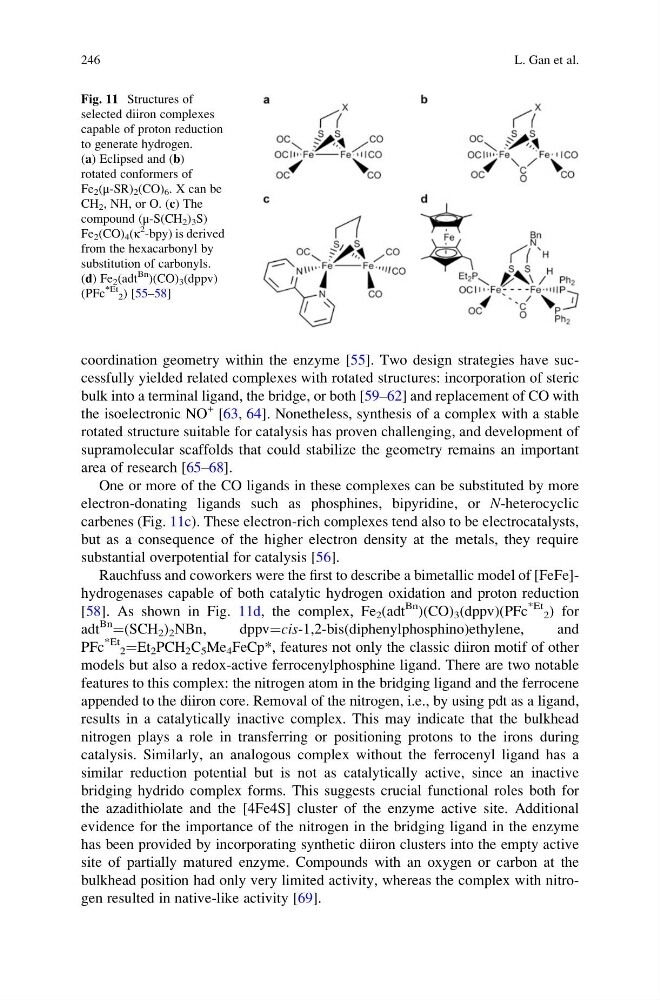
coordination geometry within the enzyme [55]. Two design strategies have successfully yielded related complexes with rotated structures: incorporation of steric
bulk into a terminal ligand, the bridge, or both [59–62] and replacement of CO with
the isoelectronic NO
+ [63, 64]. Nonetheless, synthesis of a complex with a stable
rotated structure suitable for catalysis has proven challenging, and development of
supramolecular scaffolds that could stabilize the geometry remains an important
area of research [65–68].
One or more of the CO ligands in these complexes can be substituted by more
electron-donating ligands such as phosphines, bipyridine, or N-heterocyclic
carbenes (Fig. 11c). These electron-rich complexes tend also to be electrocatalysts,
but as a consequence of the higher electron density at the metals, they require
substantial overpotential for catalysis [56].
Rauchfuss and coworkers were the first to describe a bimetallic model of [FeFe]hydrogenases capable of both catalytic hydrogen oxidation and proton reduction
[58]. As shown in Fig. 11d, the complex, Fe 2 (adt
Bn )(CO) 3 (dppv)(PFc
*Et
2 ) for
adt
Bn
¼(SCH 2 ) 2 NBn,
dppv¼cis-1,2-bis(diphenylphosphino)ethylene,
and
PFc
*Et
2 ¼Et 2 PCH 2 C 5 Me 4 FeCp*, features not only the classic diiron motif of other
models but also a redox-active ferrocenylphosphine ligand. There are two notable
features to this complex: the nitrogen atom in the bridging ligand and the ferrocene
appended to the diiron core. Removal of the nitrogen, i.e., by using pdt as a ligand,
results in a catalytically inactive complex. This may indicate that the bulkhead
nitrogen plays a role in transferring or positioning protons to the irons during
catalysis. Similarly, an analogous complex without the ferrocenyl ligand has a
similar reduction potential but is not as catalytically active, since an inactive
bridging hydrido complex forms. This suggests crucial functional roles both for
the azadithiolate and the [4Fe4S] cluster of the enzyme active site. Additional
evidence for the importance of the nitrogen in the bridging ligand in the enzyme
has been provided by incorporating synthetic diiron clusters into the empty active
site of partially matured enzyme. Compounds with an oxygen or carbon at the
bulkhead position had only very limited activity, whereas the complex with nitrogen resulted in native-like activity [69].
Fig. 11 Structures of
selected diiron complexes
capable of proton reduction
to generate hydrogen.
(a) Eclipsed and (b)
rotated conformers of
Fe 2 (μ-SR) 2 (CO) 6 . X can be
CH 2 , NH, or O. (c) The
compound (μ-S(CH 2 ) 3 S)
Fe 2 (CO) 4 (κ
2
-bpy) is derived
from the hexacarbonyl by
substitution of carbonyls.
(d) Fe 2 (adt
Bn
)(CO) 3 (dppv)
(PFc
*Et
2 ) [55–58]
246
L. Gan et al.
bulk into a terminal ligand, the bridge, or both [59–62] and replacement of CO with
the isoelectronic NO
+ [63, 64]. Nonetheless, synthesis of a complex with a stable
rotated structure suitable for catalysis has proven challenging, and development of
supramolecular scaffolds that could stabilize the geometry remains an important
area of research [65–68].
One or more of the CO ligands in these complexes can be substituted by more
electron-donating ligands such as phosphines, bipyridine, or N-heterocyclic
carbenes (Fig. 11c). These electron-rich complexes tend also to be electrocatalysts,
but as a consequence of the higher electron density at the metals, they require
substantial overpotential for catalysis [56].
Rauchfuss and coworkers were the first to describe a bimetallic model of [FeFe]hydrogenases capable of both catalytic hydrogen oxidation and proton reduction
[58]. As shown in Fig. 11d, the complex, Fe 2 (adt
Bn )(CO) 3 (dppv)(PFc
*Et
2 ) for
adt
Bn
¼(SCH 2 ) 2 NBn,
dppv¼cis-1,2-bis(diphenylphosphino)ethylene,
and
PFc
*Et
2 ¼Et 2 PCH 2 C 5 Me 4 FeCp*, features not only the classic diiron motif of other
models but also a redox-active ferrocenylphosphine ligand. There are two notable
features to this complex: the nitrogen atom in the bridging ligand and the ferrocene
appended to the diiron core. Removal of the nitrogen, i.e., by using pdt as a ligand,
results in a catalytically inactive complex. This may indicate that the bulkhead
nitrogen plays a role in transferring or positioning protons to the irons during
catalysis. Similarly, an analogous complex without the ferrocenyl ligand has a
similar reduction potential but is not as catalytically active, since an inactive
bridging hydrido complex forms. This suggests crucial functional roles both for
the azadithiolate and the [4Fe4S] cluster of the enzyme active site. Additional
evidence for the importance of the nitrogen in the bridging ligand in the enzyme
has been provided by incorporating synthetic diiron clusters into the empty active
site of partially matured enzyme. Compounds with an oxygen or carbon at the
bulkhead position had only very limited activity, whereas the complex with nitrogen resulted in native-like activity [69].
Fig. 11 Structures of
selected diiron complexes
capable of proton reduction
to generate hydrogen.
(a) Eclipsed and (b)
rotated conformers of
Fe 2 (μ-SR) 2 (CO) 6 . X can be
CH 2 , NH, or O. (c) The
compound (μ-S(CH 2 ) 3 S)
Fe 2 (CO) 4 (κ
2
-bpy) is derived
from the hexacarbonyl by
substitution of carbonyls.
(d) Fe 2 (adt
Bn
)(CO) 3 (dppv)
(PFc
*Et
2 ) [55–58]
246
L. Gan et al.