

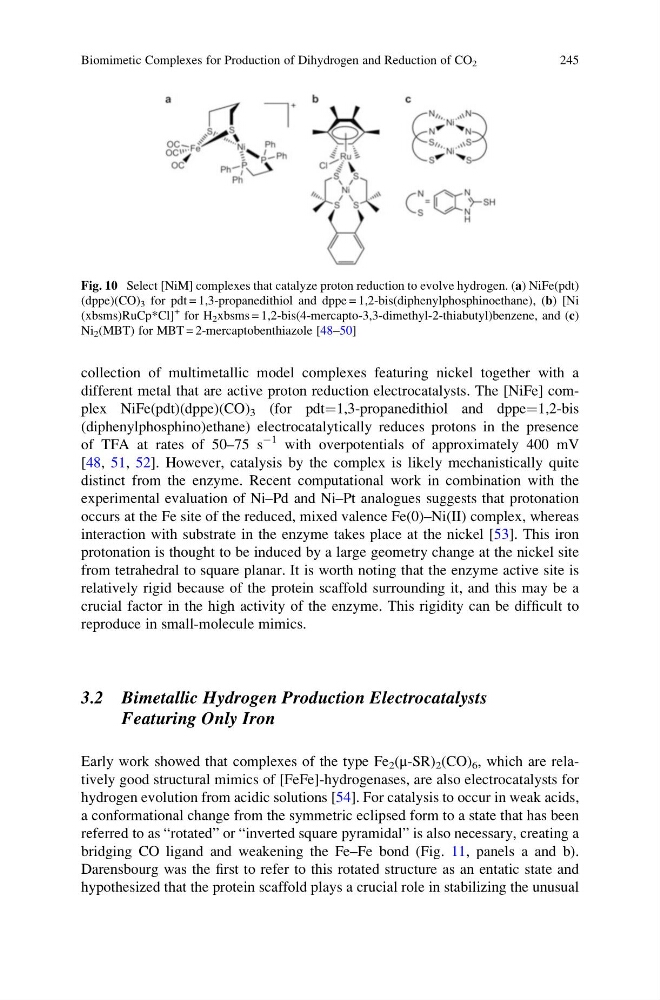
collection of multimetallic model complexes featuring nickel together with a
different metal that are active proton reduction electrocatalysts. The [NiFe] complex NiFe(pdt)(dppe)(CO) 3 (for pdt¼1,3-propanedithiol and dppe¼1,2-bis
(diphenylphosphino)ethane) electrocatalytically reduces protons in the presence
of TFA at rates of 50–75 s
À1 with overpotentials of approximately 400 mV
[48, 51, 52]. However, catalysis by the complex is likely mechanistically quite
distinct from the enzyme. Recent computational work in combination with the
experimental evaluation of Ni–Pd and Ni–Pt analogues suggests that protonation
occurs at the Fe site of the reduced, mixed valence Fe(0)–Ni(II) complex, whereas
interaction with substrate in the enzyme takes place at the nickel [53]. This iron
protonation is thought to be induced by a large geometry change at the nickel site
from tetrahedral to square planar. It is worth noting that the enzyme active site is
relatively rigid because of the protein scaffold surrounding it, and this may be a
crucial factor in the high activity of the enzyme. This rigidity can be difficult to
reproduce in small-molecule mimics.
3.2 Bimetallic Hydrogen Production Electrocatalysts
Featuring Only Iron
Early work showed that complexes of the type Fe 2 (μ-SR) 2 (CO) 6 , which are relatively good structural mimics of [FeFe]-hydrogenases, are also electrocatalysts for
hydrogen evolution from acidic solutions [54]. For catalysis to occur in weak acids,
a conformational change from the symmetric eclipsed form to a state that has been
referred to as “rotated” or “inverted square pyramidal” is also necessary, creating a
bridging CO ligand and weakening the Fe–Fe bond (Fig. 11, panels a and b).
Darensbourg was the first to refer to this rotated structure as an entatic state and
hypothesized that the protein scaffold plays a crucial role in stabilizing the unusual
Fig. 10 Select [NiM] complexes that catalyze proton reduction to evolve hydrogen. (a) NiFe(pdt)
(dppe)(CO) 3 for pdt = 1,3-propanedithiol and dppe = 1,2-bis(diphenylphosphinoethane), (b) [Ni
(xbsms)RuCp*Cl]
+ for H 2 xbsms = 1,2-bis(4-mercapto-3,3-dimethyl-2-thiabutyl)benzene, and (c)
Ni 2 (MBT) for MBT = 2-mercaptobenthiazole [48–50]
Biomimetic Complexes for Production of Dihydrogen and Reduction of CO 2
245
different metal that are active proton reduction electrocatalysts. The [NiFe] complex NiFe(pdt)(dppe)(CO) 3 (for pdt¼1,3-propanedithiol and dppe¼1,2-bis
(diphenylphosphino)ethane) electrocatalytically reduces protons in the presence
of TFA at rates of 50–75 s
À1 with overpotentials of approximately 400 mV
[48, 51, 52]. However, catalysis by the complex is likely mechanistically quite
distinct from the enzyme. Recent computational work in combination with the
experimental evaluation of Ni–Pd and Ni–Pt analogues suggests that protonation
occurs at the Fe site of the reduced, mixed valence Fe(0)–Ni(II) complex, whereas
interaction with substrate in the enzyme takes place at the nickel [53]. This iron
protonation is thought to be induced by a large geometry change at the nickel site
from tetrahedral to square planar. It is worth noting that the enzyme active site is
relatively rigid because of the protein scaffold surrounding it, and this may be a
crucial factor in the high activity of the enzyme. This rigidity can be difficult to
reproduce in small-molecule mimics.
3.2 Bimetallic Hydrogen Production Electrocatalysts
Featuring Only Iron
Early work showed that complexes of the type Fe 2 (μ-SR) 2 (CO) 6 , which are relatively good structural mimics of [FeFe]-hydrogenases, are also electrocatalysts for
hydrogen evolution from acidic solutions [54]. For catalysis to occur in weak acids,
a conformational change from the symmetric eclipsed form to a state that has been
referred to as “rotated” or “inverted square pyramidal” is also necessary, creating a
bridging CO ligand and weakening the Fe–Fe bond (Fig. 11, panels a and b).
Darensbourg was the first to refer to this rotated structure as an entatic state and
hypothesized that the protein scaffold plays a crucial role in stabilizing the unusual
Fig. 10 Select [NiM] complexes that catalyze proton reduction to evolve hydrogen. (a) NiFe(pdt)
(dppe)(CO) 3 for pdt = 1,3-propanedithiol and dppe = 1,2-bis(diphenylphosphinoethane), (b) [Ni
(xbsms)RuCp*Cl]
+ for H 2 xbsms = 1,2-bis(4-mercapto-3,3-dimethyl-2-thiabutyl)benzene, and (c)
Ni 2 (MBT) for MBT = 2-mercaptobenthiazole [48–50]
Biomimetic Complexes for Production of Dihydrogen and Reduction of CO 2
245