

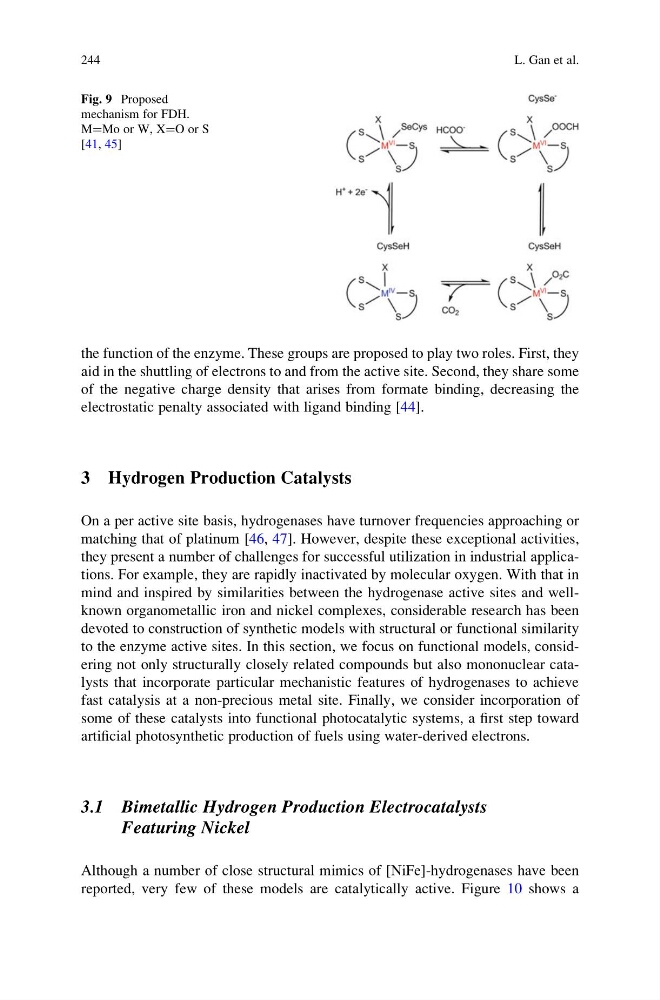
the function of the enzyme. These groups are proposed to play two roles. First, they
aid in the shuttling of electrons to and from the active site. Second, they share some
of the negative charge density that arises from formate binding, decreasing the
electrostatic penalty associated with ligand binding [44].
3 Hydrogen Production Catalysts
On a per active site basis, hydrogenases have turnover frequencies approaching or
matching that of platinum [46, 47]. However, despite these exceptional activities,
they present a number of challenges for successful utilization in industrial applications. For example, they are rapidly inactivated by molecular oxygen. With that in
mind and inspired by similarities between the hydrogenase active sites and wellknown organometallic iron and nickel complexes, considerable research has been
devoted to construction of synthetic models with structural or functional similarity
to the enzyme active sites. In this section, we focus on functional models, considering not only structurally closely related compounds but also mononuclear catalysts that incorporate particular mechanistic features of hydrogenases to achieve
fast catalysis at a non-precious metal site. Finally, we consider incorporation of
some of these catalysts into functional photocatalytic systems, a first step toward
artificial photosynthetic production of fuels using water-derived electrons.
3.1 Bimetallic Hydrogen Production Electrocatalysts
Featuring Nickel
Although a number of close structural mimics of [NiFe]-hydrogenases have been
reported, very few of these models are catalytically active. Figure 10 shows a
Fig. 9 Proposed
mechanism for FDH.
M¼Mo or W, X¼O or S
[41, 45]
244
L. Gan et al.
aid in the shuttling of electrons to and from the active site. Second, they share some
of the negative charge density that arises from formate binding, decreasing the
electrostatic penalty associated with ligand binding [44].
3 Hydrogen Production Catalysts
On a per active site basis, hydrogenases have turnover frequencies approaching or
matching that of platinum [46, 47]. However, despite these exceptional activities,
they present a number of challenges for successful utilization in industrial applications. For example, they are rapidly inactivated by molecular oxygen. With that in
mind and inspired by similarities between the hydrogenase active sites and wellknown organometallic iron and nickel complexes, considerable research has been
devoted to construction of synthetic models with structural or functional similarity
to the enzyme active sites. In this section, we focus on functional models, considering not only structurally closely related compounds but also mononuclear catalysts that incorporate particular mechanistic features of hydrogenases to achieve
fast catalysis at a non-precious metal site. Finally, we consider incorporation of
some of these catalysts into functional photocatalytic systems, a first step toward
artificial photosynthetic production of fuels using water-derived electrons.
3.1 Bimetallic Hydrogen Production Electrocatalysts
Featuring Nickel
Although a number of close structural mimics of [NiFe]-hydrogenases have been
reported, very few of these models are catalytically active. Figure 10 shows a
Fig. 9 Proposed
mechanism for FDH.
M¼Mo or W, X¼O or S
[41, 45]
244
L. Gan et al.