

2.3 Formate Dehydrogenase (FDH)
Another important enzyme in biological carbon dioxide fixation is formate dehydrogenase (FDH). This enzyme reversibly catalyzes the two-electron reduction of
CO 2 to formate. Like hydrogenases and CODHs, there are several classes of FDH;
the two main types are the NAD
+
-dependent FDHs and the NAD
+
-independent
FDHs [36]. In general, the former do not contain redox-active cofactors and will,
therefore, not be discussed further. The latter are oxygen-sensitive, [FeS] clustercontaining enzymes with a molybdenum or tungsten active site. Both X-ray crystallography and EXAFS have been essential in determining the active site structure
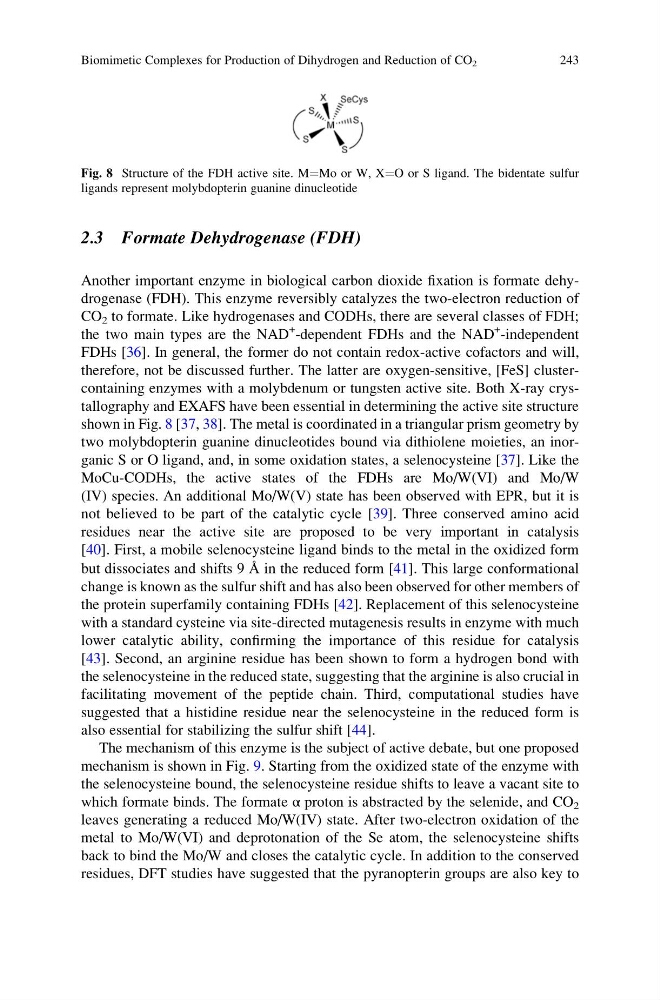
shown in Fig. 8 [37, 38]. The metal is coordinated in a triangular prism geometry by
two molybdopterin guanine dinucleotides bound via dithiolene moieties, an inorganic S or O ligand, and, in some oxidation states, a selenocysteine [37]. Like the
MoCu-CODHs, the active states of the FDHs are Mo/W(VI) and Mo/W
(IV) species. An additional Mo/W(V) state has been observed with EPR, but it is
not believed to be part of the catalytic cycle [39]. Three conserved amino acid
residues near the active site are proposed to be very important in catalysis
[40]. First, a mobile selenocysteine ligand binds to the metal in the oxidized form
but dissociates and shifts 9 Å in the reduced form [41]. This large conformational
change is known as the sulfur shift and has also been observed for other members of
the protein superfamily containing FDHs [42]. Replacement of this selenocysteine
with a standard cysteine via site-directed mutagenesis results in enzyme with much
lower catalytic ability, confirming the importance of this residue for catalysis
[43]. Second, an arginine residue has been shown to form a hydrogen bond with
the selenocysteine in the reduced state, suggesting that the arginine is also crucial in
facilitating movement of the peptide chain. Third, computational studies have
suggested that a histidine residue near the selenocysteine in the reduced form is
also essential for stabilizing the sulfur shift [44].
The mechanism of this enzyme is the subject of active debate, but one proposed
mechanism is shown in Fig. 9. Starting from the oxidized state of the enzyme with
the selenocysteine bound, the selenocysteine residue shifts to leave a vacant site to
which formate binds. The formate α proton is abstracted by the selenide, and CO 2
leaves generating a reduced Mo/W(IV) state. After two-electron oxidation of the
metal to Mo/W(VI) and deprotonation of the Se atom, the selenocysteine shifts
back to bind the Mo/W and closes the catalytic cycle. In addition to the conserved
residues, DFT studies have suggested that the pyranopterin groups are also key to
Fig. 8 Structure of the FDH active site. M¼Mo or W, X¼O or S ligand. The bidentate sulfur
ligands represent molybdopterin guanine dinucleotide
Biomimetic Complexes for Production of Dihydrogen and Reduction of CO 2
243
Another important enzyme in biological carbon dioxide fixation is formate dehydrogenase (FDH). This enzyme reversibly catalyzes the two-electron reduction of
CO 2 to formate. Like hydrogenases and CODHs, there are several classes of FDH;
the two main types are the NAD
+
-dependent FDHs and the NAD
+
-independent
FDHs [36]. In general, the former do not contain redox-active cofactors and will,
therefore, not be discussed further. The latter are oxygen-sensitive, [FeS] clustercontaining enzymes with a molybdenum or tungsten active site. Both X-ray crystallography and EXAFS have been essential in determining the active site structure
shown in Fig. 8 [37, 38]. The metal is coordinated in a triangular prism geometry by
two molybdopterin guanine dinucleotides bound via dithiolene moieties, an inorganic S or O ligand, and, in some oxidation states, a selenocysteine [37]. Like the
MoCu-CODHs, the active states of the FDHs are Mo/W(VI) and Mo/W
(IV) species. An additional Mo/W(V) state has been observed with EPR, but it is
not believed to be part of the catalytic cycle [39]. Three conserved amino acid
residues near the active site are proposed to be very important in catalysis
[40]. First, a mobile selenocysteine ligand binds to the metal in the oxidized form
but dissociates and shifts 9 Å in the reduced form [41]. This large conformational
change is known as the sulfur shift and has also been observed for other members of
the protein superfamily containing FDHs [42]. Replacement of this selenocysteine
with a standard cysteine via site-directed mutagenesis results in enzyme with much
lower catalytic ability, confirming the importance of this residue for catalysis
[43]. Second, an arginine residue has been shown to form a hydrogen bond with
the selenocysteine in the reduced state, suggesting that the arginine is also crucial in
facilitating movement of the peptide chain. Third, computational studies have
suggested that a histidine residue near the selenocysteine in the reduced form is
also essential for stabilizing the sulfur shift [44].
The mechanism of this enzyme is the subject of active debate, but one proposed
mechanism is shown in Fig. 9. Starting from the oxidized state of the enzyme with
the selenocysteine bound, the selenocysteine residue shifts to leave a vacant site to
which formate binds. The formate α proton is abstracted by the selenide, and CO 2
leaves generating a reduced Mo/W(IV) state. After two-electron oxidation of the
metal to Mo/W(VI) and deprotonation of the Se atom, the selenocysteine shifts
back to bind the Mo/W and closes the catalytic cycle. In addition to the conserved
residues, DFT studies have suggested that the pyranopterin groups are also key to
Fig. 8 Structure of the FDH active site. M¼Mo or W, X¼O or S ligand. The bidentate sulfur
ligands represent molybdopterin guanine dinucleotide
Biomimetic Complexes for Production of Dihydrogen and Reduction of CO 2
243