

2.2.2 Ni-CODHs
Ni-CODHs contain a unique cluster in the active site, called the C-cluster (Fig. 5b).
The structure is a distorted [4Fe4S] cluster with a nickel replacing one of the
traditional irons and an iron pendent to the cluster; this atom is referred to as the
“dangling iron.” All of the metal atoms in the cubane are ligated by cysteine and
inorganic sulfide, as in an ordinary [4Fe4S] cluster. In addition to a cysteine and a
cluster sulfide, the dangling iron is ligated by a histidine and a hydroxyl ligand
[34]. Spectroscopic studies have identified four states of the C-cluster [35]. C ox is an
inactive, oxidized state of the cluster. C red1 and C red2 are believed to be the active
states of the enzyme. These states are one and three electrons more reduced than
C ox , respectively. C int is two electrons more reduced than C ox , i.e., a state between
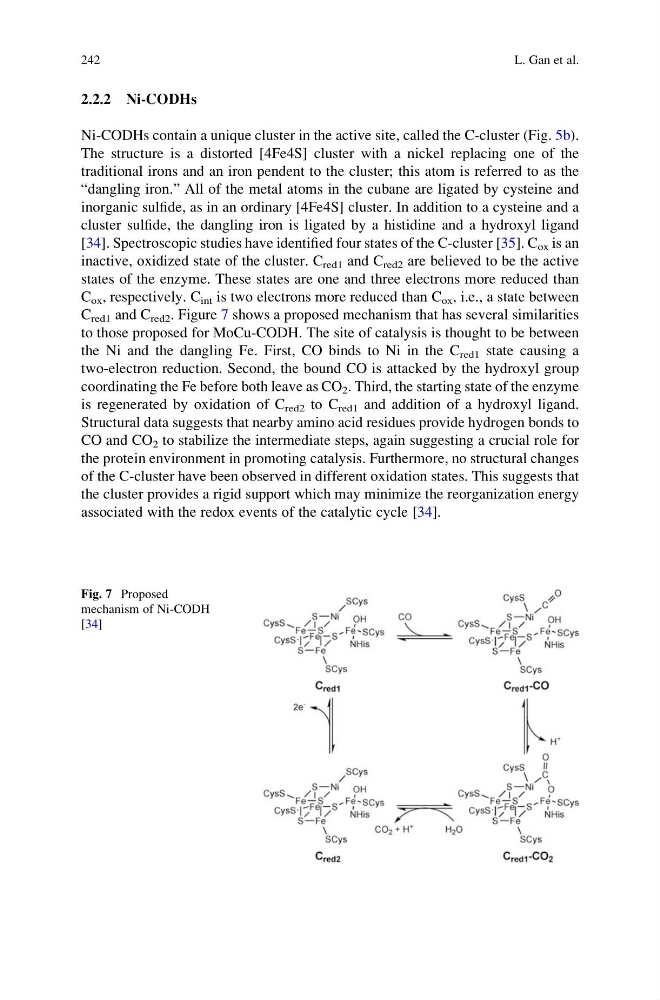
C red1 and C red2 . Figure 7 shows a proposed mechanism that has several similarities
to those proposed for MoCu-CODH. The site of catalysis is thought to be between
the Ni and the dangling Fe. First, CO binds to Ni in the C red1 state causing a
two-electron reduction. Second, the bound CO is attacked by the hydroxyl group
coordinating the Fe before both leave as CO 2 . Third, the starting state of the enzyme
is regenerated by oxidation of C red2 to C red1 and addition of a hydroxyl ligand.
Structural data suggests that nearby amino acid residues provide hydrogen bonds to
CO and CO 2 to stabilize the intermediate steps, again suggesting a crucial role for
the protein environment in promoting catalysis. Furthermore, no structural changes
of the C-cluster have been observed in different oxidation states. This suggests that
the cluster provides a rigid support which may minimize the reorganization energy
associated with the redox events of the catalytic cycle [34].
Fig. 7 Proposed
mechanism of Ni-CODH
[34]
242
L. Gan et al.
Ni-CODHs contain a unique cluster in the active site, called the C-cluster (Fig. 5b).
The structure is a distorted [4Fe4S] cluster with a nickel replacing one of the
traditional irons and an iron pendent to the cluster; this atom is referred to as the
“dangling iron.” All of the metal atoms in the cubane are ligated by cysteine and
inorganic sulfide, as in an ordinary [4Fe4S] cluster. In addition to a cysteine and a
cluster sulfide, the dangling iron is ligated by a histidine and a hydroxyl ligand
[34]. Spectroscopic studies have identified four states of the C-cluster [35]. C ox is an
inactive, oxidized state of the cluster. C red1 and C red2 are believed to be the active
states of the enzyme. These states are one and three electrons more reduced than
C ox , respectively. C int is two electrons more reduced than C ox , i.e., a state between
C red1 and C red2 . Figure 7 shows a proposed mechanism that has several similarities
to those proposed for MoCu-CODH. The site of catalysis is thought to be between
the Ni and the dangling Fe. First, CO binds to Ni in the C red1 state causing a
two-electron reduction. Second, the bound CO is attacked by the hydroxyl group
coordinating the Fe before both leave as CO 2 . Third, the starting state of the enzyme
is regenerated by oxidation of C red2 to C red1 and addition of a hydroxyl ligand.
Structural data suggests that nearby amino acid residues provide hydrogen bonds to
CO and CO 2 to stabilize the intermediate steps, again suggesting a crucial role for
the protein environment in promoting catalysis. Furthermore, no structural changes
of the C-cluster have been observed in different oxidation states. This suggests that
the cluster provides a rigid support which may minimize the reorganization energy
associated with the redox events of the catalytic cycle [34].
Fig. 7 Proposed
mechanism of Ni-CODH
[34]
242
L. Gan et al.