

2.2 Carbon Monoxide Dehydrogenases (CODHs)
Biological systems fix CO 2 through a variety of pathways employing an array of
enzymes. One of these enzymes is carbon monoxide dehydrogenase (CODH).
Physiologically, these proteins catalyze the oxidation of CO to CO 2 , and, in some
cases, they can perform the reverse reaction (Eq. 2) [28]. There are two types of
CODHs that are distinguished by the metal in the active site: MoCu and Ni. MoCuCODHs are found in aerobic bacteria, whereas the oxygen-sensitive Ni-CODHs are
found only in anaerobic bacteria [29]. Both enzymes have a bimetallic active site;
however, the structures differ significantly, as shown in Fig. 5. Ni-CODHs have
high k cat values for CO oxidation of approximately 4 Â 10
4 s
À1 . CO 2 reduction has
also been observed with this type of CODH, albeit with much lower turnover
frequency of 45 s
À1 [30]. In contrast, MoCu-CODHs turnover more slowly (circa
100 s
À1 ), and no activity for CO 2 reduction has been detected [31]. The following
sections will discuss each type of CODH with a focus on structural and mechanistic
features key to the function of these enzymes.
CO þ H 2 O Ð CO 2 þ 2e
À
þ 2H
þ
ð2Þ
2.2.1 MoCu-CODH
The MoCu-CODH active site is shown in Fig. 5a. The bimetallic structure consists
of Mo and Cu ions connected by a bridging sulfide. The Cu ion is in a linear
coordination geometry with the sulfide and a cysteinyl thiolate as ligands. The fivecoordinate geometry about the molybdenum ion is distorted square pyramidal. In
addition to the bridging sulfide, the molybdenum ligand set consists of an oxo
group, a hydroxyl group, and bidentate coordinated pterin [32]. During catalysis,
the Cu remains in a Cu(I) state, and the Mo changes from Mo(VI) to Mo(IV).
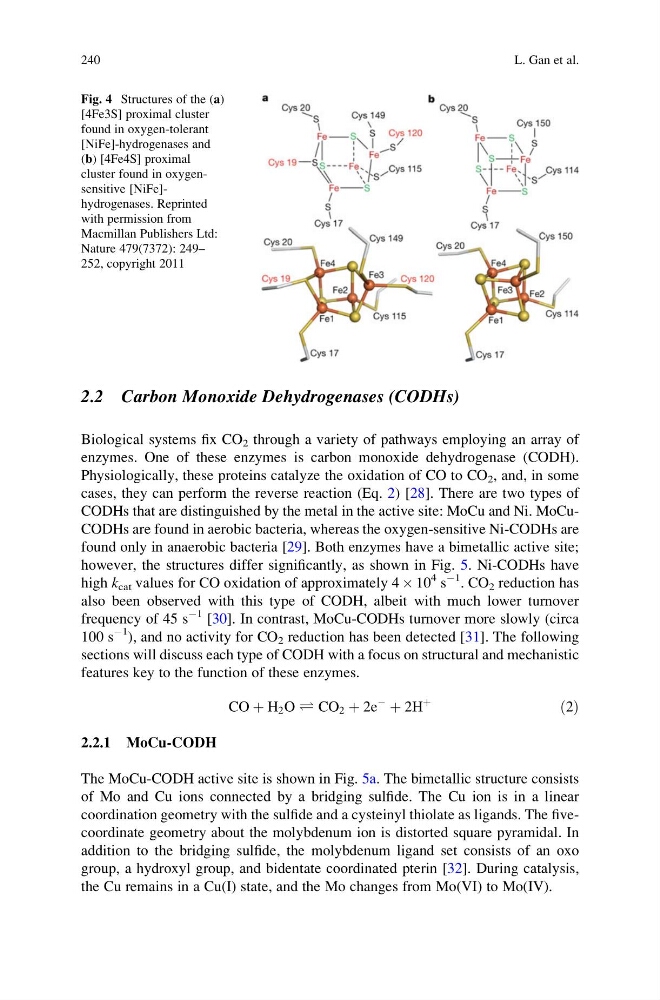
Fig. 4 Structures of the (a)
[4Fe3S] proximal cluster
found in oxygen-tolerant
[NiFe]-hydrogenases and
(b) [4Fe4S] proximal
cluster found in oxygensensitive [NiFe]hydrogenases. Reprinted
with permission from
Macmillan Publishers Ltd:
Nature 479(7372): 249–
252, copyright 2011
240
L. Gan et al.
Biological systems fix CO 2 through a variety of pathways employing an array of
enzymes. One of these enzymes is carbon monoxide dehydrogenase (CODH).
Physiologically, these proteins catalyze the oxidation of CO to CO 2 , and, in some
cases, they can perform the reverse reaction (Eq. 2) [28]. There are two types of
CODHs that are distinguished by the metal in the active site: MoCu and Ni. MoCuCODHs are found in aerobic bacteria, whereas the oxygen-sensitive Ni-CODHs are
found only in anaerobic bacteria [29]. Both enzymes have a bimetallic active site;
however, the structures differ significantly, as shown in Fig. 5. Ni-CODHs have
high k cat values for CO oxidation of approximately 4 Â 10
4 s
À1 . CO 2 reduction has
also been observed with this type of CODH, albeit with much lower turnover
frequency of 45 s
À1 [30]. In contrast, MoCu-CODHs turnover more slowly (circa
100 s
À1 ), and no activity for CO 2 reduction has been detected [31]. The following
sections will discuss each type of CODH with a focus on structural and mechanistic
features key to the function of these enzymes.
CO þ H 2 O Ð CO 2 þ 2e
À
þ 2H
þ
ð2Þ
2.2.1 MoCu-CODH
The MoCu-CODH active site is shown in Fig. 5a. The bimetallic structure consists
of Mo and Cu ions connected by a bridging sulfide. The Cu ion is in a linear
coordination geometry with the sulfide and a cysteinyl thiolate as ligands. The fivecoordinate geometry about the molybdenum ion is distorted square pyramidal. In
addition to the bridging sulfide, the molybdenum ligand set consists of an oxo
group, a hydroxyl group, and bidentate coordinated pterin [32]. During catalysis,
the Cu remains in a Cu(I) state, and the Mo changes from Mo(VI) to Mo(IV).
Fig. 4 Structures of the (a)
[4Fe3S] proximal cluster
found in oxygen-tolerant
[NiFe]-hydrogenases and
(b) [4Fe4S] proximal
cluster found in oxygensensitive [NiFe]hydrogenases. Reprinted
with permission from
Macmillan Publishers Ltd:
Nature 479(7372): 249–
252, copyright 2011
240
L. Gan et al.