

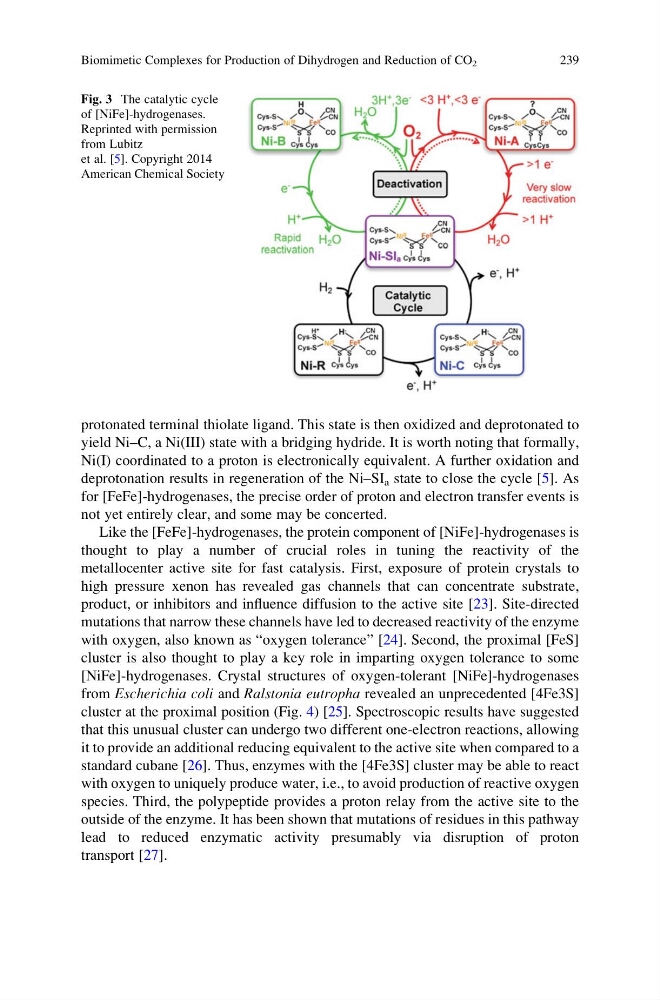
protonated terminal thiolate ligand. This state is then oxidized and deprotonated to
yield Ni–C, a Ni(III) state with a bridging hydride. It is worth noting that formally,
Ni(I) coordinated to a proton is electronically equivalent. A further oxidation and
deprotonation results in regeneration of the Ni–SI a state to close the cycle [5]. As
for [FeFe]-hydrogenases, the precise order of proton and electron transfer events is
not yet entirely clear, and some may be concerted.
Like the [FeFe]-hydrogenases, the protein component of [NiFe]-hydrogenases is
thought to play a number of crucial roles in tuning the reactivity of the
metallocenter active site for fast catalysis. First, exposure of protein crystals to
high pressure xenon has revealed gas channels that can concentrate substrate,
product, or inhibitors and influence diffusion to the active site [23]. Site-directed
mutations that narrow these channels have led to decreased reactivity of the enzyme
with oxygen, also known as “oxygen tolerance” [24]. Second, the proximal [FeS]
cluster is also thought to play a key role in imparting oxygen tolerance to some
[NiFe]-hydrogenases. Crystal structures of oxygen-tolerant [NiFe]-hydrogenases
from Escherichia coli and Ralstonia eutropha revealed an unprecedented [4Fe3S]
cluster at the proximal position (Fig. 4) [25]. Spectroscopic results have suggested
that this unusual cluster can undergo two different one-electron reactions, allowing
it to provide an additional reducing equivalent to the active site when compared to a
standard cubane [26]. Thus, enzymes with the [4Fe3S] cluster may be able to react
with oxygen to uniquely produce water, i.e., to avoid production of reactive oxygen
species. Third, the polypeptide provides a proton relay from the active site to the
outside of the enzyme. It has been shown that mutations of residues in this pathway
lead to reduced enzymatic activity presumably via disruption of proton
transport [27].
Fig. 3 The catalytic cycle
of [NiFe]-hydrogenases.
Reprinted with permission
from Lubitz
et al. [5]. Copyright 2014
American Chemical Society
Biomimetic Complexes for Production of Dihydrogen and Reduction of CO 2
239
yield Ni–C, a Ni(III) state with a bridging hydride. It is worth noting that formally,
Ni(I) coordinated to a proton is electronically equivalent. A further oxidation and
deprotonation results in regeneration of the Ni–SI a state to close the cycle [5]. As
for [FeFe]-hydrogenases, the precise order of proton and electron transfer events is
not yet entirely clear, and some may be concerted.
Like the [FeFe]-hydrogenases, the protein component of [NiFe]-hydrogenases is
thought to play a number of crucial roles in tuning the reactivity of the
metallocenter active site for fast catalysis. First, exposure of protein crystals to
high pressure xenon has revealed gas channels that can concentrate substrate,
product, or inhibitors and influence diffusion to the active site [23]. Site-directed
mutations that narrow these channels have led to decreased reactivity of the enzyme
with oxygen, also known as “oxygen tolerance” [24]. Second, the proximal [FeS]
cluster is also thought to play a key role in imparting oxygen tolerance to some
[NiFe]-hydrogenases. Crystal structures of oxygen-tolerant [NiFe]-hydrogenases
from Escherichia coli and Ralstonia eutropha revealed an unprecedented [4Fe3S]
cluster at the proximal position (Fig. 4) [25]. Spectroscopic results have suggested
that this unusual cluster can undergo two different one-electron reactions, allowing
it to provide an additional reducing equivalent to the active site when compared to a
standard cubane [26]. Thus, enzymes with the [4Fe3S] cluster may be able to react
with oxygen to uniquely produce water, i.e., to avoid production of reactive oxygen
species. Third, the polypeptide provides a proton relay from the active site to the
outside of the enzyme. It has been shown that mutations of residues in this pathway
lead to reduced enzymatic activity presumably via disruption of proton
transport [27].
Fig. 3 The catalytic cycle
of [NiFe]-hydrogenases.
Reprinted with permission
from Lubitz
et al. [5]. Copyright 2014
American Chemical Society
Biomimetic Complexes for Production of Dihydrogen and Reduction of CO 2
239