

The ease with which bimolecular reactions between mononuclear species were
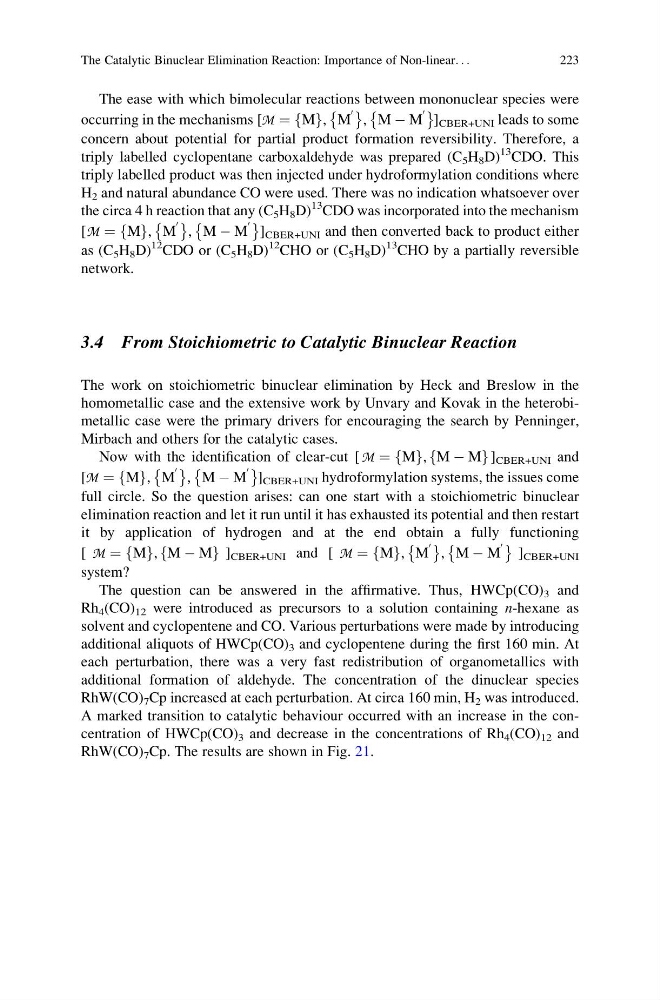
occurring in the mechanisms [M ¼ M
f g, M
0
È É
, M À M
0
È
É
] CBER+UNI leads to some
concern about potential for partial product formation reversibility. Therefore, a
triply labelled cyclopentane carboxaldehyde was prepared (C 5 H 8 D)
13 CDO. This
triply labelled product was then injected under hydroformylation conditions where
H 2 and natural abundance CO were used. There was no indication whatsoever over
the circa 4 h reaction that any (C 5 H 8 D)
13 CDO was incorporated into the mechanism
[M ¼ M
f g, M
0
È É
, M À M
0
È
É
] CBER+UNI and then converted back to product either
as (C 5 H 8 D)
12 CDO or (C 5 H 8 D)
12 CHO or (C 5 H 8 D)
13
CHO by a partially reversible
network.
3.4 From Stoichiometric to Catalytic Binuclear Reaction
The work on stoichiometric binuclear elimination by Heck and Breslow in the
homometallic case and the extensive work by Unvary and Kovak in the heterobimetallic case were the primary drivers for encouraging the search by Penninger,
Mirbach and others for the catalytic cases.
Now with the identification of clear-cut [ M ¼ M
f g, M À M
f
g] CBER+UNI and
[M ¼ M
f g, M
0
È É
, M À M
0
È
É
] CBER+UNI hydroformylation systems, the issues come
full circle. So the question arises: can one start with a stoichiometric binuclear
elimination reaction and let it run until it has exhausted its potential and then restart
it by application of hydrogen and at the end obtain a fully functioning
[ M ¼ M
f g, M À M
f
g] CBER+UNI and [ M ¼ M
f g, M
0
È É
, M À M
0
È
É
] CBER+UNI
system?
The question can be answered in the affirmative. Thus, HWCp(CO) 3 and
Rh 4 (CO) 12 were introduced as precursors to a solution containing n-hexane as
solvent and cyclopentene and CO. Various perturbations were made by introducing
additional aliquots of HWCp(CO) 3 and cyclopentene during the first 160 min. At
each perturbation, there was a very fast redistribution of organometallics with
additional formation of aldehyde. The concentration of the dinuclear species
RhW(CO) 7 Cp increased at each perturbation. At circa 160 min, H 2 was introduced.
A marked transition to catalytic behaviour occurred with an increase in the concentration of HWCp(CO) 3 and decrease in the concentrations of Rh 4 (CO) 12 and
RhW(CO) 7 Cp. The results are shown in Fig. 21.
The Catalytic Binuclear Elimination Reaction: Importance of Non-linear. . .
223
occurring in the mechanisms [M ¼ M
f g, M
0
È É
, M À M
0
È
É
] CBER+UNI leads to some
concern about potential for partial product formation reversibility. Therefore, a
triply labelled cyclopentane carboxaldehyde was prepared (C 5 H 8 D)
13 CDO. This
triply labelled product was then injected under hydroformylation conditions where
H 2 and natural abundance CO were used. There was no indication whatsoever over
the circa 4 h reaction that any (C 5 H 8 D)
13 CDO was incorporated into the mechanism
[M ¼ M
f g, M
0
È É
, M À M
0
È
É
] CBER+UNI and then converted back to product either
as (C 5 H 8 D)
12 CDO or (C 5 H 8 D)
12 CHO or (C 5 H 8 D)
13
CHO by a partially reversible
network.
3.4 From Stoichiometric to Catalytic Binuclear Reaction
The work on stoichiometric binuclear elimination by Heck and Breslow in the
homometallic case and the extensive work by Unvary and Kovak in the heterobimetallic case were the primary drivers for encouraging the search by Penninger,
Mirbach and others for the catalytic cases.
Now with the identification of clear-cut [ M ¼ M
f g, M À M
f
g] CBER+UNI and
[M ¼ M
f g, M
0
È É
, M À M
0
È
É
] CBER+UNI hydroformylation systems, the issues come
full circle. So the question arises: can one start with a stoichiometric binuclear
elimination reaction and let it run until it has exhausted its potential and then restart
it by application of hydrogen and at the end obtain a fully functioning
[ M ¼ M
f g, M À M
f
g] CBER+UNI and [ M ¼ M
f g, M
0
È É
, M À M
0
È
É
] CBER+UNI
system?
The question can be answered in the affirmative. Thus, HWCp(CO) 3 and
Rh 4 (CO) 12 were introduced as precursors to a solution containing n-hexane as
solvent and cyclopentene and CO. Various perturbations were made by introducing
additional aliquots of HWCp(CO) 3 and cyclopentene during the first 160 min. At
each perturbation, there was a very fast redistribution of organometallics with
additional formation of aldehyde. The concentration of the dinuclear species
RhW(CO) 7 Cp increased at each perturbation. At circa 160 min, H 2 was introduced.
A marked transition to catalytic behaviour occurred with an increase in the concentration of HWCp(CO) 3 and decrease in the concentrations of Rh 4 (CO) 12 and
RhW(CO) 7 Cp. The results are shown in Fig. 21.
The Catalytic Binuclear Elimination Reaction: Importance of Non-linear. . .
223