

is not involved. The unusual exponent for CO of circa À1.5 is highly reproducible
and has been consistently observed for Rh–Mn and Rh–Re systems.
r ¼ k 1 þ k 2 HRe CO
ð Þ 5
Â
Ã
À
Á
RCORh CO
ð Þ 4
Â
Ã
ð15aÞ
k 1 ¼ k
0
1 CO
ð Þ
½
À1 H 2
½
ð15bÞ
k 2 ¼ k
0
2 CO
ð Þ
½
À1:5
ð15cÞ
In the case of the Rh–Mn systems modelled, circa 10–40% of the product formation
arose from a bilinear term; in the case of Rh–Re systems, up to circa 90% of the
product formation arose from the bilinear term. This situation existed in spite of the
fact that on a mole-to-mole ratio, the ratio of Mn:Rh and Re:Rh was <1, and blank
experiments run with just HMn(CO) 5 or HRe(CO) 5 confirm that neither metal alone
shows any measurable activity at the conditions used. At the partial pressures of
hydrogen used, the mole fraction of dissolved H 2 was on the order of 0.01. The
typical mole fraction of Re used was 10
À5 . Therefore, on a mole-to-mole basis, HRe
(CO) 5 is circa 1,000 times more effective than molecular hydrogen towards attack
on RCORh(CO) 4 .
3.3 Isotopic Labelling
In order to make sure under catalytic hydroformylation conditions that the H in HRe
(CO) 5 was incorporated into the product aldehyde, deuteroformylations were
conducted with D 2 and then HRe(CO) 5 was injected into the system. These experiments showed that the H label in HRe(CO) 5 was exclusively incorporated in the
formyl group of the organic product [75].
0
0
0.2
0.4
0.6
0.8
Rh 4 (CO) 12
RCHO
RhRe(CO) 9
HRe(CO) 5
RCORh(CO) 4
1
x 10
-4
x 10
-3
4
3
2
1
50
100
150
Time (min)
200
250
300
RCHO (mole fraction)
Organometallics (mole fraction)
0
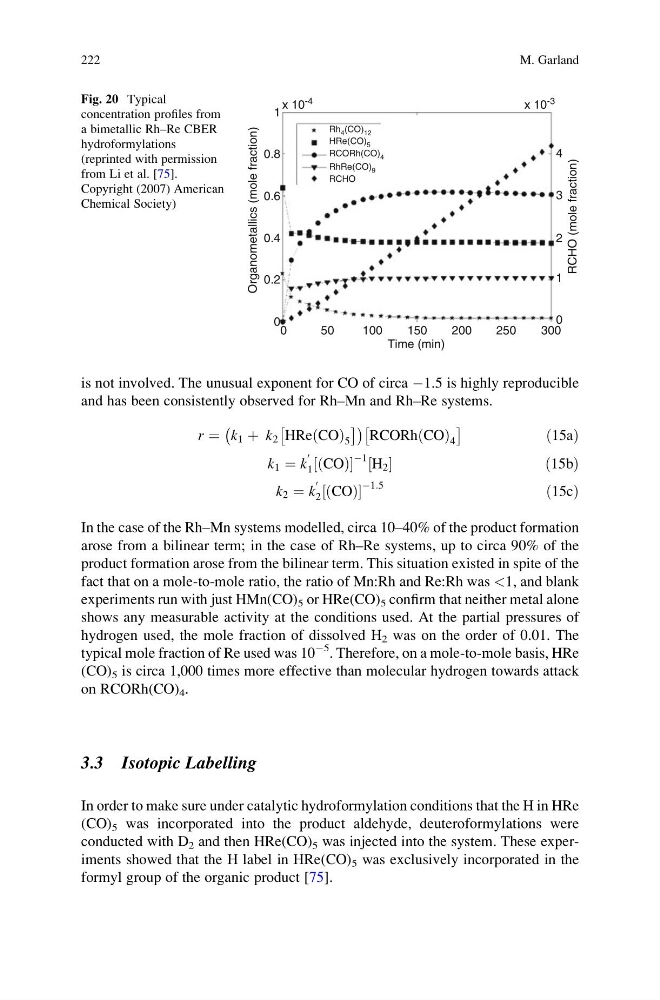
Fig. 20 Typical
concentration profiles from
a bimetallic Rh–Re CBER
hydroformylations
(reprinted with permission
from Li et al. [75].
Copyright (2007) American
Chemical Society)
222
M. Garland
and has been consistently observed for Rh–Mn and Rh–Re systems.
r ¼ k 1 þ k 2 HRe CO
ð Þ 5
Â
Ã
À
Á
RCORh CO
ð Þ 4
Â
Ã
ð15aÞ
k 1 ¼ k
0
1 CO
ð Þ
½
À1 H 2
½
ð15bÞ
k 2 ¼ k
0
2 CO
ð Þ
½
À1:5
ð15cÞ
In the case of the Rh–Mn systems modelled, circa 10–40% of the product formation
arose from a bilinear term; in the case of Rh–Re systems, up to circa 90% of the
product formation arose from the bilinear term. This situation existed in spite of the
fact that on a mole-to-mole ratio, the ratio of Mn:Rh and Re:Rh was <1, and blank
experiments run with just HMn(CO) 5 or HRe(CO) 5 confirm that neither metal alone
shows any measurable activity at the conditions used. At the partial pressures of
hydrogen used, the mole fraction of dissolved H 2 was on the order of 0.01. The
typical mole fraction of Re used was 10
À5 . Therefore, on a mole-to-mole basis, HRe
(CO) 5 is circa 1,000 times more effective than molecular hydrogen towards attack
on RCORh(CO) 4 .
3.3 Isotopic Labelling
In order to make sure under catalytic hydroformylation conditions that the H in HRe
(CO) 5 was incorporated into the product aldehyde, deuteroformylations were
conducted with D 2 and then HRe(CO) 5 was injected into the system. These experiments showed that the H label in HRe(CO) 5 was exclusively incorporated in the
formyl group of the organic product [75].
0
0
0.2
0.4
0.6
0.8
Rh 4 (CO) 12
RCHO
RhRe(CO) 9
HRe(CO) 5
RCORh(CO) 4
1
x 10
-4
x 10
-3
4
3
2
1
50
100
150
Time (min)
200
250
300
RCHO (mole fraction)
Organometallics (mole fraction)
0
Fig. 20 Typical
concentration profiles from
a bimetallic Rh–Re CBER
hydroformylations
(reprinted with permission
from Li et al. [75].
Copyright (2007) American
Chemical Society)
222
M. Garland