

3.5 Miscellaneous Mechanistic Issues
3.5.1 More on the β Step
Molecular hydrogen activation, into homolytically (or heterolytically) split hydrogen, is usually considered a very difficult step to achieve. Indeed, a significant
portion of the mechanistic work on organometallics and homogeneous catalysis by
James [88] and others clearly shows the usually high activation barriers and general
difficulty encountered when other strongly binding ligands like CO are present to
fill coordination sites. Although mononuclear organometallics were used in the vast
majority of studies, it had been widely surmised that dinuclear centres and particularly heterobimetallic dinuclear centres might yield lower activation energies and
potential new opportunities.
One of the earliest well-defined examples of very facile hydrogen activation on a
dinuclear complex occurs with CoRh(CO) 7 , a formally coordinately unsaturated
semi-bridged species first tentatively reported by Spindler et al. [89] and then
confirmed by Horvath et al. [90]. Although crystallisable under CO at cryogenic
temperatures, it was never isolated. This species remains coordinately unsaturated
even under tens of bars of CO pressure. The equilibrium is shifted to the coordinately saturated and all-terminal CoRh(CO) 8 in the range of 100 bar [70]. In situ
hydrogen activation studies showed that molecular hydrogen was split on CoRh
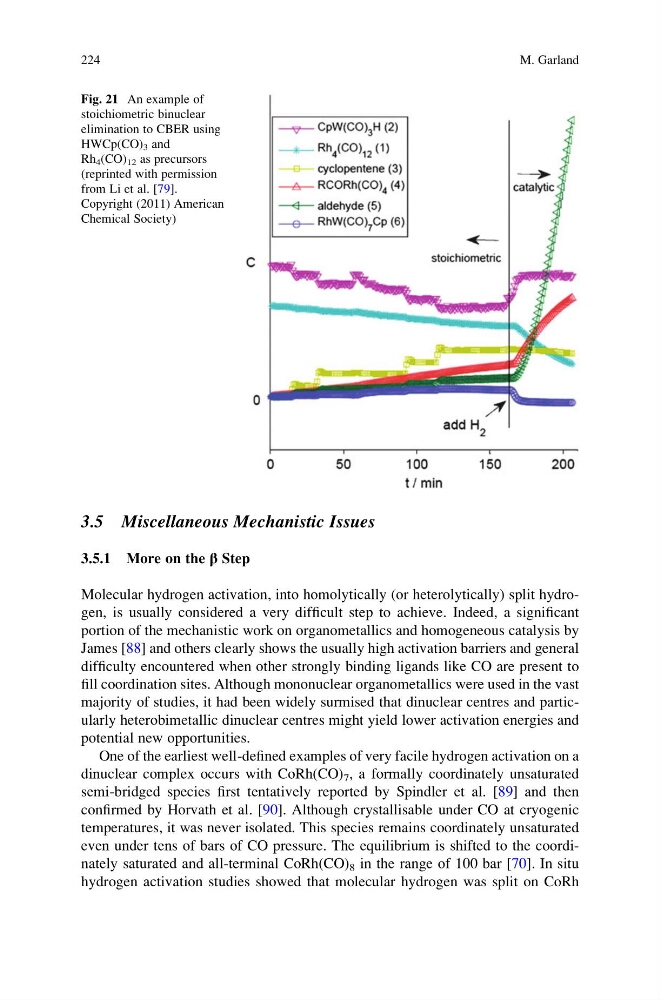
Fig. 21 An example of
stoichiometric binuclear
elimination to CBER using
HWCp(CO) 3 and
Rh 4 (CO) 12 as precursors
(reprinted with permission
from Li et al. [79].
Copyright (2011) American
Chemical Society)
224
M. Garland
3.5.1 More on the β Step
Molecular hydrogen activation, into homolytically (or heterolytically) split hydrogen, is usually considered a very difficult step to achieve. Indeed, a significant
portion of the mechanistic work on organometallics and homogeneous catalysis by
James [88] and others clearly shows the usually high activation barriers and general
difficulty encountered when other strongly binding ligands like CO are present to
fill coordination sites. Although mononuclear organometallics were used in the vast
majority of studies, it had been widely surmised that dinuclear centres and particularly heterobimetallic dinuclear centres might yield lower activation energies and
potential new opportunities.
One of the earliest well-defined examples of very facile hydrogen activation on a
dinuclear complex occurs with CoRh(CO) 7 , a formally coordinately unsaturated
semi-bridged species first tentatively reported by Spindler et al. [89] and then
confirmed by Horvath et al. [90]. Although crystallisable under CO at cryogenic
temperatures, it was never isolated. This species remains coordinately unsaturated
even under tens of bars of CO pressure. The equilibrium is shifted to the coordinately saturated and all-terminal CoRh(CO) 8 in the range of 100 bar [70]. In situ
hydrogen activation studies showed that molecular hydrogen was split on CoRh
Fig. 21 An example of
stoichiometric binuclear
elimination to CBER using
HWCp(CO) 3 and
Rh 4 (CO) 12 as precursors
(reprinted with permission
from Li et al. [79].
Copyright (2011) American
Chemical Society)
224
M. Garland