

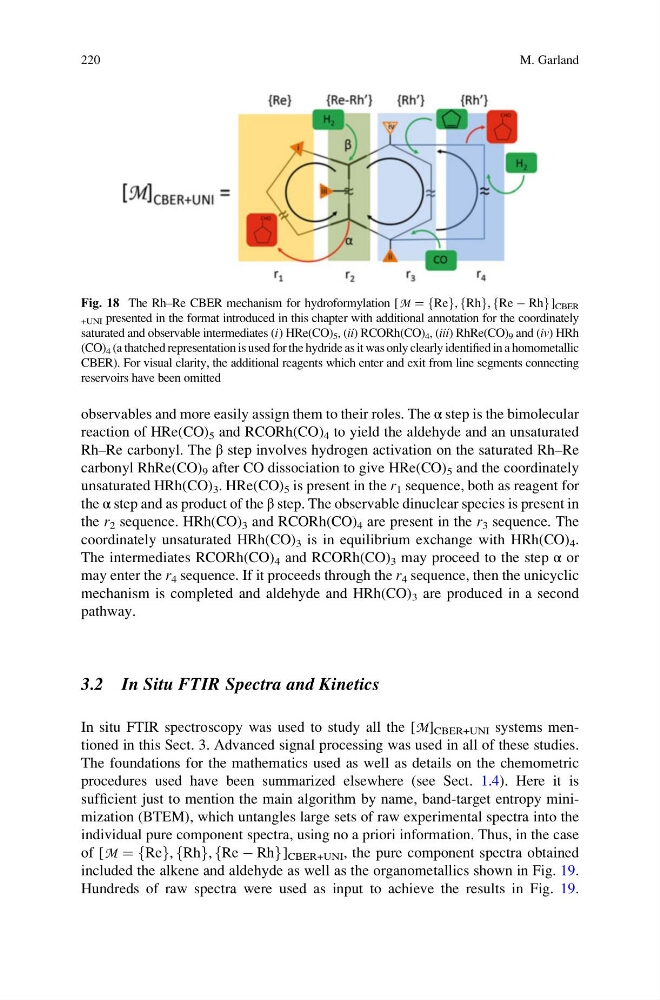
observables and more easily assign them to their roles. The α step is the bimolecular
reaction of HRe(CO) 5 and RCORh(CO) 4 to yield the aldehyde and an unsaturated
Rh–Re carbonyl. The β step involves hydrogen activation on the saturated Rh–Re
carbonyl RhRe(CO) 9 after CO dissociation to give HRe(CO) 5 and the coordinately
unsaturated HRh(CO) 3 . HRe(CO) 5 is present in the r 1 sequence, both as reagent for
the α step and as product of the β step. The observable dinuclear species is present in
the r 2 sequence. HRh(CO) 3 and RCORh(CO) 4 are present in the r 3 sequence. The
coordinately unsaturated HRh(CO) 3 is in equilibrium exchange with HRh(CO) 4 .
The intermediates RCORh(CO) 4 and RCORh(CO) 3 may proceed to the step α or
may enter the r 4 sequence. If it proceeds through the r 4 sequence, then the unicyclic
mechanism is completed and aldehyde and HRh(CO) 3 are produced in a second
pathway.
3.2 In Situ FTIR Spectra and Kinetics
In situ FTIR spectroscopy was used to study all the [M] CBER+UNI systems mentioned in this Sect. 3. Advanced signal processing was used in all of these studies.
The foundations for the mathematics used as well as details on the chemometric
procedures used have been summarized elsewhere (see Sect. 1.4). Here it is
sufficient just to mention the main algorithm by name, band-target entropy minimization (BTEM), which untangles large sets of raw experimental spectra into the
individual pure component spectra, using no a priori information. Thus, in the case
of [M ¼ Re
f g, Rh
f g, Re À Rh
f
g] CBER+UNI , the pure component spectra obtained
included the alkene and aldehyde as well as the organometallics shown in Fig. 19.
Hundreds of raw spectra were used as input to achieve the results in Fig. 19.
Fig. 18 The Rh–Re CBER mechanism for hydroformylation [M ¼ Re
f g, Rh
f g, Re À Rh
f
g ] CBER
+UNI presented in the format introduced in this chapter with additional annotation for the coordinately
saturated and observable intermediates (i) HRe(CO) 5 , (ii) RCORh(CO) 4 , (iii) RhRe(CO) 9 and (iv) HRh
(CO) 4 (a thatched representation is used for the hydride as it was only clearly identified in a homometallic
CBER). For visual clarity, the additional reagents which enter and exit from line segments connecting
reservoirs have been omitted
220
M. Garland
reaction of HRe(CO) 5 and RCORh(CO) 4 to yield the aldehyde and an unsaturated
Rh–Re carbonyl. The β step involves hydrogen activation on the saturated Rh–Re
carbonyl RhRe(CO) 9 after CO dissociation to give HRe(CO) 5 and the coordinately
unsaturated HRh(CO) 3 . HRe(CO) 5 is present in the r 1 sequence, both as reagent for
the α step and as product of the β step. The observable dinuclear species is present in
the r 2 sequence. HRh(CO) 3 and RCORh(CO) 4 are present in the r 3 sequence. The
coordinately unsaturated HRh(CO) 3 is in equilibrium exchange with HRh(CO) 4 .
The intermediates RCORh(CO) 4 and RCORh(CO) 3 may proceed to the step α or
may enter the r 4 sequence. If it proceeds through the r 4 sequence, then the unicyclic
mechanism is completed and aldehyde and HRh(CO) 3 are produced in a second
pathway.
3.2 In Situ FTIR Spectra and Kinetics
In situ FTIR spectroscopy was used to study all the [M] CBER+UNI systems mentioned in this Sect. 3. Advanced signal processing was used in all of these studies.
The foundations for the mathematics used as well as details on the chemometric
procedures used have been summarized elsewhere (see Sect. 1.4). Here it is
sufficient just to mention the main algorithm by name, band-target entropy minimization (BTEM), which untangles large sets of raw experimental spectra into the
individual pure component spectra, using no a priori information. Thus, in the case
of [M ¼ Re
f g, Rh
f g, Re À Rh
f
g] CBER+UNI , the pure component spectra obtained
included the alkene and aldehyde as well as the organometallics shown in Fig. 19.
Hundreds of raw spectra were used as input to achieve the results in Fig. 19.
Fig. 18 The Rh–Re CBER mechanism for hydroformylation [M ¼ Re
f g, Rh
f g, Re À Rh
f
g ] CBER
+UNI presented in the format introduced in this chapter with additional annotation for the coordinately
saturated and observable intermediates (i) HRe(CO) 5 , (ii) RCORh(CO) 4 , (iii) RhRe(CO) 9 and (iv) HRh
(CO) 4 (a thatched representation is used for the hydride as it was only clearly identified in a homometallic
CBER). For visual clarity, the additional reagents which enter and exit from line segments connecting
reservoirs have been omitted
220
M. Garland