

3 The Catalytic Binuclear Elimination Reaction
3.1 Chemistry, Structure
This section will concentrate on the single-product heterobimetallic hydroformylation [M ¼ Re
f g, Rh
f g, Re À Rh
f
g ] CBER+UNI mechanism, although the analogous Mn–Rh, Mo–Rh and W–Rh systems will be selectively used to emphasize
various issues.
The single-product heterobimetallic hydroformylation [ M ¼ Re
f g, Rh
f g,
Re À Rh
f
g ] CBER+UNI mechanism is typically initiated by the combined application
of HRe(CO) 5 and Rh 4 (CO) 12 as catalyst precursors to a n-hexane solution
containing an alkene, hydrogen and CO at ambient temperature [75–78]. The
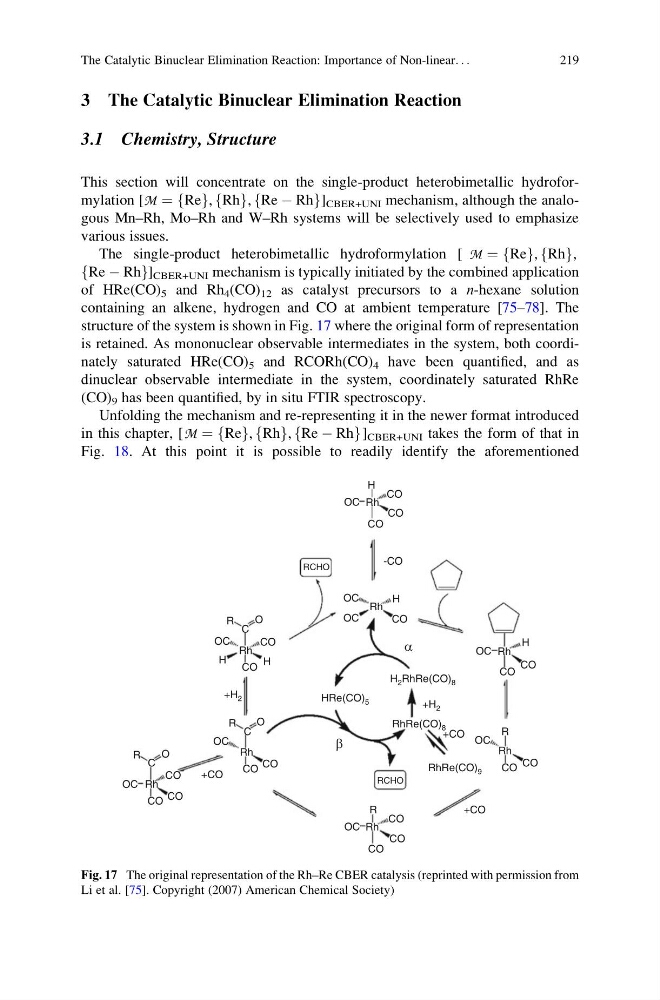
structure of the system is shown in Fig. 17 where the original form of representation
is retained. As mononuclear observable intermediates in the system, both coordinately saturated HRe(CO) 5 and RCORh(CO) 4 have been quantified, and as
dinuclear observable intermediate in the system, coordinately saturated RhRe
(CO) 9 has been quantified, by in situ FTIR spectroscopy.
Unfolding the mechanism and re-representing it in the newer format introduced
in this chapter, [M ¼ Re
f g, Rh
f g, Re À Rh
f
g] CBER+UNI takes the form of that in
Fig. 18. At this point it is possible to readily identify the aforementioned
CO
CO
CO
OC
H
Rh
CO
O
CO
CO
C
CO
CO
CO
HRe(CO) 5
H 2 RhRe(CO) 8
RhRe(CO) 9
RhRe(CO) 8
+CO
OC
R
β
Rh
H
Rh
H
R
CO
CO
CO
+CO
+CO
+H 2
CO
OC
-CO
OC
OC
CO
RCHO
RCHO
OC Rh
Rh
CO CO
CO
CO
OC
C
O
R
H
H
Rh
OC
OC
O
+H 2
C
R
Rh
Rh
R
α
–
Fig. 17 The original representation of the Rh–Re CBER catalysis (reprinted with permission from
Li et al. [75]. Copyright (2007) American Chemical Society)
The Catalytic Binuclear Elimination Reaction: Importance of Non-linear. . .
219
3.1 Chemistry, Structure
This section will concentrate on the single-product heterobimetallic hydroformylation [M ¼ Re
f g, Rh
f g, Re À Rh
f
g ] CBER+UNI mechanism, although the analogous Mn–Rh, Mo–Rh and W–Rh systems will be selectively used to emphasize
various issues.
The single-product heterobimetallic hydroformylation [ M ¼ Re
f g, Rh
f g,
Re À Rh
f
g ] CBER+UNI mechanism is typically initiated by the combined application
of HRe(CO) 5 and Rh 4 (CO) 12 as catalyst precursors to a n-hexane solution
containing an alkene, hydrogen and CO at ambient temperature [75–78]. The
structure of the system is shown in Fig. 17 where the original form of representation
is retained. As mononuclear observable intermediates in the system, both coordinately saturated HRe(CO) 5 and RCORh(CO) 4 have been quantified, and as
dinuclear observable intermediate in the system, coordinately saturated RhRe
(CO) 9 has been quantified, by in situ FTIR spectroscopy.
Unfolding the mechanism and re-representing it in the newer format introduced
in this chapter, [M ¼ Re
f g, Rh
f g, Re À Rh
f
g] CBER+UNI takes the form of that in
Fig. 18. At this point it is possible to readily identify the aforementioned
CO
CO
CO
OC
H
Rh
CO
O
CO
CO
C
CO
CO
CO
HRe(CO) 5
H 2 RhRe(CO) 8
RhRe(CO) 9
RhRe(CO) 8
+CO
OC
R
β
Rh
H
Rh
H
R
CO
CO
CO
+CO
+CO
+H 2
CO
OC
-CO
OC
OC
CO
RCHO
RCHO
OC Rh
Rh
CO CO
CO
CO
OC
C
O
R
H
H
Rh
OC
OC
O
+H 2
C
R
Rh
Rh
R
α
–
Fig. 17 The original representation of the Rh–Re CBER catalysis (reprinted with permission from
Li et al. [75]. Copyright (2007) American Chemical Society)
The Catalytic Binuclear Elimination Reaction: Importance of Non-linear. . .
219