

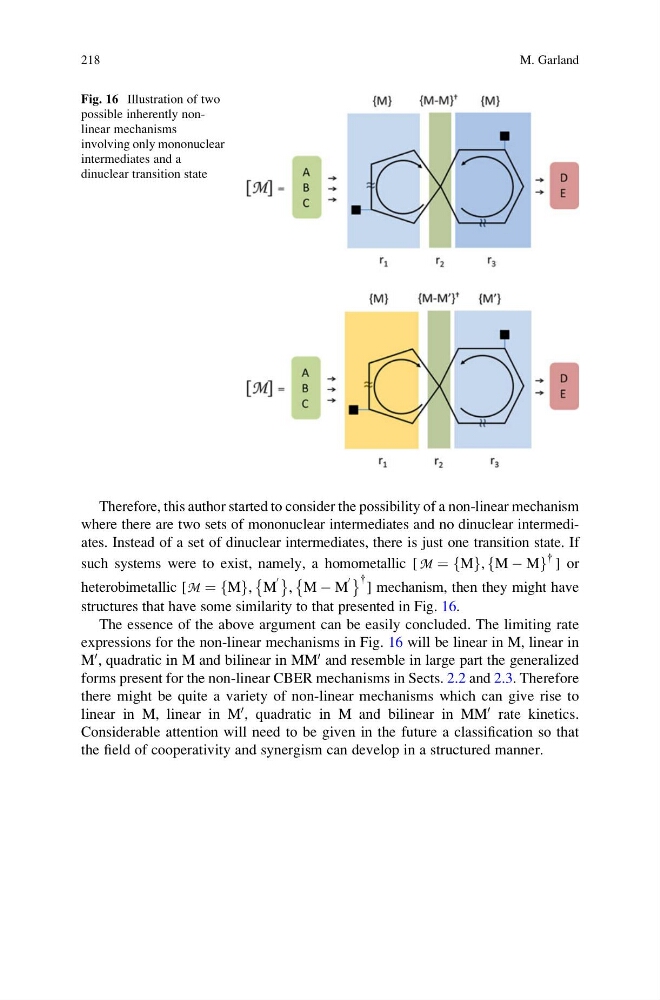
Therefore, this author started to consider the possibility of a non-linear mechanism
where there are two sets of mononuclear intermediates and no dinuclear intermediates. Instead of a set of dinuclear intermediates, there is just one transition state. If
such systems were to exist, namely, a homometallic [ M ¼ M
f g, M À M
f
g
{ ] or
heterobimetallic [M ¼ M
f g, M
0
È É
, M À M
0
È
É { ] mechanism, then they might have
structures that have some similarity to that presented in Fig. 16.
The essence of the above argument can be easily concluded. The limiting rate
expressions for the non-linear mechanisms in Fig. 16 will be linear in M, linear in
M
0 , quadratic in M and bilinear in MM
0 and resemble in large part the generalized
forms present for the non-linear CBER mechanisms in Sects. 2.2 and 2.3. Therefore
there might be quite a variety of non-linear mechanisms which can give rise to
linear in M, linear in M
0 , quadratic in M and bilinear in MM
0 rate kinetics.
Considerable attention will need to be given in the future a classification so that
the field of cooperativity and synergism can develop in a structured manner.
Fig. 16 Illustration of two
possible inherently nonlinear mechanisms
involving only mononuclear
intermediates and a
dinuclear transition state
218
M. Garland
where there are two sets of mononuclear intermediates and no dinuclear intermediates. Instead of a set of dinuclear intermediates, there is just one transition state. If
such systems were to exist, namely, a homometallic [ M ¼ M
f g, M À M
f
g
{ ] or
heterobimetallic [M ¼ M
f g, M
0
È É
, M À M
0
È
É { ] mechanism, then they might have
structures that have some similarity to that presented in Fig. 16.
The essence of the above argument can be easily concluded. The limiting rate
expressions for the non-linear mechanisms in Fig. 16 will be linear in M, linear in
M
0 , quadratic in M and bilinear in MM
0 and resemble in large part the generalized
forms present for the non-linear CBER mechanisms in Sects. 2.2 and 2.3. Therefore
there might be quite a variety of non-linear mechanisms which can give rise to
linear in M, linear in M
0 , quadratic in M and bilinear in MM
0 rate kinetics.
Considerable attention will need to be given in the future a classification so that
the field of cooperativity and synergism can develop in a structured manner.
Fig. 16 Illustration of two
possible inherently nonlinear mechanisms
involving only mononuclear
intermediates and a
dinuclear transition state
218
M. Garland