

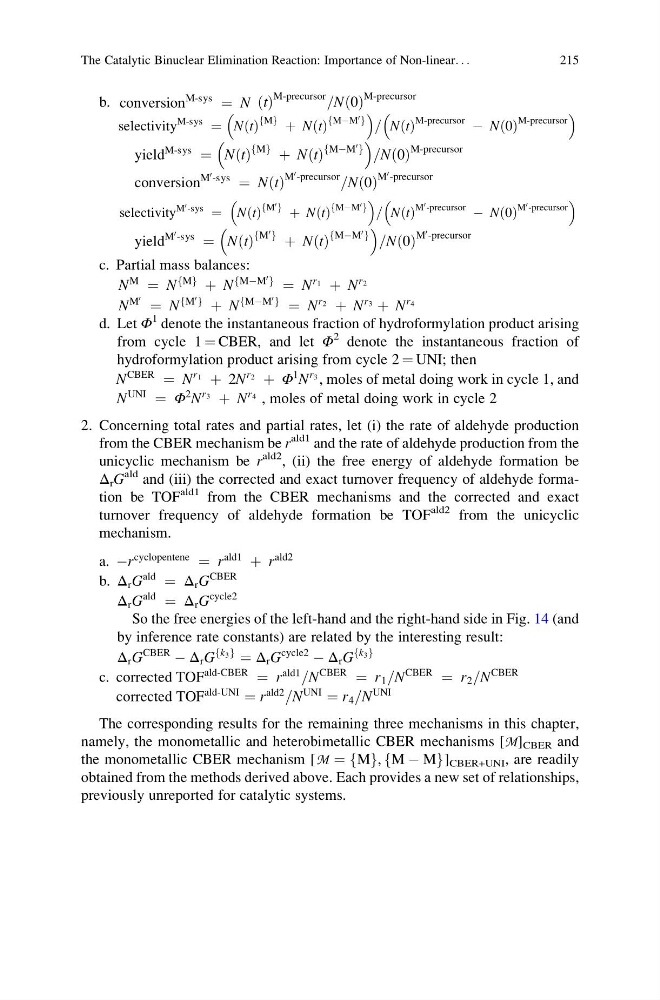
b. conversion
M-sys
¼ N t
ð Þ
M-precursor =N 0
ð Þ
M-precursor
selectivity
M-sys
¼ N t
ð Þ
M
f g þ N t
ð Þ
MÀM
0
f
g
= N t
ð Þ
M-precursor À N 0
ð Þ
M-precursor
yield
M-sys
¼ N t
ð Þ
M
f g þ N t
ð Þ
MÀM
0
f
g
=N 0
ð Þ
M-precursor
conversion
M
0 -sys
¼ N t
ð Þ
M
0 -precursor =N 0
ð Þ
M
0 -precursor
selectivity
M 0 -sys ¼ N t
ð Þ
M
0
f g þ N t
ð Þ
MÀM
0
f
g
= N t
ð Þ
M
0 -precursor À N 0
ð Þ
M
0 -precursor
yield
M
0 -sys
¼ N t
ð Þ
M
0
f g þ N t
ð Þ
MÀM
0
f
g
=N 0
ð Þ
M
0 -precursor
c. Partial mass balances:
N
M
¼ N
M
f g
þ N
MÀM
0
f
g
¼ N
r 1 þ N
r 2
N
M
0 ¼ N
M
0
f g
þ N
MÀM
0
f
g
¼ N
r 2 þ N
r 3 þ N
r 4
d. Let Φ
1 denote the instantaneous fraction of hydroformylation product arising
from cycle 1 ¼ CBER, and let Φ
2 denote the instantaneous fraction of
hydroformylation product arising from cycle 2 ¼ UNI; then
N
CBER
¼ N
r 1 þ 2N
r 2 þ Φ
1 N
r 3 , moles of metal doing work in cycle 1, and
N
UNI
¼ Φ
2 N
r 3 þ N
r 4 , moles of metal doing work in cycle 2
2. Concerning total rates and partial rates, let (i) the rate of aldehyde production
from the CBER mechanism be r
ald1 and the rate of aldehyde production from the
unicyclic mechanism be r
ald2 , (ii) the free energy of aldehyde formation be
Δ r G
ald and (iii) the corrected and exact turnover frequency of aldehyde formation be TOF
ald1 from the CBER mechanisms and the corrected and exact
turnover frequency of aldehyde formation be TOF
ald2 from the unicyclic
mechanism.
a. Àr
cyclopentene
¼ r
ald1
þ r
ald2
b. Δ r G
ald
¼ Δ r G
CBER
Δ r G
ald
¼ Δ r G
cycle2
So the free energies of the left-hand and the right-hand side in Fig. 14 (and
by inference rate constants) are related by the interesting result:
Δ r G
CBER
À Δ r G
k 3
f g
¼ Δ r G
cycle2
À Δ r G
k 3
f g
c. corrected TOF
ald-CBER
¼ r
ald1
=N
CBER
¼ r 1 =N
CBER
¼ r 2 =N
CBER
corrected TOF
ald-UNI
¼ r
ald2
=N
UNI
¼ r 4 =N
UNI
The corresponding results for the remaining three mechanisms in this chapter,
namely, the monometallic and heterobimetallic CBER mechanisms [M] CBER and
the monometallic CBER mechanism [M ¼ M
f g, M À M
f
g] CBER+UNI , are readily
obtained from the methods derived above. Each provides a new set of relationships,
previously unreported for catalytic systems.
The Catalytic Binuclear Elimination Reaction: Importance of Non-linear. . .
215
M-sys
¼ N t
ð Þ
M-precursor =N 0
ð Þ
M-precursor
selectivity
M-sys
¼ N t
ð Þ
M
f g þ N t
ð Þ
MÀM
0
f
g
= N t
ð Þ
M-precursor À N 0
ð Þ
M-precursor
yield
M-sys
¼ N t
ð Þ
M
f g þ N t
ð Þ
MÀM
0
f
g
=N 0
ð Þ
M-precursor
conversion
M
0 -sys
¼ N t
ð Þ
M
0 -precursor =N 0
ð Þ
M
0 -precursor
selectivity
M 0 -sys ¼ N t
ð Þ
M
0
f g þ N t
ð Þ
MÀM
0
f
g
= N t
ð Þ
M
0 -precursor À N 0
ð Þ
M
0 -precursor
yield
M
0 -sys
¼ N t
ð Þ
M
0
f g þ N t
ð Þ
MÀM
0
f
g
=N 0
ð Þ
M
0 -precursor
c. Partial mass balances:
N
M
¼ N
M
f g
þ N
MÀM
0
f
g
¼ N
r 1 þ N
r 2
N
M
0 ¼ N
M
0
f g
þ N
MÀM
0
f
g
¼ N
r 2 þ N
r 3 þ N
r 4
d. Let Φ
1 denote the instantaneous fraction of hydroformylation product arising
from cycle 1 ¼ CBER, and let Φ
2 denote the instantaneous fraction of
hydroformylation product arising from cycle 2 ¼ UNI; then
N
CBER
¼ N
r 1 þ 2N
r 2 þ Φ
1 N
r 3 , moles of metal doing work in cycle 1, and
N
UNI
¼ Φ
2 N
r 3 þ N
r 4 , moles of metal doing work in cycle 2
2. Concerning total rates and partial rates, let (i) the rate of aldehyde production
from the CBER mechanism be r
ald1 and the rate of aldehyde production from the
unicyclic mechanism be r
ald2 , (ii) the free energy of aldehyde formation be
Δ r G
ald and (iii) the corrected and exact turnover frequency of aldehyde formation be TOF
ald1 from the CBER mechanisms and the corrected and exact
turnover frequency of aldehyde formation be TOF
ald2 from the unicyclic
mechanism.
a. Àr
cyclopentene
¼ r
ald1
þ r
ald2
b. Δ r G
ald
¼ Δ r G
CBER
Δ r G
ald
¼ Δ r G
cycle2
So the free energies of the left-hand and the right-hand side in Fig. 14 (and
by inference rate constants) are related by the interesting result:
Δ r G
CBER
À Δ r G
k 3
f g
¼ Δ r G
cycle2
À Δ r G
k 3
f g
c. corrected TOF
ald-CBER
¼ r
ald1
=N
CBER
¼ r 1 =N
CBER
¼ r 2 =N
CBER
corrected TOF
ald-UNI
¼ r
ald2
=N
UNI
¼ r 4 =N
UNI
The corresponding results for the remaining three mechanisms in this chapter,
namely, the monometallic and heterobimetallic CBER mechanisms [M] CBER and
the monometallic CBER mechanism [M ¼ M
f g, M À M
f
g] CBER+UNI , are readily
obtained from the methods derived above. Each provides a new set of relationships,
previously unreported for catalytic systems.
The Catalytic Binuclear Elimination Reaction: Importance of Non-linear. . .
215