

2.8 Other Systems, Other Non-linear Mechanisms
2.8.1 Importance of Pre-catalytic Stoichiometric Transformations
There is a class of stoichiometric reactions which exacerbate the interpretation of
catalytic rates and which must be mentioned. This class of stoichiometric reactions
confound not only the novice in catalytic sciences but occasionally seasoned
practitioners as well, since extremely dramatic effects on catalytic reaction rates
can arise – and of course, these may then be misinterpreted as suggesting some sort
of cooperativity or synergism in the catalytic mechanism.
This class of stoichiometric reactions are those associated with the conversion of
the catalyst precursor to intermediates. The half-lives for conversion can easily vary
over many orders of magnitude – seconds to days (especially when inorganic salts
or micronized metal is used). Moreover, depending on the ligands present, their
concentrations, the auxiliaries used and the sequence of additions, the selectivity to
spectator species rather than intermediates may be favoured and the ultimate yield
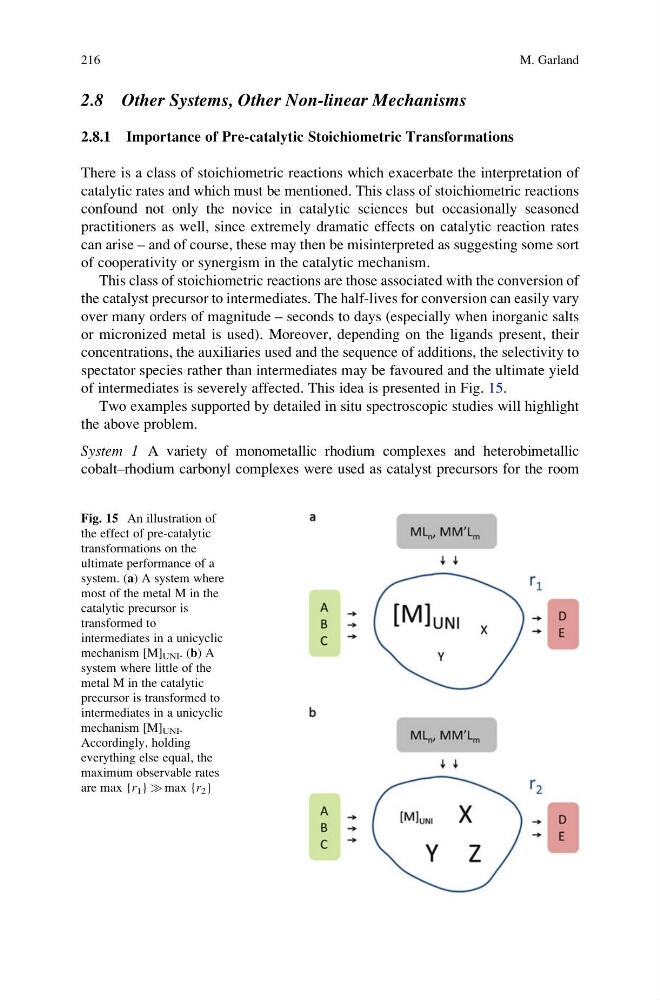
of intermediates is severely affected. This idea is presented in Fig. 15.
Two examples supported by detailed in situ spectroscopic studies will highlight
the above problem.
System 1 A variety of monometallic rhodium complexes and heterobimetallic
cobalt–rhodium carbonyl complexes were used as catalyst precursors for the room
Fig. 15 An illustration of
the effect of pre-catalytic
transformations on the
ultimate performance of a
system. (a) A system where
most of the metal M in the
catalytic precursor is
transformed to
intermediates in a unicyclic
mechanism [M] UNI . (b) A
system where little of the
metal M in the catalytic
precursor is transformed to
intermediates in a unicyclic
mechanism [M] UNI .
Accordingly, holding
everything else equal, the
maximum observable rates
are max {r 1 } ) max {r 2 }
216
M. Garland
2.8.1 Importance of Pre-catalytic Stoichiometric Transformations
There is a class of stoichiometric reactions which exacerbate the interpretation of
catalytic rates and which must be mentioned. This class of stoichiometric reactions
confound not only the novice in catalytic sciences but occasionally seasoned
practitioners as well, since extremely dramatic effects on catalytic reaction rates
can arise – and of course, these may then be misinterpreted as suggesting some sort
of cooperativity or synergism in the catalytic mechanism.
This class of stoichiometric reactions are those associated with the conversion of
the catalyst precursor to intermediates. The half-lives for conversion can easily vary
over many orders of magnitude – seconds to days (especially when inorganic salts
or micronized metal is used). Moreover, depending on the ligands present, their
concentrations, the auxiliaries used and the sequence of additions, the selectivity to
spectator species rather than intermediates may be favoured and the ultimate yield
of intermediates is severely affected. This idea is presented in Fig. 15.
Two examples supported by detailed in situ spectroscopic studies will highlight
the above problem.
System 1 A variety of monometallic rhodium complexes and heterobimetallic
cobalt–rhodium carbonyl complexes were used as catalyst precursors for the room
Fig. 15 An illustration of
the effect of pre-catalytic
transformations on the
ultimate performance of a
system. (a) A system where
most of the metal M in the
catalytic precursor is
transformed to
intermediates in a unicyclic
mechanism [M] UNI . (b) A
system where little of the
metal M in the catalytic
precursor is transformed to
intermediates in a unicyclic
mechanism [M] UNI .
Accordingly, holding
everything else equal, the
maximum observable rates
are max {r 1 } ) max {r 2 }
216
M. Garland