

Δ r G
alk
¼ Δ r G
cycle2
So the free energies of the two cycles (and by inference rate constants) are
related since the {k 2 } sequence is common.
c. corrected TOF
ald
¼ r
ald
=N
cycle1
¼ r 1 =N
cycle1
corrected TOF
alk
¼ r
alk
=N
cycle2
¼ r 3 =N
cycle2
In Sect. 2.3.2 a single-product heterobimetallic
½M ¼ M
f g, M
0
È É
,
M À M
0
È
É CBER+UNI mechanism was presented for a hydroformylation where
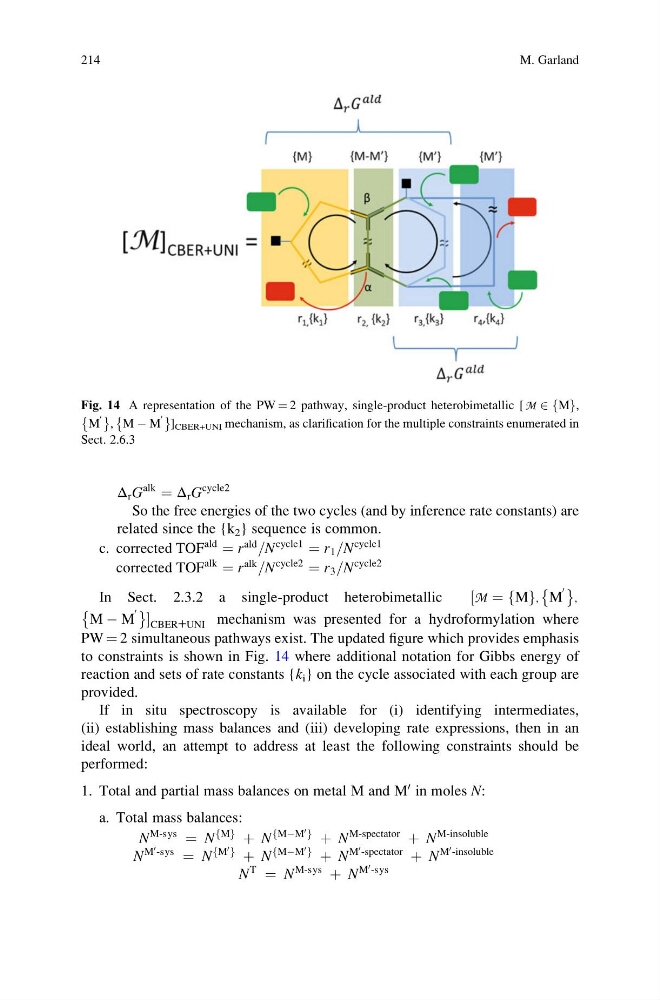
PW ¼ 2 simultaneous pathways exist. The updated figure which provides emphasis
to constraints is shown in Fig. 14 where additional notation for Gibbs energy of
reaction and sets of rate constants {k i } on the cycle associated with each group are
provided.
If in situ spectroscopy is available for (i) identifying intermediates,
(ii) establishing mass balances and (iii) developing rate expressions, then in an
ideal world, an attempt to address at least the following constraints should be
performed:
1. Total and partial mass balances on metal M and M
0 in moles N:
a. Total mass balances:
N
M-sys
¼ N
M
f g
þ N
MÀM
0
f
g
þ N
M-spectator
þ N
M-insoluble
N
M
0 -sys
¼ N
M
0
f g
þ N
MÀM
0
f
g
þ N
M
0 -spectator
þ N
M
0 -insoluble
N
T
¼ N
M-sys
þ N
M
0 -sys
Fig. 14 A representation of the PW ¼ 2 pathway, single-product heterobimetallic [ M 2 M
f g,
M
0
È É
, M À M
0
È
É
] CBER+UNI mechanism, as clarification for the multiple constraints enumerated in
Sect. 2.6.3
214
M. Garland
alk
¼ Δ r G
cycle2
So the free energies of the two cycles (and by inference rate constants) are
related since the {k 2 } sequence is common.
c. corrected TOF
ald
¼ r
ald
=N
cycle1
¼ r 1 =N
cycle1
corrected TOF
alk
¼ r
alk
=N
cycle2
¼ r 3 =N
cycle2
In Sect. 2.3.2 a single-product heterobimetallic
½M ¼ M
f g, M
0
È É
,
M À M
0
È
É CBER+UNI mechanism was presented for a hydroformylation where
PW ¼ 2 simultaneous pathways exist. The updated figure which provides emphasis
to constraints is shown in Fig. 14 where additional notation for Gibbs energy of
reaction and sets of rate constants {k i } on the cycle associated with each group are
provided.
If in situ spectroscopy is available for (i) identifying intermediates,
(ii) establishing mass balances and (iii) developing rate expressions, then in an
ideal world, an attempt to address at least the following constraints should be
performed:
1. Total and partial mass balances on metal M and M
0 in moles N:
a. Total mass balances:
N
M-sys
¼ N
M
f g
þ N
MÀM
0
f
g
þ N
M-spectator
þ N
M-insoluble
N
M
0 -sys
¼ N
M
0
f g
þ N
MÀM
0
f
g
þ N
M
0 -spectator
þ N
M
0 -insoluble
N
T
¼ N
M-sys
þ N
M
0 -sys
Fig. 14 A representation of the PW ¼ 2 pathway, single-product heterobimetallic [ M 2 M
f g,
M
0
È É
, M À M
0
È
É
] CBER+UNI mechanism, as clarification for the multiple constraints enumerated in
Sect. 2.6.3
214
M. Garland