

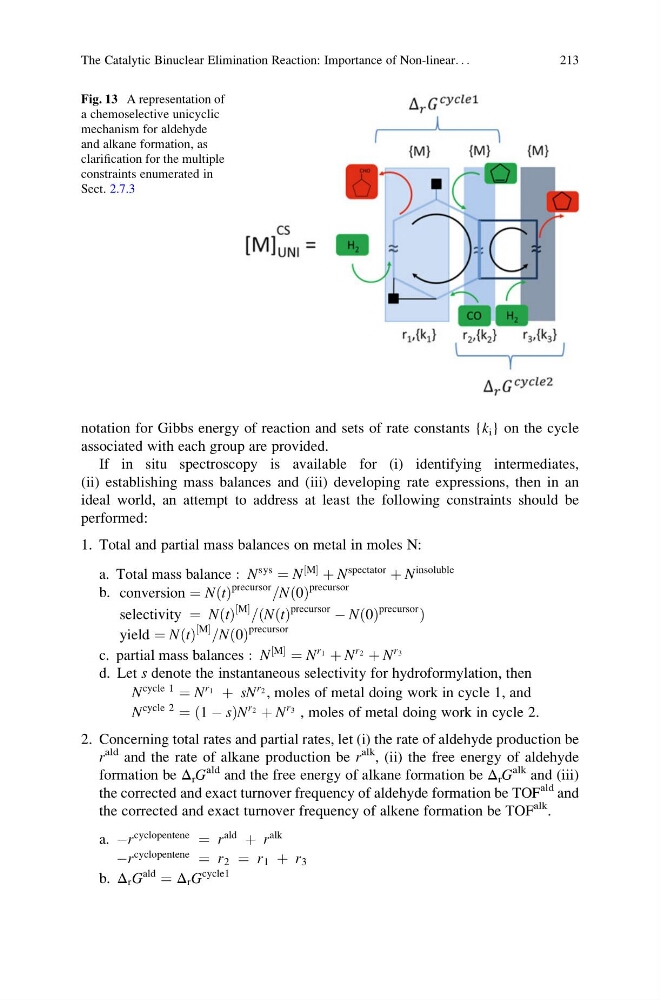
notation for Gibbs energy of reaction and sets of rate constants {k i } on the cycle
associated with each group are provided.
If in situ spectroscopy is available for (i) identifying intermediates,
(ii) establishing mass balances and (iii) developing rate expressions, then in an
ideal world, an attempt to address at least the following constraints should be
performed:
1. Total and partial mass balances on metal in moles N:
a. Total mass balance : N
sys
¼ N
M
½
þ N
spectator
þ N
insoluble
b. conversion ¼ N t
ð Þ
precursor =N 0
ð Þ
precursor
selectivity ¼ N t
ð Þ
M
½ = N t
ð Þ
precursor À N 0
ð Þ
precursor
ð
Þ
yield ¼ N t
ð Þ
M
½ =N 0
ð Þ
precursor
c. partial mass balances : N
M
½
¼ N
r 1 þ N
r 2 þ N
r 3
d. Let s denote the instantaneous selectivity for hydroformylation, then
N
cycle 1
¼ N
r 1 þ sN
r 2 , moles of metal doing work in cycle 1, and
N
cycle 2
¼ 1 À s
ð
ÞN
r 2 þ N
r 3 , moles of metal doing work in cycle 2.
2. Concerning total rates and partial rates, let (i) the rate of aldehyde production be
r
ald and the rate of alkane production be r
alk , (ii) the free energy of aldehyde
formation be Δ r G
ald and the free energy of alkane formation be Δ r G
alk and (iii)
the corrected and exact turnover frequency of aldehyde formation be TOF
ald and
the corrected and exact turnover frequency of alkene formation be TOF
alk .
a. Àr
cyclopentene
¼ r
ald
þ r
alk
Àr
cyclopentene
¼ r 2 ¼ r 1 þ r 3
b. Δ r G
ald
¼ Δ r G
cycle1
Fig. 13 A representation of
a chemoselective unicyclic
mechanism for aldehyde
and alkane formation, as
clarification for the multiple
constraints enumerated in
Sect. 2.7.3
The Catalytic Binuclear Elimination Reaction: Importance of Non-linear. . .
213
associated with each group are provided.
If in situ spectroscopy is available for (i) identifying intermediates,
(ii) establishing mass balances and (iii) developing rate expressions, then in an
ideal world, an attempt to address at least the following constraints should be
performed:
1. Total and partial mass balances on metal in moles N:
a. Total mass balance : N
sys
¼ N
M
½
þ N
spectator
þ N
insoluble
b. conversion ¼ N t
ð Þ
precursor =N 0
ð Þ
precursor
selectivity ¼ N t
ð Þ
M
½ = N t
ð Þ
precursor À N 0
ð Þ
precursor
ð
Þ
yield ¼ N t
ð Þ
M
½ =N 0
ð Þ
precursor
c. partial mass balances : N
M
½
¼ N
r 1 þ N
r 2 þ N
r 3
d. Let s denote the instantaneous selectivity for hydroformylation, then
N
cycle 1
¼ N
r 1 þ sN
r 2 , moles of metal doing work in cycle 1, and
N
cycle 2
¼ 1 À s
ð
ÞN
r 2 þ N
r 3 , moles of metal doing work in cycle 2.
2. Concerning total rates and partial rates, let (i) the rate of aldehyde production be
r
ald and the rate of alkane production be r
alk , (ii) the free energy of aldehyde
formation be Δ r G
ald and the free energy of alkane formation be Δ r G
alk and (iii)
the corrected and exact turnover frequency of aldehyde formation be TOF
ald and
the corrected and exact turnover frequency of alkene formation be TOF
alk .
a. Àr
cyclopentene
¼ r
ald
þ r
alk
Àr
cyclopentene
¼ r 2 ¼ r 1 þ r 3
b. Δ r G
ald
¼ Δ r G
cycle1
Fig. 13 A representation of
a chemoselective unicyclic
mechanism for aldehyde
and alkane formation, as
clarification for the multiple
constraints enumerated in
Sect. 2.7.3
The Catalytic Binuclear Elimination Reaction: Importance of Non-linear. . .
213