

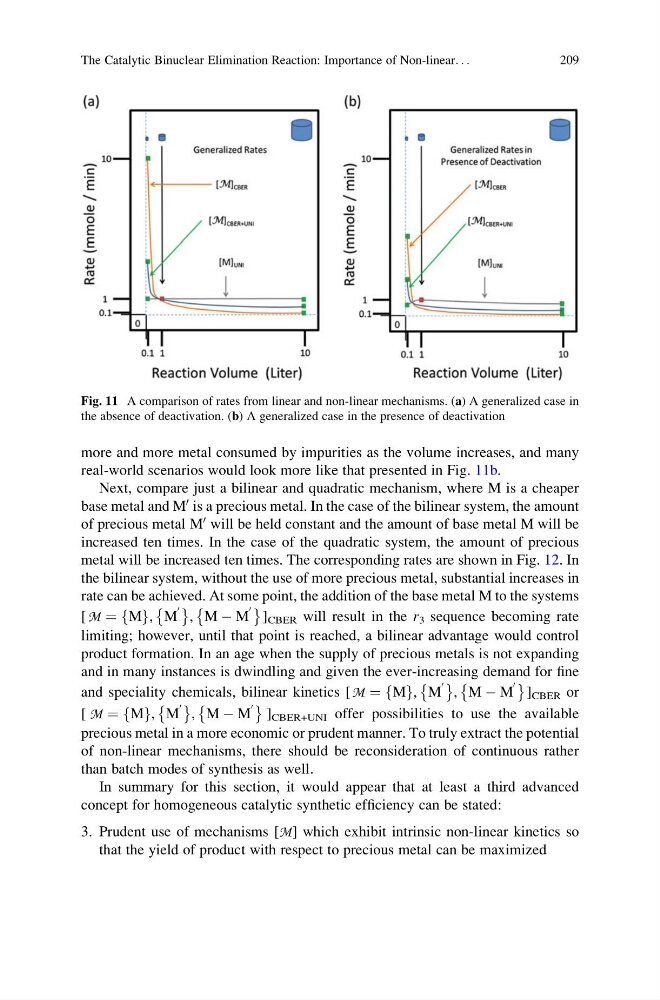
more and more metal consumed by impurities as the volume increases, and many
real-world scenarios would look more like that presented in Fig. 11b.
Next, compare just a bilinear and quadratic mechanism, where M is a cheaper
base metal and M
0 is a precious metal. In the case of the bilinear system, the amount
of precious metal M
0 will be held constant and the amount of base metal M will be
increased ten times. In the case of the quadratic system, the amount of precious
metal will be increased ten times. The corresponding rates are shown in Fig. 12. In
the bilinear system, without the use of more precious metal, substantial increases in
rate can be achieved. At some point, the addition of the base metal M to the systems
[ M ¼ M
f g, M
0
È É
, M À M
0
È
É
] CBER will result in the r 3 sequence becoming rate
limiting; however, until that point is reached, a bilinear advantage would control
product formation. In an age when the supply of precious metals is not expanding
and in many instances is dwindling and given the ever-increasing demand for fine
and speciality chemicals, bilinear kinetics [M ¼ M
f g, M
0
È É
, M À M
0
È
É
] CBER or
[ M ¼ M
f g, M
0
È É
, M À M
0
È
É
] CBER+UNI offer possibilities to use the available
precious metal in a more economic or prudent manner. To truly extract the potential
of non-linear mechanisms, there should be reconsideration of continuous rather
than batch modes of synthesis as well.
In summary for this section, it would appear that at least a third advanced
concept for homogeneous catalytic synthetic efficiency can be stated:
3. Prudent use of mechanisms [M] which exhibit intrinsic non-linear kinetics so
that the yield of product with respect to precious metal can be maximized
Fig. 11 A comparison of rates from linear and non-linear mechanisms. (a) A generalized case in
the absence of deactivation. (b) A generalized case in the presence of deactivation
The Catalytic Binuclear Elimination Reaction: Importance of Non-linear. . .
209
real-world scenarios would look more like that presented in Fig. 11b.
Next, compare just a bilinear and quadratic mechanism, where M is a cheaper
base metal and M
0 is a precious metal. In the case of the bilinear system, the amount
of precious metal M
0 will be held constant and the amount of base metal M will be
increased ten times. In the case of the quadratic system, the amount of precious
metal will be increased ten times. The corresponding rates are shown in Fig. 12. In
the bilinear system, without the use of more precious metal, substantial increases in
rate can be achieved. At some point, the addition of the base metal M to the systems
[ M ¼ M
f g, M
0
È É
, M À M
0
È
É
] CBER will result in the r 3 sequence becoming rate
limiting; however, until that point is reached, a bilinear advantage would control
product formation. In an age when the supply of precious metals is not expanding
and in many instances is dwindling and given the ever-increasing demand for fine
and speciality chemicals, bilinear kinetics [M ¼ M
f g, M
0
È É
, M À M
0
È
É
] CBER or
[ M ¼ M
f g, M
0
È É
, M À M
0
È
É
] CBER+UNI offer possibilities to use the available
precious metal in a more economic or prudent manner. To truly extract the potential
of non-linear mechanisms, there should be reconsideration of continuous rather
than batch modes of synthesis as well.
In summary for this section, it would appear that at least a third advanced
concept for homogeneous catalytic synthetic efficiency can be stated:
3. Prudent use of mechanisms [M] which exhibit intrinsic non-linear kinetics so
that the yield of product with respect to precious metal can be maximized
Fig. 11 A comparison of rates from linear and non-linear mechanisms. (a) A generalized case in
the absence of deactivation. (b) A generalized case in the presence of deactivation
The Catalytic Binuclear Elimination Reaction: Importance of Non-linear. . .
209