

2.6 Regio-, Chemo- and Stereoselectivities
Presently, there is very little known concerning selectivity patterns in [M] CBER and
[M] CBER+UNI . There were attempts in our laboratory to detect regioselective
changes in unmodified [ M ¼ Mn
f g, Rh
f g, Mn À Rh
f
g ] CBER+UNI and
[M ¼ Re
f g, Rh
f g, Re À Rh
f
g ] CBER+UNI , but these studies were inconclusive. Additionally,
bidentate
phosphines
were
used
in
conjunction
with
[ M ¼ Re
f g, Rh
f g, Re À Rh
f
g] CBER+UNI as a prelude to stereoselective studies,
but at the typical room temperatures used for previous unmodified [ M ¼ Re
f g,
Rh
f g, Re À Rh
f
g ] CBER+UNI , the systems did not appear to turnover. It would appear
that more work in this area is needed in order to better understand the potential for
[M] CBER and [M] CBER+UNI to control selectivity. A cursory inspection suggests that
severe steric constraints in the α step may direct preferential regioselectivity
towards terminal products. Furthermore, the idea that not just one but two metals
could be simultaneously modified using chiral ligands suggests that if an α step
exists in such systems, then given the chirality on {M} and the chirality on {M
0 },
perhaps the energetics are such that very high stereoselectivities might arise in
some types of reactions (think of the diastereomeric pocket in enzymes as perhaps a
similar example). Therefore, this area looks potentially fruitful for dramatic selectivity increases due to the above-mentioned reasons. Due to considerable branching
of the main reaction pathways, such systems are expected to be difficult to represent
and visualize diagrammatically.
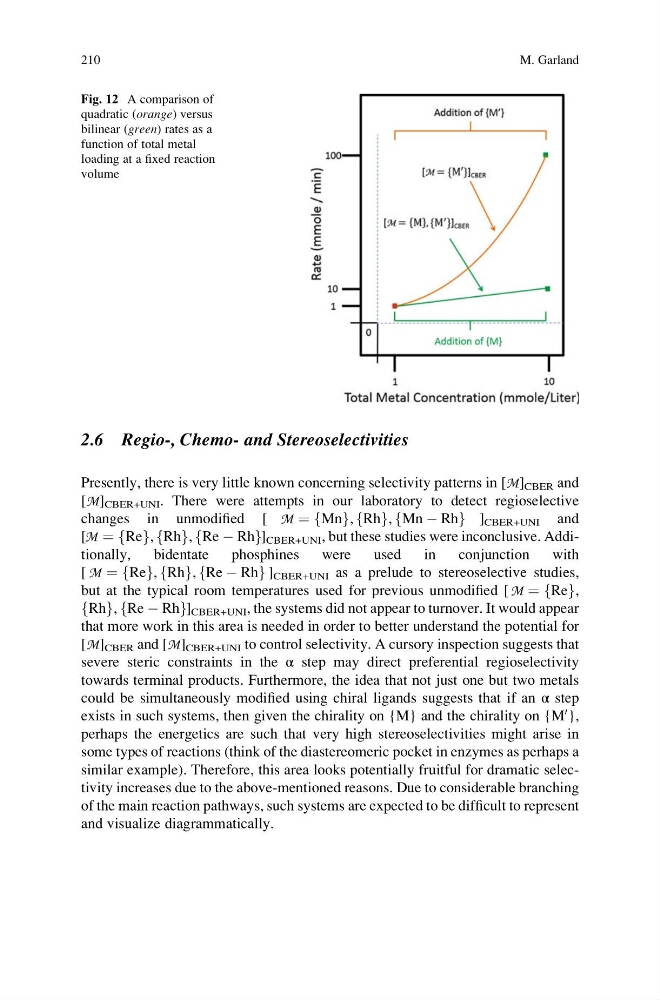
Fig. 12 A comparison of
quadratic (orange) versus
bilinear (green) rates as a
function of total metal
loading at a fixed reaction
volume
210
M. Garland
Presently, there is very little known concerning selectivity patterns in [M] CBER and
[M] CBER+UNI . There were attempts in our laboratory to detect regioselective
changes in unmodified [ M ¼ Mn
f g, Rh
f g, Mn À Rh
f
g ] CBER+UNI and
[M ¼ Re
f g, Rh
f g, Re À Rh
f
g ] CBER+UNI , but these studies were inconclusive. Additionally,
bidentate
phosphines
were
used
in
conjunction
with
[ M ¼ Re
f g, Rh
f g, Re À Rh
f
g] CBER+UNI as a prelude to stereoselective studies,
but at the typical room temperatures used for previous unmodified [ M ¼ Re
f g,
Rh
f g, Re À Rh
f
g ] CBER+UNI , the systems did not appear to turnover. It would appear
that more work in this area is needed in order to better understand the potential for
[M] CBER and [M] CBER+UNI to control selectivity. A cursory inspection suggests that
severe steric constraints in the α step may direct preferential regioselectivity
towards terminal products. Furthermore, the idea that not just one but two metals
could be simultaneously modified using chiral ligands suggests that if an α step
exists in such systems, then given the chirality on {M} and the chirality on {M
0 },
perhaps the energetics are such that very high stereoselectivities might arise in
some types of reactions (think of the diastereomeric pocket in enzymes as perhaps a
similar example). Therefore, this area looks potentially fruitful for dramatic selectivity increases due to the above-mentioned reasons. Due to considerable branching
of the main reaction pathways, such systems are expected to be difficult to represent
and visualize diagrammatically.
Fig. 12 A comparison of
quadratic (orange) versus
bilinear (green) rates as a
function of total metal
loading at a fixed reaction
volume
210
M. Garland