

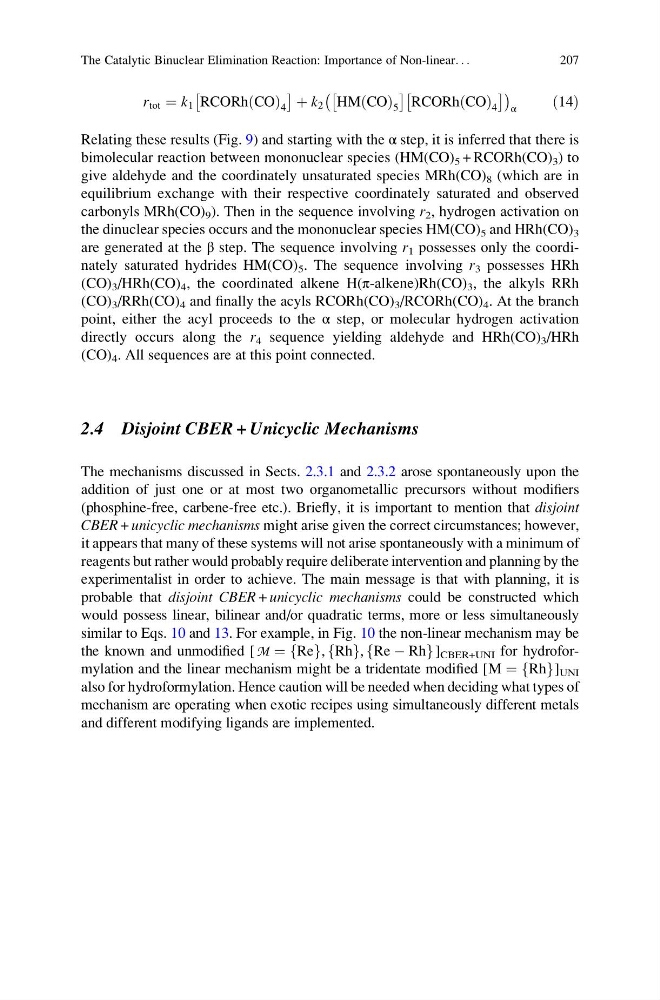
r tot ¼ k 1 RCORh CO
ð Þ 4
Â
à þ k 2 HM CO
ð Þ 5
Â
Ã
RCORh CO
ð Þ 4
Â
Ã
À
Á
α
ð14Þ
Relating these results (Fig. 9) and starting with the α step, it is inferred that there is
bimolecular reaction between mononuclear species (HM(CO) 5 + RCORh(CO) 3 ) to
give aldehyde and the coordinately unsaturated species MRh(CO) 8 (which are in
equilibrium exchange with their respective coordinately saturated and observed
carbonyls MRh(CO) 9 ). Then in the sequence involving r 2 , hydrogen activation on
the dinuclear species occurs and the mononuclear species HM(CO) 5 and HRh(CO) 3
are generated at the β step. The sequence involving r 1 possesses only the coordinately saturated hydrides HM(CO) 5 . The sequence involving r 3 possesses HRh
(CO) 3 /HRh(CO) 4 , the coordinated alkene H(π-alkene)Rh(CO) 3 , the alkyls RRh
(CO) 3 /RRh(CO) 4 and finally the acyls RCORh(CO) 3 /RCORh(CO) 4 . At the branch
point, either the acyl proceeds to the α step, or molecular hydrogen activation
directly occurs along the r 4 sequence yielding aldehyde and HRh(CO) 3 /HRh
(CO) 4 . All sequences are at this point connected.
2.4 Disjoint CBER + Unicyclic Mechanisms
The mechanisms discussed in Sects. 2.3.1 and 2.3.2 arose spontaneously upon the
addition of just one or at most two organometallic precursors without modifiers
(phosphine-free, carbene-free etc.). Briefly, it is important to mention that disjoint
CBER + unicyclic mechanisms might arise given the correct circumstances; however,
it appears that many of these systems will not arise spontaneously with a minimum of
reagents but rather would probably require deliberate intervention and planning by the
experimentalist in order to achieve. The main message is that with planning, it is
probable that disjoint CBER + unicyclic mechanisms could be constructed which
would possess linear, bilinear and/or quadratic terms, more or less simultaneously
similar to Eqs. 10 and 13. For example, in Fig. 10 the non-linear mechanism may be
the known and unmodified [ M ¼ Re
f g, Rh
f g, Re À Rh
f
g] CBER+UNI for hydroformylation and the linear mechanism might be a tridentate modified [M ¼ Rh
f g] UNI
also for hydroformylation. Hence caution will be needed when deciding what types of
mechanism are operating when exotic recipes using simultaneously different metals
and different modifying ligands are implemented.
The Catalytic Binuclear Elimination Reaction: Importance of Non-linear. . .
207
ð Þ 4
Â
à þ k 2 HM CO
ð Þ 5
Â
Ã
RCORh CO
ð Þ 4
Â
Ã
À
Á
α
ð14Þ
Relating these results (Fig. 9) and starting with the α step, it is inferred that there is
bimolecular reaction between mononuclear species (HM(CO) 5 + RCORh(CO) 3 ) to
give aldehyde and the coordinately unsaturated species MRh(CO) 8 (which are in
equilibrium exchange with their respective coordinately saturated and observed
carbonyls MRh(CO) 9 ). Then in the sequence involving r 2 , hydrogen activation on
the dinuclear species occurs and the mononuclear species HM(CO) 5 and HRh(CO) 3
are generated at the β step. The sequence involving r 1 possesses only the coordinately saturated hydrides HM(CO) 5 . The sequence involving r 3 possesses HRh
(CO) 3 /HRh(CO) 4 , the coordinated alkene H(π-alkene)Rh(CO) 3 , the alkyls RRh
(CO) 3 /RRh(CO) 4 and finally the acyls RCORh(CO) 3 /RCORh(CO) 4 . At the branch
point, either the acyl proceeds to the α step, or molecular hydrogen activation
directly occurs along the r 4 sequence yielding aldehyde and HRh(CO) 3 /HRh
(CO) 4 . All sequences are at this point connected.
2.4 Disjoint CBER + Unicyclic Mechanisms
The mechanisms discussed in Sects. 2.3.1 and 2.3.2 arose spontaneously upon the
addition of just one or at most two organometallic precursors without modifiers
(phosphine-free, carbene-free etc.). Briefly, it is important to mention that disjoint
CBER + unicyclic mechanisms might arise given the correct circumstances; however,
it appears that many of these systems will not arise spontaneously with a minimum of
reagents but rather would probably require deliberate intervention and planning by the
experimentalist in order to achieve. The main message is that with planning, it is
probable that disjoint CBER + unicyclic mechanisms could be constructed which
would possess linear, bilinear and/or quadratic terms, more or less simultaneously
similar to Eqs. 10 and 13. For example, in Fig. 10 the non-linear mechanism may be
the known and unmodified [ M ¼ Re
f g, Rh
f g, Re À Rh
f
g] CBER+UNI for hydroformylation and the linear mechanism might be a tridentate modified [M ¼ Rh
f g] UNI
also for hydroformylation. Hence caution will be needed when deciding what types of
mechanism are operating when exotic recipes using simultaneously different metals
and different modifying ligands are implemented.
The Catalytic Binuclear Elimination Reaction: Importance of Non-linear. . .
207