

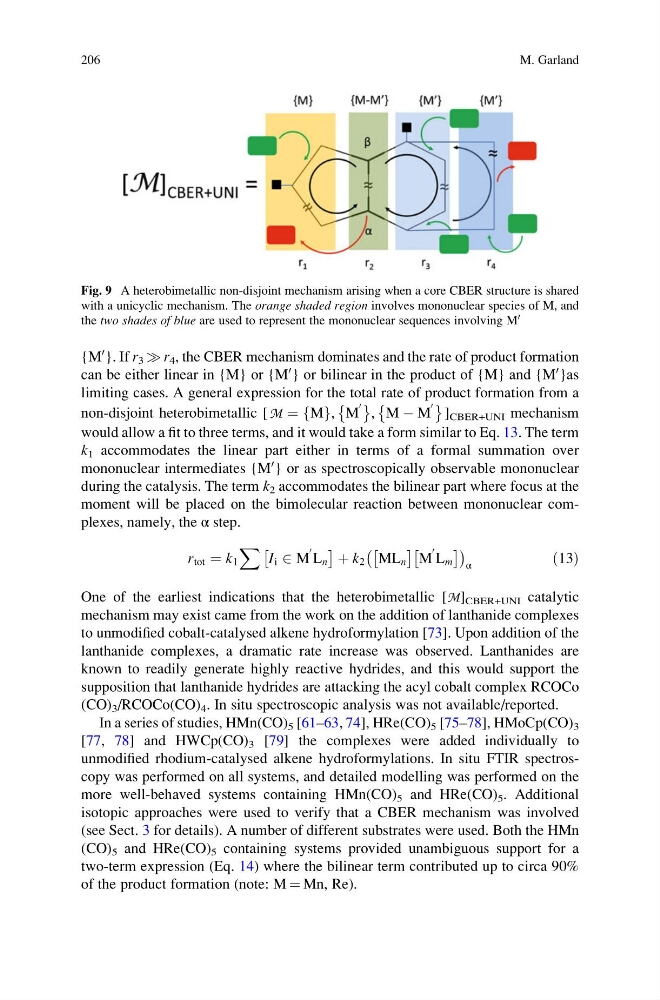
{M
0 }. If r 3 ) r 4 , the CBER mechanism dominates and the rate of product formation
can be either linear in {M} or {M
0 } or bilinear in the product of {M} and {M
0 }as
limiting cases. A general expression for the total rate of product formation from a
non-disjoint heterobimetallic [ M ¼ M
f g, M
0
È É
, M À M
0
È
É
] CBER+UNI mechanism
would allow a fit to three terms, and it would take a form similar to Eq. 13. The term
k 1 accommodates the linear part either in terms of a formal summation over
mononuclear intermediates {M
0 } or as spectroscopically observable mononuclear
during the catalysis. The term k 2 accommodates the bilinear part where focus at the
moment will be placed on the bimolecular reaction between mononuclear complexes, namely, the α step.
r tot ¼ k 1
X Â
I i 2 M
0 L n
à þ k 2
ÀÂ
ML n
ÃÂ
M
0 L m
ÃÁ
α
ð13Þ
One of the earliest indications that the heterobimetallic [M] CBER+UNI catalytic
mechanism may exist came from the work on the addition of lanthanide complexes
to unmodified cobalt-catalysed alkene hydroformylation [73]. Upon addition of the
lanthanide complexes, a dramatic rate increase was observed. Lanthanides are
known to readily generate highly reactive hydrides, and this would support the
supposition that lanthanide hydrides are attacking the acyl cobalt complex RCOCo
(CO) 3 /RCOCo(CO) 4 . In situ spectroscopic analysis was not available/reported.
In a series of studies, HMn(CO) 5 [61–63, 74], HRe(CO) 5 [75–78], HMoCp(CO) 3
[77, 78] and HWCp(CO) 3 [79] the complexes were added individually to
unmodified rhodium-catalysed alkene hydroformylations. In situ FTIR spectroscopy was performed on all systems, and detailed modelling was performed on the
more well-behaved systems containing HMn(CO) 5 and HRe(CO) 5 . Additional
isotopic approaches were used to verify that a CBER mechanism was involved
(see Sect. 3 for details). A number of different substrates were used. Both the HMn
(CO) 5 and HRe(CO) 5 containing systems provided unambiguous support for a
two-term expression (Eq. 14) where the bilinear term contributed up to circa 90%
of the product formation (note: M ¼ Mn, Re).
Fig. 9 A heterobimetallic non-disjoint mechanism arising when a core CBER structure is shared
with a unicyclic mechanism. The orange shaded region involves mononuclear species of M, and
the two shades of blue are used to represent the mononuclear sequences involving M
0
206
M. Garland
0 }. If r 3 ) r 4 , the CBER mechanism dominates and the rate of product formation
can be either linear in {M} or {M
0 } or bilinear in the product of {M} and {M
0 }as
limiting cases. A general expression for the total rate of product formation from a
non-disjoint heterobimetallic [ M ¼ M
f g, M
0
È É
, M À M
0
È
É
] CBER+UNI mechanism
would allow a fit to three terms, and it would take a form similar to Eq. 13. The term
k 1 accommodates the linear part either in terms of a formal summation over
mononuclear intermediates {M
0 } or as spectroscopically observable mononuclear
during the catalysis. The term k 2 accommodates the bilinear part where focus at the
moment will be placed on the bimolecular reaction between mononuclear complexes, namely, the α step.
r tot ¼ k 1
X Â
I i 2 M
0 L n
à þ k 2
ÀÂ
ML n
ÃÂ
M
0 L m
ÃÁ
α
ð13Þ
One of the earliest indications that the heterobimetallic [M] CBER+UNI catalytic
mechanism may exist came from the work on the addition of lanthanide complexes
to unmodified cobalt-catalysed alkene hydroformylation [73]. Upon addition of the
lanthanide complexes, a dramatic rate increase was observed. Lanthanides are
known to readily generate highly reactive hydrides, and this would support the
supposition that lanthanide hydrides are attacking the acyl cobalt complex RCOCo
(CO) 3 /RCOCo(CO) 4 . In situ spectroscopic analysis was not available/reported.
In a series of studies, HMn(CO) 5 [61–63, 74], HRe(CO) 5 [75–78], HMoCp(CO) 3
[77, 78] and HWCp(CO) 3 [79] the complexes were added individually to
unmodified rhodium-catalysed alkene hydroformylations. In situ FTIR spectroscopy was performed on all systems, and detailed modelling was performed on the
more well-behaved systems containing HMn(CO) 5 and HRe(CO) 5 . Additional
isotopic approaches were used to verify that a CBER mechanism was involved
(see Sect. 3 for details). A number of different substrates were used. Both the HMn
(CO) 5 and HRe(CO) 5 containing systems provided unambiguous support for a
two-term expression (Eq. 14) where the bilinear term contributed up to circa 90%
of the product formation (note: M ¼ Mn, Re).
Fig. 9 A heterobimetallic non-disjoint mechanism arising when a core CBER structure is shared
with a unicyclic mechanism. The orange shaded region involves mononuclear species of M, and
the two shades of blue are used to represent the mononuclear sequences involving M
0
206
M. Garland