

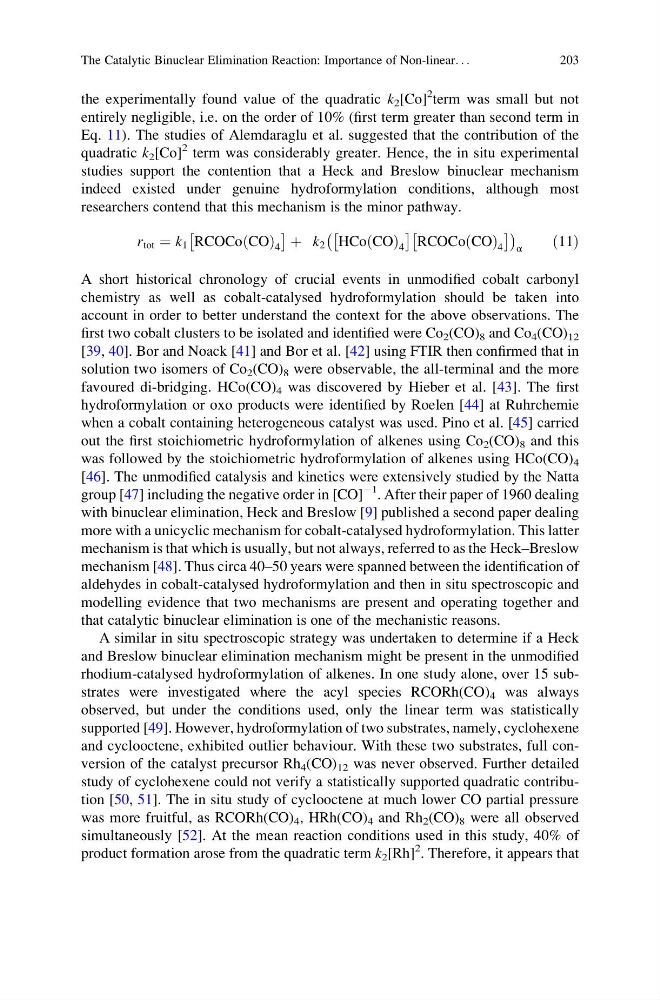
the experimentally found value of the quadratic k 2 [Co]
2 term was small but not
entirely negligible, i.e. on the order of 10% (first term greater than second term in
Eq. 11). The studies of Alemdaraglu et al. suggested that the contribution of the
quadratic k 2 [Co]
2 term was considerably greater. Hence, the in situ experimental
studies support the contention that a Heck and Breslow binuclear mechanism
indeed existed under genuine hydroformylation conditions, although most
researchers contend that this mechanism is the minor pathway.
r tot ¼ k 1 RCOCo CO
ð Þ 4
Â
à þ k 2 HCo CO
ð Þ 4
Â
Ã
RCOCo CO
ð Þ 4
Â
Ã
À
Á
α
ð11Þ
A short historical chronology of crucial events in unmodified cobalt carbonyl
chemistry as well as cobalt-catalysed hydroformylation should be taken into
account in order to better understand the context for the above observations. The
first two cobalt clusters to be isolated and identified were Co 2 (CO) 8 and Co 4 (CO) 12
[39, 40]. Bor and Noack [41] and Bor et al. [42] using FTIR then confirmed that in
solution two isomers of Co 2 (CO) 8 were observable, the all-terminal and the more
favoured di-bridging. HCo(CO) 4 was discovered by Hieber et al. [43]. The first
hydroformylation or oxo products were identified by Roelen [44] at Ruhrchemie
when a cobalt containing heterogeneous catalyst was used. Pino et al. [45] carried
out the first stoichiometric hydroformylation of alkenes using Co 2 (CO) 8 and this
was followed by the stoichiometric hydroformylation of alkenes using HCo(CO) 4
[46]. The unmodified catalysis and kinetics were extensively studied by the Natta
group [47] including the negative order in [CO]
À1 . After their paper of 1960 dealing
with binuclear elimination, Heck and Breslow [9] published a second paper dealing
more with a unicyclic mechanism for cobalt-catalysed hydroformylation. This latter
mechanism is that which is usually, but not always, referred to as the Heck–Breslow
mechanism [48]. Thus circa 40–50 years were spanned between the identification of
aldehydes in cobalt-catalysed hydroformylation and then in situ spectroscopic and
modelling evidence that two mechanisms are present and operating together and
that catalytic binuclear elimination is one of the mechanistic reasons.
A similar in situ spectroscopic strategy was undertaken to determine if a Heck
and Breslow binuclear elimination mechanism might be present in the unmodified
rhodium-catalysed hydroformylation of alkenes. In one study alone, over 15 substrates were investigated where the acyl species RCORh(CO) 4 was always
observed, but under the conditions used, only the linear term was statistically
supported [49]. However, hydroformylation of two substrates, namely, cyclohexene
and cyclooctene, exhibited outlier behaviour. With these two substrates, full conversion of the catalyst precursor Rh 4 (CO) 12 was never observed. Further detailed
study of cyclohexene could not verify a statistically supported quadratic contribution [50, 51]. The in situ study of cyclooctene at much lower CO partial pressure
was more fruitful, as RCORh(CO) 4 , HRh(CO) 4 and Rh 2 (CO) 8 were all observed
simultaneously [52]. At the mean reaction conditions used in this study, 40% of
product formation arose from the quadratic term k 2 [Rh]
2 . Therefore, it appears that
The Catalytic Binuclear Elimination Reaction: Importance of Non-linear. . .
203
2 term was small but not
entirely negligible, i.e. on the order of 10% (first term greater than second term in
Eq. 11). The studies of Alemdaraglu et al. suggested that the contribution of the
quadratic k 2 [Co]
2 term was considerably greater. Hence, the in situ experimental
studies support the contention that a Heck and Breslow binuclear mechanism
indeed existed under genuine hydroformylation conditions, although most
researchers contend that this mechanism is the minor pathway.
r tot ¼ k 1 RCOCo CO
ð Þ 4
Â
à þ k 2 HCo CO
ð Þ 4
Â
Ã
RCOCo CO
ð Þ 4
Â
Ã
À
Á
α
ð11Þ
A short historical chronology of crucial events in unmodified cobalt carbonyl
chemistry as well as cobalt-catalysed hydroformylation should be taken into
account in order to better understand the context for the above observations. The
first two cobalt clusters to be isolated and identified were Co 2 (CO) 8 and Co 4 (CO) 12
[39, 40]. Bor and Noack [41] and Bor et al. [42] using FTIR then confirmed that in
solution two isomers of Co 2 (CO) 8 were observable, the all-terminal and the more
favoured di-bridging. HCo(CO) 4 was discovered by Hieber et al. [43]. The first
hydroformylation or oxo products were identified by Roelen [44] at Ruhrchemie
when a cobalt containing heterogeneous catalyst was used. Pino et al. [45] carried
out the first stoichiometric hydroformylation of alkenes using Co 2 (CO) 8 and this
was followed by the stoichiometric hydroformylation of alkenes using HCo(CO) 4
[46]. The unmodified catalysis and kinetics were extensively studied by the Natta
group [47] including the negative order in [CO]
À1 . After their paper of 1960 dealing
with binuclear elimination, Heck and Breslow [9] published a second paper dealing
more with a unicyclic mechanism for cobalt-catalysed hydroformylation. This latter
mechanism is that which is usually, but not always, referred to as the Heck–Breslow
mechanism [48]. Thus circa 40–50 years were spanned between the identification of
aldehydes in cobalt-catalysed hydroformylation and then in situ spectroscopic and
modelling evidence that two mechanisms are present and operating together and
that catalytic binuclear elimination is one of the mechanistic reasons.
A similar in situ spectroscopic strategy was undertaken to determine if a Heck
and Breslow binuclear elimination mechanism might be present in the unmodified
rhodium-catalysed hydroformylation of alkenes. In one study alone, over 15 substrates were investigated where the acyl species RCORh(CO) 4 was always
observed, but under the conditions used, only the linear term was statistically
supported [49]. However, hydroformylation of two substrates, namely, cyclohexene
and cyclooctene, exhibited outlier behaviour. With these two substrates, full conversion of the catalyst precursor Rh 4 (CO) 12 was never observed. Further detailed
study of cyclohexene could not verify a statistically supported quadratic contribution [50, 51]. The in situ study of cyclooctene at much lower CO partial pressure
was more fruitful, as RCORh(CO) 4 , HRh(CO) 4 and Rh 2 (CO) 8 were all observed
simultaneously [52]. At the mean reaction conditions used in this study, 40% of
product formation arose from the quadratic term k 2 [Rh]
2 . Therefore, it appears that
The Catalytic Binuclear Elimination Reaction: Importance of Non-linear. . .
203