

a CBER mechanism is operating in the unmodified rhodium case, at least when
some special substrates are used at appropriate reaction conditions.
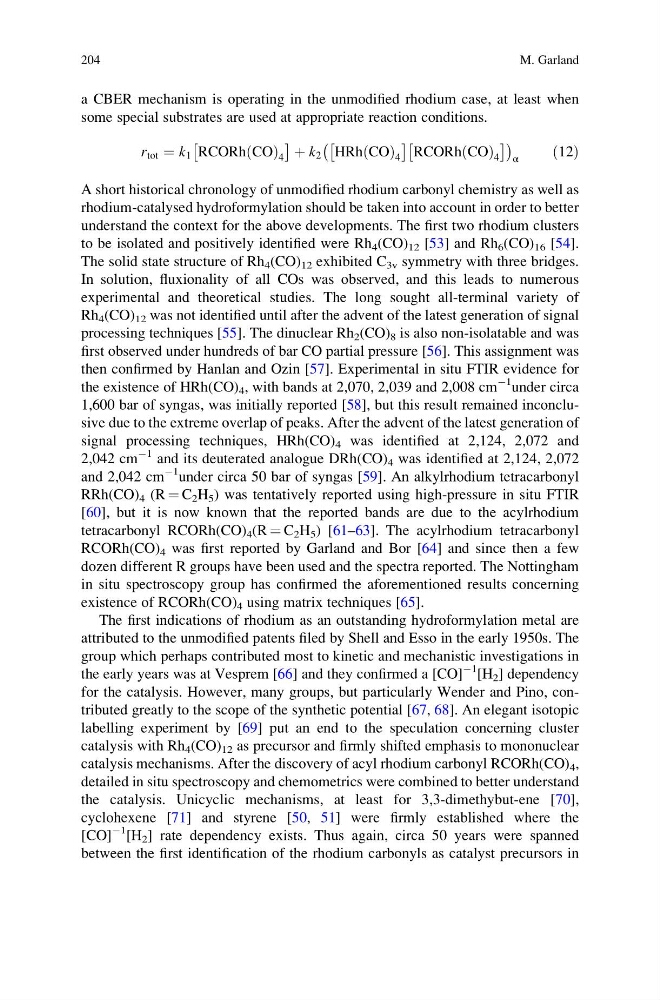
r tot ¼ k 1 RCORh CO
ð Þ 4
Â
à þ k 2 HRh CO
ð Þ 4
Â
Ã
RCORh CO
ð Þ 4
Â
Ã
À
Á
α
ð12Þ
A short historical chronology of unmodified rhodium carbonyl chemistry as well as
rhodium-catalysed hydroformylation should be taken into account in order to better
understand the context for the above developments. The first two rhodium clusters
to be isolated and positively identified were Rh 4 (CO) 12 [53] and Rh 6 (CO) 16 [54].
The solid state structure of Rh 4 (CO) 12 exhibited C 3v symmetry with three bridges.
In solution, fluxionality of all COs was observed, and this leads to numerous
experimental and theoretical studies. The long sought all-terminal variety of
Rh 4 (CO) 12 was not identified until after the advent of the latest generation of signal
processing techniques [55]. The dinuclear Rh 2 (CO) 8 is also non-isolatable and was
first observed under hundreds of bar CO partial pressure [56]. This assignment was
then confirmed by Hanlan and Ozin [57]. Experimental in situ FTIR evidence for
the existence of HRh(CO) 4 , with bands at 2,070, 2,039 and 2,008 cm
À1 under circa
1,600 bar of syngas, was initially reported [58], but this result remained inconclusive due to the extreme overlap of peaks. After the advent of the latest generation of
signal processing techniques, HRh(CO) 4 was identified at 2,124, 2,072 and
2,042 cm
À1 and its deuterated analogue DRh(CO) 4 was identified at 2,124, 2,072
and 2,042 cm
À1 under circa 50 bar of syngas [59]. An alkylrhodium tetracarbonyl
RRh(CO) 4 (R ¼ C 2 H 5 ) was tentatively reported using high-pressure in situ FTIR
[60], but it is now known that the reported bands are due to the acylrhodium
tetracarbonyl RCORh(CO) 4 (R ¼ C 2 H 5 ) [61–63]. The acylrhodium tetracarbonyl
RCORh(CO) 4 was first reported by Garland and Bor [64] and since then a few
dozen different R groups have been used and the spectra reported. The Nottingham
in situ spectroscopy group has confirmed the aforementioned results concerning
existence of RCORh(CO) 4 using matrix techniques [65].
The first indications of rhodium as an outstanding hydroformylation metal are
attributed to the unmodified patents filed by Shell and Esso in the early 1950s. The
group which perhaps contributed most to kinetic and mechanistic investigations in
the early years was at Vesprem [66] and they confirmed a [CO]
À1
[H 2 ] dependency
for the catalysis. However, many groups, but particularly Wender and Pino, contributed greatly to the scope of the synthetic potential [67, 68]. An elegant isotopic
labelling experiment by [69] put an end to the speculation concerning cluster
catalysis with Rh 4 (CO) 12 as precursor and firmly shifted emphasis to mononuclear
catalysis mechanisms. After the discovery of acyl rhodium carbonyl RCORh(CO) 4 ,
detailed in situ spectroscopy and chemometrics were combined to better understand
the catalysis. Unicyclic mechanisms, at least for 3,3-dimethybut-ene [70],
cyclohexene [71] and styrene [50, 51] were firmly established where the
[CO]
À1 [H 2 ] rate dependency exists. Thus again, circa 50 years were spanned
between the first identification of the rhodium carbonyls as catalyst precursors in
204
M. Garland
some special substrates are used at appropriate reaction conditions.
r tot ¼ k 1 RCORh CO
ð Þ 4
Â
à þ k 2 HRh CO
ð Þ 4
Â
Ã
RCORh CO
ð Þ 4
Â
Ã
À
Á
α
ð12Þ
A short historical chronology of unmodified rhodium carbonyl chemistry as well as
rhodium-catalysed hydroformylation should be taken into account in order to better
understand the context for the above developments. The first two rhodium clusters
to be isolated and positively identified were Rh 4 (CO) 12 [53] and Rh 6 (CO) 16 [54].
The solid state structure of Rh 4 (CO) 12 exhibited C 3v symmetry with three bridges.
In solution, fluxionality of all COs was observed, and this leads to numerous
experimental and theoretical studies. The long sought all-terminal variety of
Rh 4 (CO) 12 was not identified until after the advent of the latest generation of signal
processing techniques [55]. The dinuclear Rh 2 (CO) 8 is also non-isolatable and was
first observed under hundreds of bar CO partial pressure [56]. This assignment was
then confirmed by Hanlan and Ozin [57]. Experimental in situ FTIR evidence for
the existence of HRh(CO) 4 , with bands at 2,070, 2,039 and 2,008 cm
À1 under circa
1,600 bar of syngas, was initially reported [58], but this result remained inconclusive due to the extreme overlap of peaks. After the advent of the latest generation of
signal processing techniques, HRh(CO) 4 was identified at 2,124, 2,072 and
2,042 cm
À1 and its deuterated analogue DRh(CO) 4 was identified at 2,124, 2,072
and 2,042 cm
À1 under circa 50 bar of syngas [59]. An alkylrhodium tetracarbonyl
RRh(CO) 4 (R ¼ C 2 H 5 ) was tentatively reported using high-pressure in situ FTIR
[60], but it is now known that the reported bands are due to the acylrhodium
tetracarbonyl RCORh(CO) 4 (R ¼ C 2 H 5 ) [61–63]. The acylrhodium tetracarbonyl
RCORh(CO) 4 was first reported by Garland and Bor [64] and since then a few
dozen different R groups have been used and the spectra reported. The Nottingham
in situ spectroscopy group has confirmed the aforementioned results concerning
existence of RCORh(CO) 4 using matrix techniques [65].
The first indications of rhodium as an outstanding hydroformylation metal are
attributed to the unmodified patents filed by Shell and Esso in the early 1950s. The
group which perhaps contributed most to kinetic and mechanistic investigations in
the early years was at Vesprem [66] and they confirmed a [CO]
À1
[H 2 ] dependency
for the catalysis. However, many groups, but particularly Wender and Pino, contributed greatly to the scope of the synthetic potential [67, 68]. An elegant isotopic
labelling experiment by [69] put an end to the speculation concerning cluster
catalysis with Rh 4 (CO) 12 as precursor and firmly shifted emphasis to mononuclear
catalysis mechanisms. After the discovery of acyl rhodium carbonyl RCORh(CO) 4 ,
detailed in situ spectroscopy and chemometrics were combined to better understand
the catalysis. Unicyclic mechanisms, at least for 3,3-dimethybut-ene [70],
cyclohexene [71] and styrene [50, 51] were firmly established where the
[CO]
À1 [H 2 ] rate dependency exists. Thus again, circa 50 years were spanned
between the first identification of the rhodium carbonyls as catalyst precursors in
204
M. Garland