

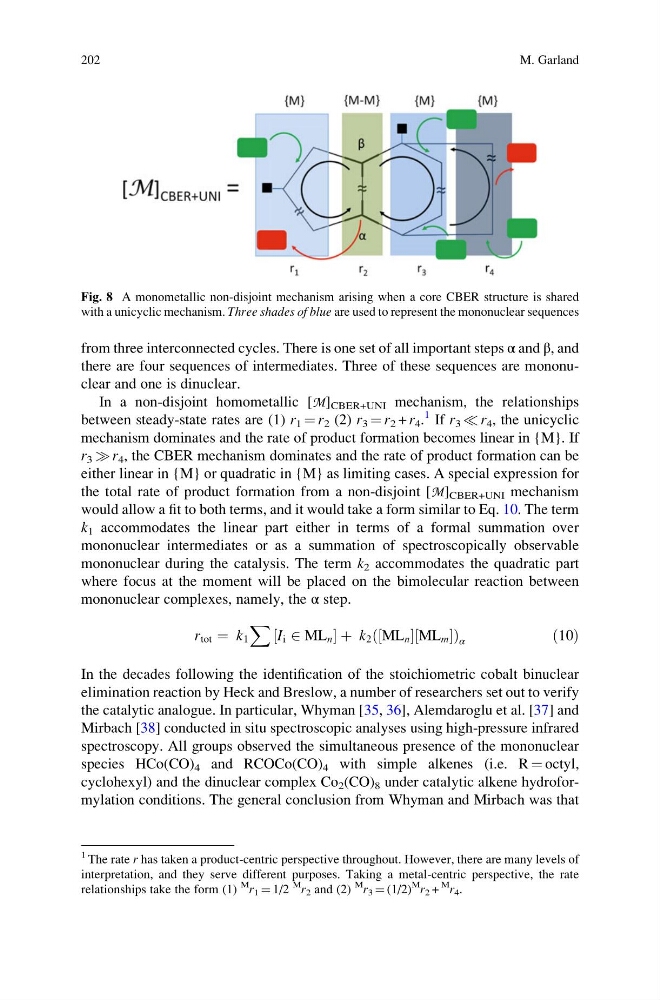
from three interconnected cycles. There is one set of all important steps α and β, and
there are four sequences of intermediates. Three of these sequences are mononuclear and one is dinuclear.
In a non-disjoint homometallic [M] CBER+UNI mechanism, the relationships
between steady-state rates are (1) r 1 ¼ r 2 (2) r 3 ¼ r 2 + r 4 .
1 If r 3 ( r 4 , the unicyclic
mechanism dominates and the rate of product formation becomes linear in {M}. If
r 3 ) r 4 , the CBER mechanism dominates and the rate of product formation can be
either linear in {M} or quadratic in {M} as limiting cases. A special expression for
the total rate of product formation from a non-disjoint [M] CBER+UNI mechanism
would allow a fit to both terms, and it would take a form similar to Eq. 10. The term
k 1 accommodates the linear part either in terms of a formal summation over
mononuclear intermediates or as a summation of spectroscopically observable
mononuclear during the catalysis. The term k 2 accommodates the quadratic part
where focus at the moment will be placed on the bimolecular reaction between
mononuclear complexes, namely, the α step.
r tot ¼ k 1
X
I i 2 ML n
½
þ k 2 ML n
½
ML m
½
ð
Þ α
ð10Þ
In the decades following the identification of the stoichiometric cobalt binuclear
elimination reaction by Heck and Breslow, a number of researchers set out to verify
the catalytic analogue. In particular, Whyman [35, 36], Alemdaroglu et al. [37] and
Mirbach [38] conducted in situ spectroscopic analyses using high-pressure infrared
spectroscopy. All groups observed the simultaneous presence of the mononuclear
species HCo(CO) 4 and RCOCo(CO) 4 with simple alkenes (i.e. R ¼ octyl,
cyclohexyl) and the dinuclear complex Co 2 (CO) 8 under catalytic alkene hydroformylation conditions. The general conclusion from Whyman and Mirbach was that
Fig. 8 A monometallic non-disjoint mechanism arising when a core CBER structure is shared
with a unicyclic mechanism. Three shades of blue are used to represent the mononuclear sequences
1 The rate r has taken a product-centric perspective throughout. However, there are many levels of
interpretation, and they serve different purposes. Taking a metal-centric perspective, the rate
relationships take the form (1)
M
r 1 ¼ 1/2
M
r 2 and (2)
M
r 3 ¼ (1/2)
M
r 2 +
M
r 4 .
202
M. Garland
there are four sequences of intermediates. Three of these sequences are mononuclear and one is dinuclear.
In a non-disjoint homometallic [M] CBER+UNI mechanism, the relationships
between steady-state rates are (1) r 1 ¼ r 2 (2) r 3 ¼ r 2 + r 4 .
1 If r 3 ( r 4 , the unicyclic
mechanism dominates and the rate of product formation becomes linear in {M}. If
r 3 ) r 4 , the CBER mechanism dominates and the rate of product formation can be
either linear in {M} or quadratic in {M} as limiting cases. A special expression for
the total rate of product formation from a non-disjoint [M] CBER+UNI mechanism
would allow a fit to both terms, and it would take a form similar to Eq. 10. The term
k 1 accommodates the linear part either in terms of a formal summation over
mononuclear intermediates or as a summation of spectroscopically observable
mononuclear during the catalysis. The term k 2 accommodates the quadratic part
where focus at the moment will be placed on the bimolecular reaction between
mononuclear complexes, namely, the α step.
r tot ¼ k 1
X
I i 2 ML n
½
þ k 2 ML n
½
ML m
½
ð
Þ α
ð10Þ
In the decades following the identification of the stoichiometric cobalt binuclear
elimination reaction by Heck and Breslow, a number of researchers set out to verify
the catalytic analogue. In particular, Whyman [35, 36], Alemdaroglu et al. [37] and
Mirbach [38] conducted in situ spectroscopic analyses using high-pressure infrared
spectroscopy. All groups observed the simultaneous presence of the mononuclear
species HCo(CO) 4 and RCOCo(CO) 4 with simple alkenes (i.e. R ¼ octyl,
cyclohexyl) and the dinuclear complex Co 2 (CO) 8 under catalytic alkene hydroformylation conditions. The general conclusion from Whyman and Mirbach was that
Fig. 8 A monometallic non-disjoint mechanism arising when a core CBER structure is shared
with a unicyclic mechanism. Three shades of blue are used to represent the mononuclear sequences
1 The rate r has taken a product-centric perspective throughout. However, there are many levels of
interpretation, and they serve different purposes. Taking a metal-centric perspective, the rate
relationships take the form (1)
M
r 1 ¼ 1/2
M
r 2 and (2)
M
r 3 ¼ (1/2)
M
r 2 +
M
r 4 .
202
M. Garland