

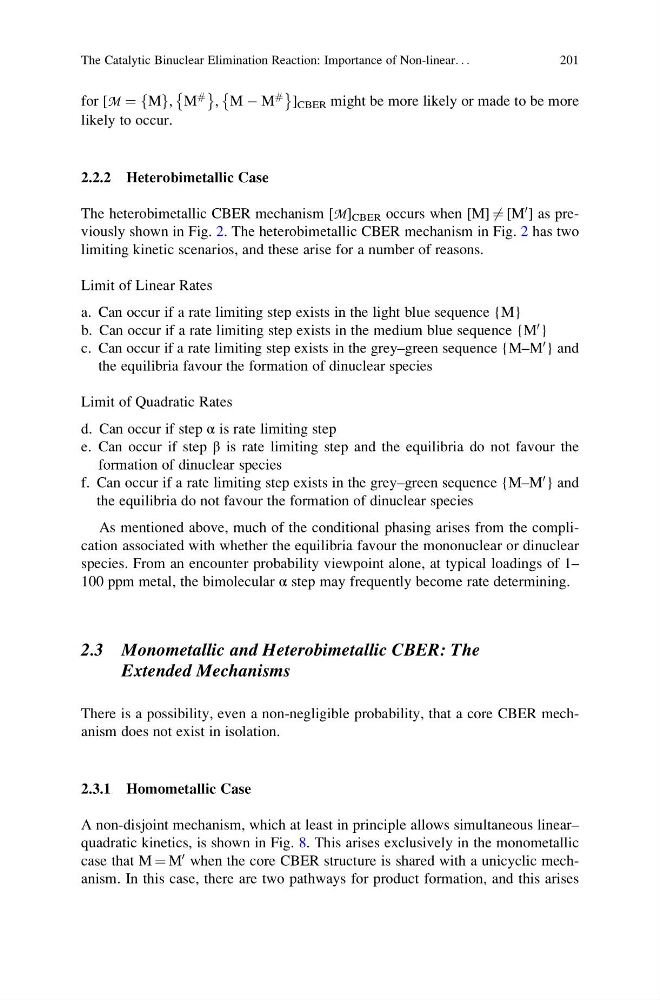
for [M ¼ M
f g, M
#
È
É
, M À M
#
È
É
] CBER might be more likely or made to be more
likely to occur.
2.2.2 Heterobimetallic Case
The heterobimetallic CBER mechanism [M] CBER occurs when [M] 6 ¼ [M
0 ] as previously shown in Fig. 2. The heterobimetallic CBER mechanism in Fig. 2 has two
limiting kinetic scenarios, and these arise for a number of reasons.
Limit of Linear Rates
a. Can occur if a rate limiting step exists in the light blue sequence {M}
b. Can occur if a rate limiting step exists in the medium blue sequence {M
0 }
c. Can occur if a rate limiting step exists in the grey–green sequence {M–M
0 } and
the equilibria favour the formation of dinuclear species
Limit of Quadratic Rates
d. Can occur if step α is rate limiting step
e. Can occur if step β is rate limiting step and the equilibria do not favour the
formation of dinuclear species
f. Can occur if a rate limiting step exists in the grey–green sequence {M–M
0 } and
the equilibria do not favour the formation of dinuclear species
As mentioned above, much of the conditional phasing arises from the complication associated with whether the equilibria favour the mononuclear or dinuclear
species. From an encounter probability viewpoint alone, at typical loadings of 1–
100 ppm metal, the bimolecular α step may frequently become rate determining.
2.3 Monometallic and Heterobimetallic CBER: The
Extended Mechanisms
There is a possibility, even a non-negligible probability, that a core CBER mechanism does not exist in isolation.
2.3.1 Homometallic Case
A non-disjoint mechanism, which at least in principle allows simultaneous linear–
quadratic kinetics, is shown in Fig. 8. This arises exclusively in the monometallic
case that M ¼ M
0 when the core CBER structure is shared with a unicyclic mechanism. In this case, there are two pathways for product formation, and this arises
The Catalytic Binuclear Elimination Reaction: Importance of Non-linear. . .
201
f g, M
#
È
É
, M À M
#
È
É
] CBER might be more likely or made to be more
likely to occur.
2.2.2 Heterobimetallic Case
The heterobimetallic CBER mechanism [M] CBER occurs when [M] 6 ¼ [M
0 ] as previously shown in Fig. 2. The heterobimetallic CBER mechanism in Fig. 2 has two
limiting kinetic scenarios, and these arise for a number of reasons.
Limit of Linear Rates
a. Can occur if a rate limiting step exists in the light blue sequence {M}
b. Can occur if a rate limiting step exists in the medium blue sequence {M
0 }
c. Can occur if a rate limiting step exists in the grey–green sequence {M–M
0 } and
the equilibria favour the formation of dinuclear species
Limit of Quadratic Rates
d. Can occur if step α is rate limiting step
e. Can occur if step β is rate limiting step and the equilibria do not favour the
formation of dinuclear species
f. Can occur if a rate limiting step exists in the grey–green sequence {M–M
0 } and
the equilibria do not favour the formation of dinuclear species
As mentioned above, much of the conditional phasing arises from the complication associated with whether the equilibria favour the mononuclear or dinuclear
species. From an encounter probability viewpoint alone, at typical loadings of 1–
100 ppm metal, the bimolecular α step may frequently become rate determining.
2.3 Monometallic and Heterobimetallic CBER: The
Extended Mechanisms
There is a possibility, even a non-negligible probability, that a core CBER mechanism does not exist in isolation.
2.3.1 Homometallic Case
A non-disjoint mechanism, which at least in principle allows simultaneous linear–
quadratic kinetics, is shown in Fig. 8. This arises exclusively in the monometallic
case that M ¼ M
0 when the core CBER structure is shared with a unicyclic mechanism. In this case, there are two pathways for product formation, and this arises
The Catalytic Binuclear Elimination Reaction: Importance of Non-linear. . .
201