

distinct products plus one rate expression for consumption of styrene. The takehome message is that all five rate expressions are linear in the concentrations of
intermediates. No intrinsic rate non-linearities exist in spite of the network complexity. The systematic evaluation of the number of independent synthetic routes in
an arbitrary network was clearly developed in a mathematical framework by
Horiuti [31].
In the context of unicyclic networks, one further case must be considered for
completeness and this is the case of disjoint unicyclic mechanisms. In this case,
assume that there are two precursors which independently and selectively effect
alkene hydroformylation and that the mechanisms do not share any common
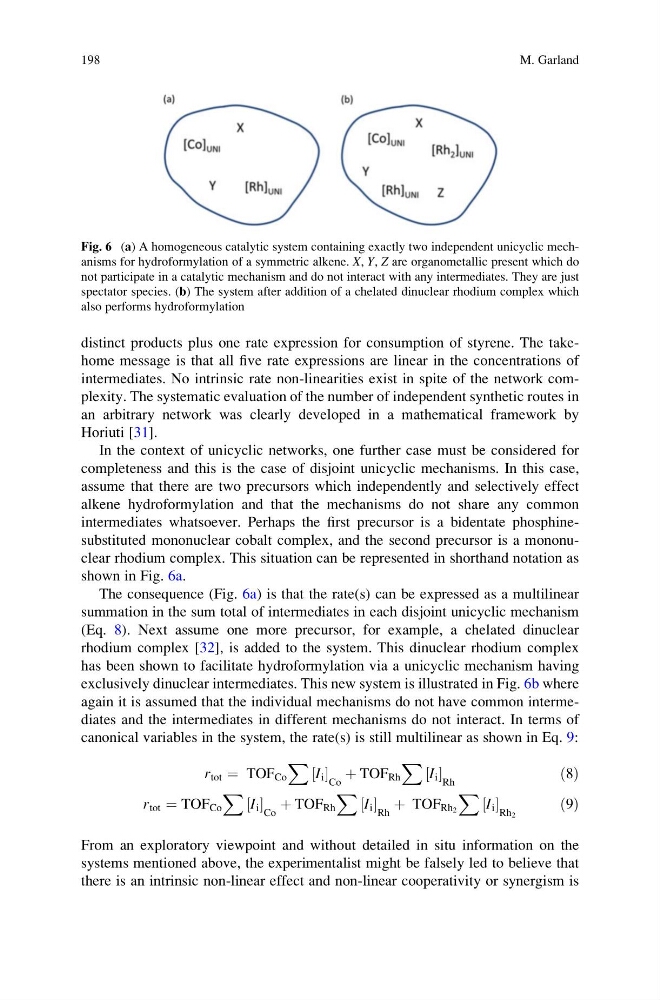
intermediates whatsoever. Perhaps the first precursor is a bidentate phosphinesubstituted mononuclear cobalt complex, and the second precursor is a mononuclear rhodium complex. This situation can be represented in shorthand notation as
shown in Fig. 6a.
The consequence (Fig. 6a) is that the rate(s) can be expressed as a multilinear
summation in the sum total of intermediates in each disjoint unicyclic mechanism
(Eq. 8). Next assume one more precursor, for example, a chelated dinuclear
rhodium complex [32], is added to the system. This dinuclear rhodium complex
has been shown to facilitate hydroformylation via a unicyclic mechanism having
exclusively dinuclear intermediates. This new system is illustrated in Fig. 6b where
again it is assumed that the individual mechanisms do not have common intermediates and the intermediates in different mechanisms do not interact. In terms of
canonical variables in the system, the rate(s) is still multilinear as shown in Eq. 9:
r tot ¼ TOF Co
X
I i
½
Co
þ TOF Rh
X
I i
½
Rh
ð8Þ
r tot ¼ TOF Co
X
I i
½
Co
þ TOF Rh
X
I i
½
Rh
þ TOF Rh 2
X
I i
½
Rh 2
ð9Þ
From an exploratory viewpoint and without detailed in situ information on the
systems mentioned above, the experimentalist might be falsely led to believe that
there is an intrinsic non-linear effect and non-linear cooperativity or synergism is
Fig. 6 (a) A homogeneous catalytic system containing exactly two independent unicyclic mechanisms for hydroformylation of a symmetric alkene. X, Y, Z are organometallic present which do
not participate in a catalytic mechanism and do not interact with any intermediates. They are just
spectator species. (b) The system after addition of a chelated dinuclear rhodium complex which
also performs hydroformylation
198
M. Garland
intermediates. No intrinsic rate non-linearities exist in spite of the network complexity. The systematic evaluation of the number of independent synthetic routes in
an arbitrary network was clearly developed in a mathematical framework by
Horiuti [31].
In the context of unicyclic networks, one further case must be considered for
completeness and this is the case of disjoint unicyclic mechanisms. In this case,
assume that there are two precursors which independently and selectively effect
alkene hydroformylation and that the mechanisms do not share any common
intermediates whatsoever. Perhaps the first precursor is a bidentate phosphinesubstituted mononuclear cobalt complex, and the second precursor is a mononuclear rhodium complex. This situation can be represented in shorthand notation as
shown in Fig. 6a.
The consequence (Fig. 6a) is that the rate(s) can be expressed as a multilinear
summation in the sum total of intermediates in each disjoint unicyclic mechanism
(Eq. 8). Next assume one more precursor, for example, a chelated dinuclear
rhodium complex [32], is added to the system. This dinuclear rhodium complex
has been shown to facilitate hydroformylation via a unicyclic mechanism having
exclusively dinuclear intermediates. This new system is illustrated in Fig. 6b where
again it is assumed that the individual mechanisms do not have common intermediates and the intermediates in different mechanisms do not interact. In terms of
canonical variables in the system, the rate(s) is still multilinear as shown in Eq. 9:
r tot ¼ TOF Co
X
I i
½
Co
þ TOF Rh
X
I i
½
Rh
ð8Þ
r tot ¼ TOF Co
X
I i
½
Co
þ TOF Rh
X
I i
½
Rh
þ TOF Rh 2
X
I i
½
Rh 2
ð9Þ
From an exploratory viewpoint and without detailed in situ information on the
systems mentioned above, the experimentalist might be falsely led to believe that
there is an intrinsic non-linear effect and non-linear cooperativity or synergism is
Fig. 6 (a) A homogeneous catalytic system containing exactly two independent unicyclic mechanisms for hydroformylation of a symmetric alkene. X, Y, Z are organometallic present which do
not participate in a catalytic mechanism and do not interact with any intermediates. They are just
spectator species. (b) The system after addition of a chelated dinuclear rhodium complex which
also performs hydroformylation
198
M. Garland