

occurring in the system. Indeed, without in situ spectroscopic information and
without proper mass balances, the experimentalist has just the nominal additions
of metal complexes on which to base conclusions and the nominal loading are not
the canonical variables for the system. The remainder of this chapter occasionally
emphasizes this very important observation concerning the ease by which misleading conclusions can be obtained when supporting in situ spectroscopic information
is not available.
2.2 Monometallic and Heterobimetallic CBER: The Core
Mechanisms
2.2.1 Monometallic Case
The monometallic CBER mechanism [M] CBER occurs when M ¼ M
0 and hence
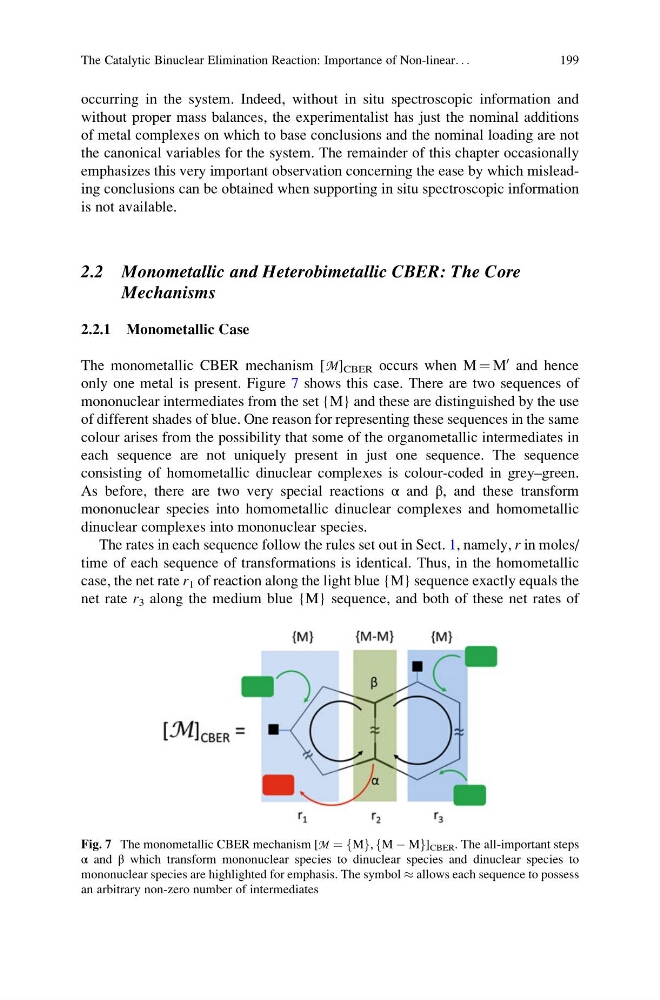
only one metal is present. Figure 7 shows this case. There are two sequences of
mononuclear intermediates from the set {M} and these are distinguished by the use
of different shades of blue. One reason for representing these sequences in the same
colour arises from the possibility that some of the organometallic intermediates in
each sequence are not uniquely present in just one sequence. The sequence
consisting of homometallic dinuclear complexes is colour-coded in grey–green.
As before, there are two very special reactions α and β, and these transform
mononuclear species into homometallic dinuclear complexes and homometallic
dinuclear complexes into mononuclear species.
The rates in each sequence follow the rules set out in Sect. 1, namely, r in moles/
time of each sequence of transformations is identical. Thus, in the homometallic
case, the net rate r 1 of reaction along the light blue {M} sequence exactly equals the
net rate r 3 along the medium blue {M} sequence, and both of these net rates of
Fig. 7 The monometallic CBER mechanism [M ¼ M
f g, M À M
f
g ] CBER . The all-important steps
α and β which transform mononuclear species to dinuclear species and dinuclear species to
mononuclear species are highlighted for emphasis. The symbol % allows each sequence to possess
an arbitrary non-zero number of intermediates
The Catalytic Binuclear Elimination Reaction: Importance of Non-linear. . .
199
without proper mass balances, the experimentalist has just the nominal additions
of metal complexes on which to base conclusions and the nominal loading are not
the canonical variables for the system. The remainder of this chapter occasionally
emphasizes this very important observation concerning the ease by which misleading conclusions can be obtained when supporting in situ spectroscopic information
is not available.
2.2 Monometallic and Heterobimetallic CBER: The Core
Mechanisms
2.2.1 Monometallic Case
The monometallic CBER mechanism [M] CBER occurs when M ¼ M
0 and hence
only one metal is present. Figure 7 shows this case. There are two sequences of
mononuclear intermediates from the set {M} and these are distinguished by the use
of different shades of blue. One reason for representing these sequences in the same
colour arises from the possibility that some of the organometallic intermediates in
each sequence are not uniquely present in just one sequence. The sequence
consisting of homometallic dinuclear complexes is colour-coded in grey–green.
As before, there are two very special reactions α and β, and these transform
mononuclear species into homometallic dinuclear complexes and homometallic
dinuclear complexes into mononuclear species.
The rates in each sequence follow the rules set out in Sect. 1, namely, r in moles/
time of each sequence of transformations is identical. Thus, in the homometallic
case, the net rate r 1 of reaction along the light blue {M} sequence exactly equals the
net rate r 3 along the medium blue {M} sequence, and both of these net rates of
Fig. 7 The monometallic CBER mechanism [M ¼ M
f g, M À M
f
g ] CBER . The all-important steps
α and β which transform mononuclear species to dinuclear species and dinuclear species to
mononuclear species are highlighted for emphasis. The symbol % allows each sequence to possess
an arbitrary non-zero number of intermediates
The Catalytic Binuclear Elimination Reaction: Importance of Non-linear. . .
199