

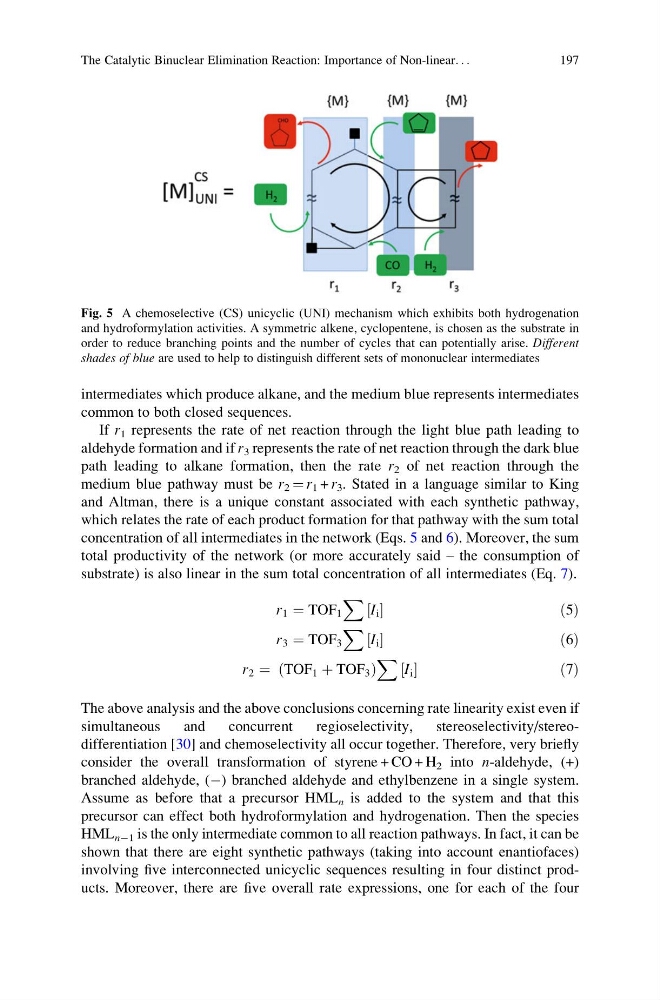
intermediates which produce alkane, and the medium blue represents intermediates
common to both closed sequences.
If r 1 represents the rate of net reaction through the light blue path leading to
aldehyde formation and if r 3 represents the rate of net reaction through the dark blue
path leading to alkane formation, then the rate r 2 of net reaction through the
medium blue pathway must be r 2 ¼ r 1 + r 3 . Stated in a language similar to King
and Altman, there is a unique constant associated with each synthetic pathway,
which relates the rate of each product formation for that pathway with the sum total
concentration of all intermediates in the network (Eqs. 5 and 6). Moreover, the sum
total productivity of the network (or more accurately said – the consumption of
substrate) is also linear in the sum total concentration of all intermediates (Eq. 7).
r 1 ¼ TOF 1
X
I i
½
ð5Þ
r 3 ¼ TOF 3
X
I i
½
ð6Þ
r 2 ¼ TOF 1 þ TOF 3
ð
Þ
X
I i
½
ð7Þ
The above analysis and the above conclusions concerning rate linearity exist even if
simultaneous
and
concurrent
regioselectivity,
stereoselectivity/stereodifferentiation [30] and chemoselectivity all occur together. Therefore, very briefly
consider the overall transformation of styrene + CO + H 2 into n-aldehyde, (+)
branched aldehyde, (À) branched aldehyde and ethylbenzene in a single system.
Assume as before that a precursor HML n is added to the system and that this
precursor can effect both hydroformylation and hydrogenation. Then the species
HML nÀ1 is the only intermediate common to all reaction pathways. In fact, it can be
shown that there are eight synthetic pathways (taking into account enantiofaces)
involving five interconnected unicyclic sequences resulting in four distinct products. Moreover, there are five overall rate expressions, one for each of the four
Fig. 5 A chemoselective (CS) unicyclic (UNI) mechanism which exhibits both hydrogenation
and hydroformylation activities. A symmetric alkene, cyclopentene, is chosen as the substrate in
order to reduce branching points and the number of cycles that can potentially arise. Different
shades of blue are used to help to distinguish different sets of mononuclear intermediates
The Catalytic Binuclear Elimination Reaction: Importance of Non-linear. . .
197
common to both closed sequences.
If r 1 represents the rate of net reaction through the light blue path leading to
aldehyde formation and if r 3 represents the rate of net reaction through the dark blue
path leading to alkane formation, then the rate r 2 of net reaction through the
medium blue pathway must be r 2 ¼ r 1 + r 3 . Stated in a language similar to King
and Altman, there is a unique constant associated with each synthetic pathway,
which relates the rate of each product formation for that pathway with the sum total
concentration of all intermediates in the network (Eqs. 5 and 6). Moreover, the sum
total productivity of the network (or more accurately said – the consumption of
substrate) is also linear in the sum total concentration of all intermediates (Eq. 7).
r 1 ¼ TOF 1
X
I i
½
ð5Þ
r 3 ¼ TOF 3
X
I i
½
ð6Þ
r 2 ¼ TOF 1 þ TOF 3
ð
Þ
X
I i
½
ð7Þ
The above analysis and the above conclusions concerning rate linearity exist even if
simultaneous
and
concurrent
regioselectivity,
stereoselectivity/stereodifferentiation [30] and chemoselectivity all occur together. Therefore, very briefly
consider the overall transformation of styrene + CO + H 2 into n-aldehyde, (+)
branched aldehyde, (À) branched aldehyde and ethylbenzene in a single system.
Assume as before that a precursor HML n is added to the system and that this
precursor can effect both hydroformylation and hydrogenation. Then the species
HML nÀ1 is the only intermediate common to all reaction pathways. In fact, it can be
shown that there are eight synthetic pathways (taking into account enantiofaces)
involving five interconnected unicyclic sequences resulting in four distinct products. Moreover, there are five overall rate expressions, one for each of the four
Fig. 5 A chemoselective (CS) unicyclic (UNI) mechanism which exhibits both hydrogenation
and hydroformylation activities. A symmetric alkene, cyclopentene, is chosen as the substrate in
order to reduce branching points and the number of cycles that can potentially arise. Different
shades of blue are used to help to distinguish different sets of mononuclear intermediates
The Catalytic Binuclear Elimination Reaction: Importance of Non-linear. . .
197