

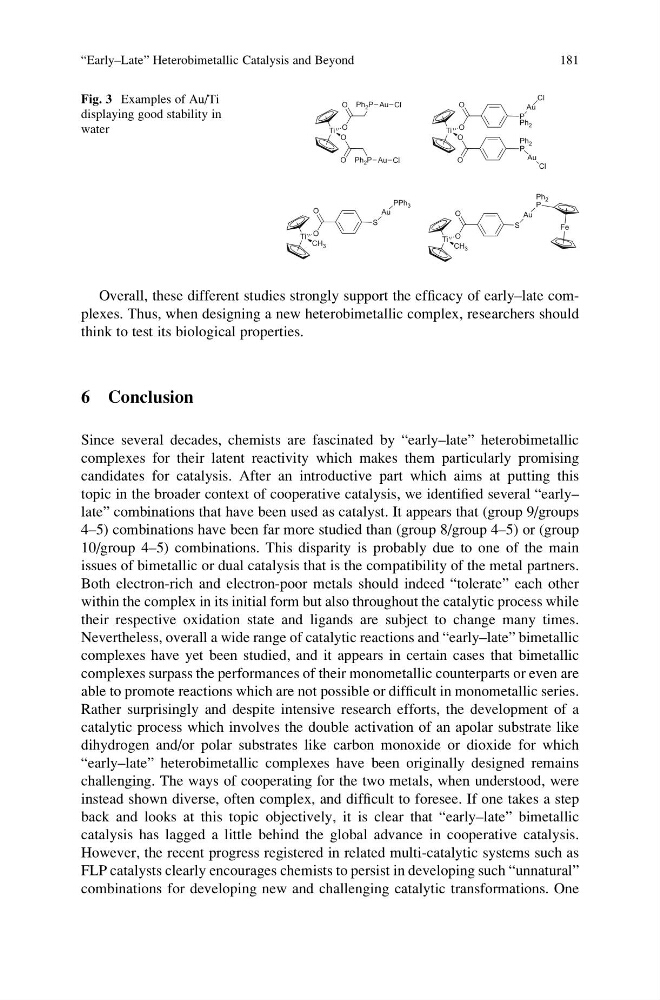
Overall, these different studies strongly support the efficacy of early–late complexes. Thus, when designing a new heterobimetallic complex, researchers should
think to test its biological properties.
6 Conclusion
Since several decades, chemists are fascinated by “early–late” heterobimetallic
complexes for their latent reactivity which makes them particularly promising
candidates for catalysis. After an introductive part which aims at putting this
topic in the broader context of cooperative catalysis, we identified several “early–
late” combinations that have been used as catalyst. It appears that (group 9/groups
4–5) combinations have been far more studied than (group 8/group 4–5) or (group
10/group 4–5) combinations. This disparity is probably due to one of the main
issues of bimetallic or dual catalysis that is the compatibility of the metal partners.
Both electron-rich and electron-poor metals should indeed “tolerate” each other
within the complex in its initial form but also throughout the catalytic process while
their respective oxidation state and ligands are subject to change many times.
Nevertheless, overall a wide range of catalytic reactions and “early–late” bimetallic
complexes have yet been studied, and it appears in certain cases that bimetallic
complexes surpass the performances of their monometallic counterparts or even are
able to promote reactions which are not possible or difficult in monometallic series.
Rather surprisingly and despite intensive research efforts, the development of a
catalytic process which involves the double activation of an apolar substrate like
dihydrogen and/or polar substrates like carbon monoxide or dioxide for which
“early–late” heterobimetallic complexes have been originally designed remains
challenging. The ways of cooperating for the two metals, when understood, were
instead shown diverse, often complex, and difficult to foresee. If one takes a step
back and looks at this topic objectively, it is clear that “early–late” bimetallic
catalysis has lagged a little behind the global advance in cooperative catalysis.
However, the recent progress registered in related multi-catalytic systems such as
FLP catalysts clearly encourages chemists to persist in developing such “unnatural”
combinations for developing new and challenging catalytic transformations. One
Ti O
O
O Ph 2 P
O Ph 2 P
Au Cl
Au Cl
Ti O
O
O
O
P
Ph 2
Ph 2
P
Au
Cl
Au
Cl
Ti O
CH 3
O
S
Au
PPh 3
Ti O
CH 3
O
S
Au
Ph 2
P
Fe
Fig. 3 Examples of Au/Ti
displaying good stability in
water
“Early–Late” Heterobimetallic Catalysis and Beyond
181
think to test its biological properties.
6 Conclusion
Since several decades, chemists are fascinated by “early–late” heterobimetallic
complexes for their latent reactivity which makes them particularly promising
candidates for catalysis. After an introductive part which aims at putting this
topic in the broader context of cooperative catalysis, we identified several “early–
late” combinations that have been used as catalyst. It appears that (group 9/groups
4–5) combinations have been far more studied than (group 8/group 4–5) or (group
10/group 4–5) combinations. This disparity is probably due to one of the main
issues of bimetallic or dual catalysis that is the compatibility of the metal partners.
Both electron-rich and electron-poor metals should indeed “tolerate” each other
within the complex in its initial form but also throughout the catalytic process while
their respective oxidation state and ligands are subject to change many times.
Nevertheless, overall a wide range of catalytic reactions and “early–late” bimetallic
complexes have yet been studied, and it appears in certain cases that bimetallic
complexes surpass the performances of their monometallic counterparts or even are
able to promote reactions which are not possible or difficult in monometallic series.
Rather surprisingly and despite intensive research efforts, the development of a
catalytic process which involves the double activation of an apolar substrate like
dihydrogen and/or polar substrates like carbon monoxide or dioxide for which
“early–late” heterobimetallic complexes have been originally designed remains
challenging. The ways of cooperating for the two metals, when understood, were
instead shown diverse, often complex, and difficult to foresee. If one takes a step
back and looks at this topic objectively, it is clear that “early–late” bimetallic
catalysis has lagged a little behind the global advance in cooperative catalysis.
However, the recent progress registered in related multi-catalytic systems such as
FLP catalysts clearly encourages chemists to persist in developing such “unnatural”
combinations for developing new and challenging catalytic transformations. One
Ti O
O
O Ph 2 P
O Ph 2 P
Au Cl
Au Cl
Ti O
O
O
O
P
Ph 2
Ph 2
P
Au
Cl
Au
Cl
Ti O
CH 3
O
S
Au
PPh 3
Ti O
CH 3
O
S
Au
Ph 2
P
Fe
Fig. 3 Examples of Au/Ti
displaying good stability in
water
“Early–Late” Heterobimetallic Catalysis and Beyond
181