

enzymes, proteins, RNA, etc. Consequently, combining two metals with different
targets should prevent resistance phenomena and may induce synergistic effects.
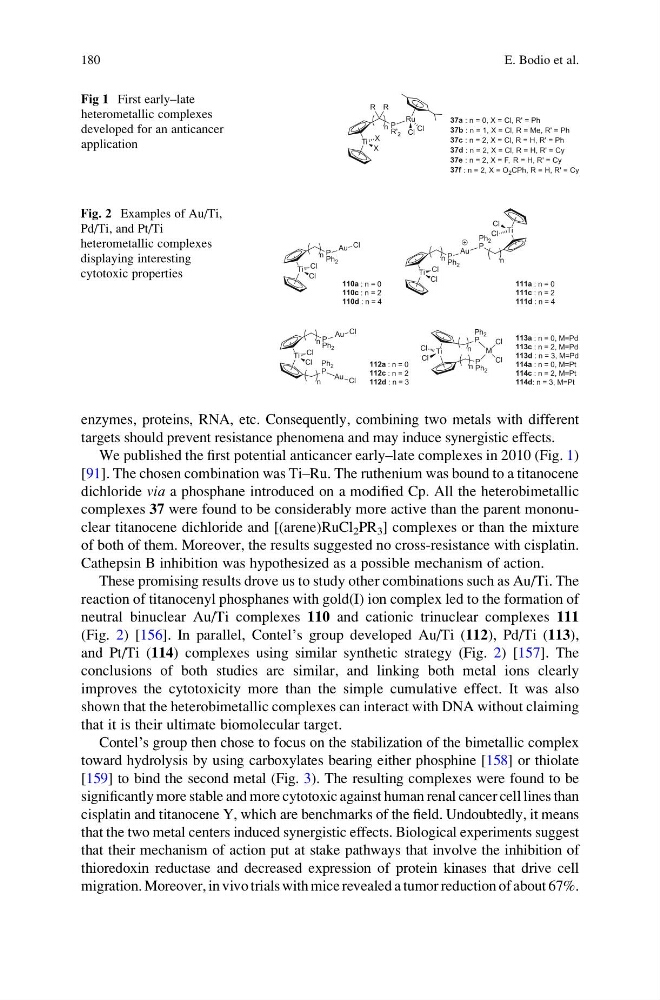
We published the first potential anticancer early–late complexes in 2010 (Fig. 1)
[91]. The chosen combination was Ti–Ru. The ruthenium was bound to a titanocene
dichloride via a phosphane introduced on a modified Cp. All the heterobimetallic
complexes 37 were found to be considerably more active than the parent mononuclear titanocene dichloride and [(arene)RuCl 2 PR 3 ] complexes or than the mixture
of both of them. Moreover, the results suggested no cross-resistance with cisplatin.
Cathepsin B inhibition was hypothesized as a possible mechanism of action.
These promising results drove us to study other combinations such as Au/Ti. The
reaction of titanocenyl phosphanes with gold(I) ion complex led to the formation of
neutral binuclear Au/Ti complexes 110 and cationic trinuclear complexes 111
(Fig. 2) [156]. In parallel, Contel’s group developed Au/Ti (112), Pd/Ti (113),
and Pt/Ti (114) complexes using similar synthetic strategy (Fig. 2) [157]. The
conclusions of both studies are similar, and linking both metal ions clearly
improves the cytotoxicity more than the simple cumulative effect. It was also
shown that the heterobimetallic complexes can interact with DNA without claiming
that it is their ultimate biomolecular target.
Contel’s group then chose to focus on the stabilization of the bimetallic complex
toward hydrolysis by using carboxylates bearing either phosphine [158] or thiolate
[159] to bind the second metal (Fig. 3). The resulting complexes were found to be
significantly more stable and more cytotoxic against human renal cancer cell lines than
cisplatin and titanocene Y, which are benchmarks of the field. Undoubtedly, it means
that the two metal centers induced synergistic effects. Biological experiments suggest
that their mechanism of action put at stake pathways that involve the inhibition of
thioredoxin reductase and decreased expression of protein kinases that drive cell
migration. Moreover, in vivo trials with mice revealed a tumor reduction of about 67%.
Ti X
X
P
R' 2
R
R
n
Ru
Cl
Cl
37a : n = 0, X = Cl, R' = Ph
37b : n = 1, X = Cl, R = Me, R' = Ph
37c : n = 2, X = Cl, R = H, R' = Ph
37d : n = 2, X = Cl, R = H, R' = Cy
37e : n = 2, X = F, R = H, R' = Cy
37f : n = 2, X = O 2 CPh, R = H, R' = Cy
Fig 1 First early–late
heterometallic complexes
developed for an anticancer
application
Ti Cl
Cl
P
Ph 2
n
Au
111a : n = 0
111c : n = 2
111d : n = 4
Ti
Cl
Cl
Ph 2
P
n
Ti Cl
Cl
P
Ph 2
n
Au Cl
110a : n = 0
110c : n = 2
110d : n = 4
Ti Cl
Cl
P
Ph 2
n
Au Cl
112a : n = 0
112c : n = 2
112d : n = 3
Ph 2
P
Au Cl
Ti
Cl
Cl
n
n
Ph 2
P
P
Ph 2
M
Cl
Cl
n
113a : n = 0, M=Pd
113c : n = 2, M=Pd
113d : n = 3, M=Pd
114a : n = 0, M=Pt
114c : n = 2, M=Pt
114d: n = 3, M=Pt
Fig. 2 Examples of Au/Ti,
Pd/Ti, and Pt/Ti
heterometallic complexes
displaying interesting
cytotoxic properties
180
E. Bodio et al.
targets should prevent resistance phenomena and may induce synergistic effects.
We published the first potential anticancer early–late complexes in 2010 (Fig. 1)
[91]. The chosen combination was Ti–Ru. The ruthenium was bound to a titanocene
dichloride via a phosphane introduced on a modified Cp. All the heterobimetallic
complexes 37 were found to be considerably more active than the parent mononuclear titanocene dichloride and [(arene)RuCl 2 PR 3 ] complexes or than the mixture
of both of them. Moreover, the results suggested no cross-resistance with cisplatin.
Cathepsin B inhibition was hypothesized as a possible mechanism of action.
These promising results drove us to study other combinations such as Au/Ti. The
reaction of titanocenyl phosphanes with gold(I) ion complex led to the formation of
neutral binuclear Au/Ti complexes 110 and cationic trinuclear complexes 111
(Fig. 2) [156]. In parallel, Contel’s group developed Au/Ti (112), Pd/Ti (113),
and Pt/Ti (114) complexes using similar synthetic strategy (Fig. 2) [157]. The
conclusions of both studies are similar, and linking both metal ions clearly
improves the cytotoxicity more than the simple cumulative effect. It was also
shown that the heterobimetallic complexes can interact with DNA without claiming
that it is their ultimate biomolecular target.
Contel’s group then chose to focus on the stabilization of the bimetallic complex
toward hydrolysis by using carboxylates bearing either phosphine [158] or thiolate
[159] to bind the second metal (Fig. 3). The resulting complexes were found to be
significantly more stable and more cytotoxic against human renal cancer cell lines than
cisplatin and titanocene Y, which are benchmarks of the field. Undoubtedly, it means
that the two metal centers induced synergistic effects. Biological experiments suggest
that their mechanism of action put at stake pathways that involve the inhibition of
thioredoxin reductase and decreased expression of protein kinases that drive cell
migration. Moreover, in vivo trials with mice revealed a tumor reduction of about 67%.
Ti X
X
P
R' 2
R
R
n
Ru
Cl
Cl
37a : n = 0, X = Cl, R' = Ph
37b : n = 1, X = Cl, R = Me, R' = Ph
37c : n = 2, X = Cl, R = H, R' = Ph
37d : n = 2, X = Cl, R = H, R' = Cy
37e : n = 2, X = F, R = H, R' = Cy
37f : n = 2, X = O 2 CPh, R = H, R' = Cy
Fig 1 First early–late
heterometallic complexes
developed for an anticancer
application
Ti Cl
Cl
P
Ph 2
n
Au
111a : n = 0
111c : n = 2
111d : n = 4
Ti
Cl
Cl
Ph 2
P
n
Ti Cl
Cl
P
Ph 2
n
Au Cl
110a : n = 0
110c : n = 2
110d : n = 4
Ti Cl
Cl
P
Ph 2
n
Au Cl
112a : n = 0
112c : n = 2
112d : n = 3
Ph 2
P
Au Cl
Ti
Cl
Cl
n
n
Ph 2
P
P
Ph 2
M
Cl
Cl
n
113a : n = 0, M=Pd
113c : n = 2, M=Pd
113d : n = 3, M=Pd
114a : n = 0, M=Pt
114c : n = 2, M=Pt
114d: n = 3, M=Pt
Fig. 2 Examples of Au/Ti,
Pd/Ti, and Pt/Ti
heterometallic complexes
displaying interesting
cytotoxic properties
180
E. Bodio et al.