

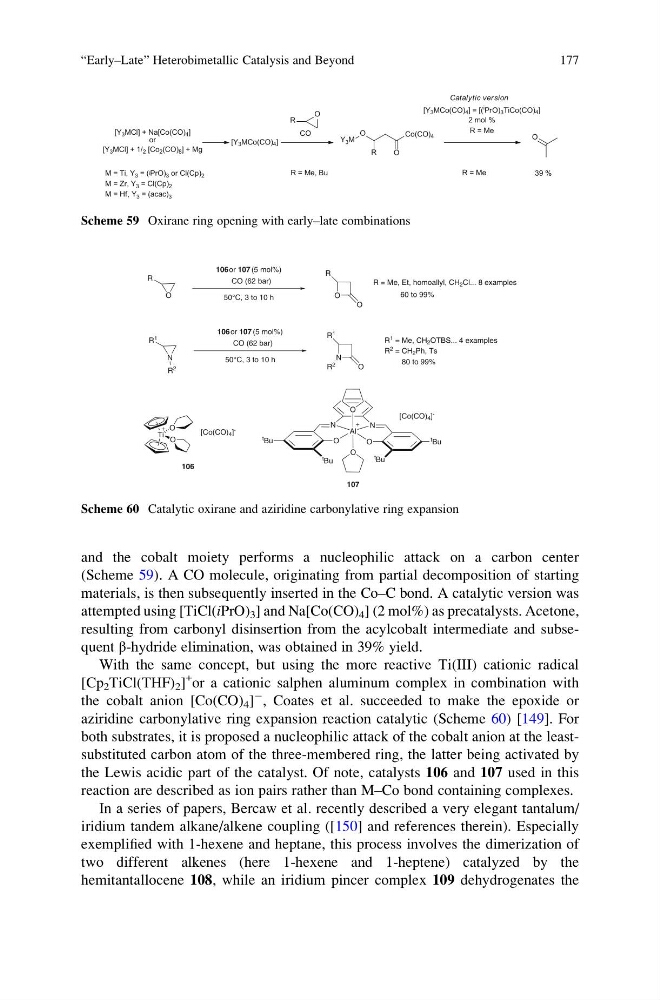
and the cobalt moiety performs a nucleophilic attack on a carbon center
(Scheme 59). A CO molecule, originating from partial decomposition of starting
materials, is then subsequently inserted in the Co–C bond. A catalytic version was
attempted using [TiCl(iPrO) 3 ] and Na[Co(CO) 4 ] (2 mol%) as precatalysts. Acetone,
resulting from carbonyl disinsertion from the acylcobalt intermediate and subsequent β-hydride elimination, was obtained in 39% yield.
With the same concept, but using the more reactive Ti(III) cationic radical
[Cp 2 TiCl(THF) 2 ]
+
or a cationic salphen aluminum complex in combination with
the cobalt anion [Co(CO) 4 ]
À , Coates et al. succeeded to make the epoxide or
aziridine carbonylative ring expansion reaction catalytic (Scheme 60) [149]. For
both substrates, it is proposed a nucleophilic attack of the cobalt anion at the leastsubstituted carbon atom of the three-membered ring, the latter being activated by
the Lewis acidic part of the catalyst. Of note, catalysts 106 and 107 used in this
reaction are described as ion pairs rather than M–Co bond containing complexes.
In a series of papers, Bercaw et al. recently described a very elegant tantalum/
iridium tandem alkane/alkene coupling ([150] and references therein). Especially
exemplified with 1-hexene and heptane, this process involves the dimerization of
two different alkenes (here 1-hexene and 1-heptene) catalyzed by the
hemitantallocene 108, while an iridium pincer complex 109 dehydrogenates the
M = Ti, Y 3 = (iPrO) 3 or Cl(Cp) 2
M = Zr, Y 3 = Cl(Cp) 2
M = Hf, Y 3 = (acac) 3
[Y 3 MCl] + Na[Co(CO)4]
or
[Y 3 MCl] + 1/ 2 [Co 2 (CO) 8 ] + Mg
[Y3MCo(CO)4]
O
R
CO
Y 3 M
O
R
Co(CO)4
O
R = Me, Bu
Catalytic ver sion
[Y3MCo(CO)4] = [( i PrO)3TiCo(CO)4]
2 mol %
R = Me
O
39 %
R = Me
Scheme 59 Oxirane ring opening with early–late combinations
Ti
O
O
106
[Co(CO)4] -
N
N
t Bu
t Bu
t Bu
t Bu
Al
O
O
O
O
[Co(CO)4] -
107
O
R
106 or 107 (5 mol%)
CO (62 bar)
50°C, 3 to 10 h
O
R
O
R = Me, Et, homoallyl, CH2Cl... 8 examples
60 to 99%
N
R 1
106 or 107 (5 mol%)
CO (62 bar)
50°C, 3 to 10 h
N
R 1
O
R 1 = Me, CH2OTBS... 4 examples
R 2 = CH2Ph, Ts
80 to 99%
R 2
R 2
Scheme 60 Catalytic oxirane and aziridine carbonylative ring expansion
“Early–Late” Heterobimetallic Catalysis and Beyond
177
(Scheme 59). A CO molecule, originating from partial decomposition of starting
materials, is then subsequently inserted in the Co–C bond. A catalytic version was
attempted using [TiCl(iPrO) 3 ] and Na[Co(CO) 4 ] (2 mol%) as precatalysts. Acetone,
resulting from carbonyl disinsertion from the acylcobalt intermediate and subsequent β-hydride elimination, was obtained in 39% yield.
With the same concept, but using the more reactive Ti(III) cationic radical
[Cp 2 TiCl(THF) 2 ]
+
or a cationic salphen aluminum complex in combination with
the cobalt anion [Co(CO) 4 ]
À , Coates et al. succeeded to make the epoxide or
aziridine carbonylative ring expansion reaction catalytic (Scheme 60) [149]. For
both substrates, it is proposed a nucleophilic attack of the cobalt anion at the leastsubstituted carbon atom of the three-membered ring, the latter being activated by
the Lewis acidic part of the catalyst. Of note, catalysts 106 and 107 used in this
reaction are described as ion pairs rather than M–Co bond containing complexes.
In a series of papers, Bercaw et al. recently described a very elegant tantalum/
iridium tandem alkane/alkene coupling ([150] and references therein). Especially
exemplified with 1-hexene and heptane, this process involves the dimerization of
two different alkenes (here 1-hexene and 1-heptene) catalyzed by the
hemitantallocene 108, while an iridium pincer complex 109 dehydrogenates the
M = Ti, Y 3 = (iPrO) 3 or Cl(Cp) 2
M = Zr, Y 3 = Cl(Cp) 2
M = Hf, Y 3 = (acac) 3
[Y 3 MCl] + Na[Co(CO)4]
or
[Y 3 MCl] + 1/ 2 [Co 2 (CO) 8 ] + Mg
[Y3MCo(CO)4]
O
R
CO
Y 3 M
O
R
Co(CO)4
O
R = Me, Bu
Catalytic ver sion
[Y3MCo(CO)4] = [( i PrO)3TiCo(CO)4]
2 mol %
R = Me
O
39 %
R = Me
Scheme 59 Oxirane ring opening with early–late combinations
Ti
O
O
106
[Co(CO)4] -
N
N
t Bu
t Bu
t Bu
t Bu
Al
O
O
O
O
[Co(CO)4] -
107
O
R
106 or 107 (5 mol%)
CO (62 bar)
50°C, 3 to 10 h
O
R
O
R = Me, Et, homoallyl, CH2Cl... 8 examples
60 to 99%
N
R 1
106 or 107 (5 mol%)
CO (62 bar)
50°C, 3 to 10 h
N
R 1
O
R 1 = Me, CH2OTBS... 4 examples
R 2 = CH2Ph, Ts
80 to 99%
R 2
R 2
Scheme 60 Catalytic oxirane and aziridine carbonylative ring expansion
“Early–Late” Heterobimetallic Catalysis and Beyond
177