

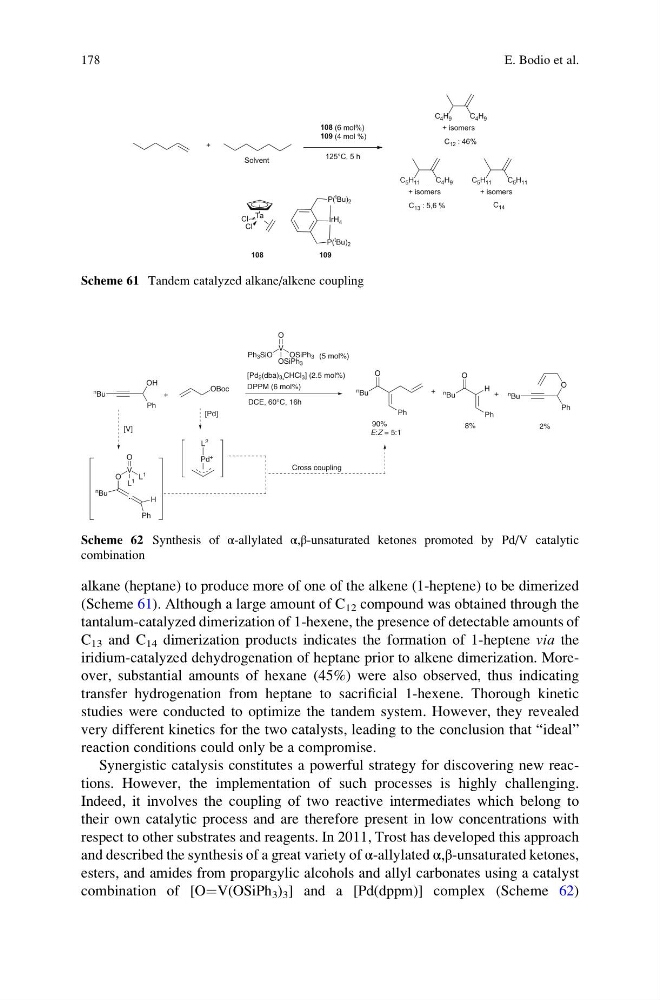
alkane (heptane) to produce more of one of the alkene (1-heptene) to be dimerized
(Scheme 61). Although a large amount of C 12 compound was obtained through the
tantalum-catalyzed dimerization of 1-hexene, the presence of detectable amounts of
C 13 and C 14 dimerization products indicates the formation of 1-heptene via the
iridium-catalyzed dehydrogenation of heptane prior to alkene dimerization. Moreover, substantial amounts of hexane (45%) were also observed, thus indicating
transfer hydrogenation from heptane to sacrificial 1-hexene. Thorough kinetic
studies were conducted to optimize the tandem system. However, they revealed
very different kinetics for the two catalysts, leading to the conclusion that “ideal”
reaction conditions could only be a compromise.
Synergistic catalysis constitutes a powerful strategy for discovering new reactions. However, the implementation of such processes is highly challenging.
Indeed, it involves the coupling of two reactive intermediates which belong to
their own catalytic process and are therefore present in low concentrations with
respect to other substrates and reagents. In 2011, Trost has developed this approach
and described the synthesis of a great variety of α-allylated α,β-unsaturated ketones,
esters, and amides from propargylic alcohols and allyl carbonates using a catalyst
combination of [O¼V(OSiPh 3 ) 3 ] and a [Pd(dppm)] complex (Scheme 62)
n
Bu
Ph
OH
+
OBoc
O
V
Ph3SiO
OSiPh3
OSiPh3
[Pd2(dba)3 . CHCl3] (2.5 mol%)
DPPM (6 mol%)
DCE, 60°C, 16h
n
Bu
Ph
O
90%
E:Z = 5:1
(5 mol%)
.
Ph
H
n Bu
O
V
L 1 L 1
O
Pd +
L 2
Cross coupling
[V]
[Pd]
+ n Bu
Ph
O
H
n Bu
Ph
O
+
8%
2%
Scheme 62 Synthesis of α-allylated α,β-unsaturated ketones promoted by Pd/V catalytic
combination
+
Solvent
C 5 H 11
C 4 H 9
+ isomers
C 5 H 11
C 5 H 11
+ isomers
C 13 : 5,6 %
C 14
108 (6 mol%)
109 (4 mol %)
125°C, 5 h
Ta
Cl
Cl
108
IrH 4
P( t Bu)2
P( t Bu)2
109
C 4 H 9
C 4 H 9
+ isomers
C 12 : 46%
Scheme 61 Tandem catalyzed alkane/alkene coupling
178
E. Bodio et al.
(Scheme 61). Although a large amount of C 12 compound was obtained through the
tantalum-catalyzed dimerization of 1-hexene, the presence of detectable amounts of
C 13 and C 14 dimerization products indicates the formation of 1-heptene via the
iridium-catalyzed dehydrogenation of heptane prior to alkene dimerization. Moreover, substantial amounts of hexane (45%) were also observed, thus indicating
transfer hydrogenation from heptane to sacrificial 1-hexene. Thorough kinetic
studies were conducted to optimize the tandem system. However, they revealed
very different kinetics for the two catalysts, leading to the conclusion that “ideal”
reaction conditions could only be a compromise.
Synergistic catalysis constitutes a powerful strategy for discovering new reactions. However, the implementation of such processes is highly challenging.
Indeed, it involves the coupling of two reactive intermediates which belong to
their own catalytic process and are therefore present in low concentrations with
respect to other substrates and reagents. In 2011, Trost has developed this approach
and described the synthesis of a great variety of α-allylated α,β-unsaturated ketones,
esters, and amides from propargylic alcohols and allyl carbonates using a catalyst
combination of [O¼V(OSiPh 3 ) 3 ] and a [Pd(dppm)] complex (Scheme 62)
n
Bu
Ph
OH
+
OBoc
O
V
Ph3SiO
OSiPh3
OSiPh3
[Pd2(dba)3 . CHCl3] (2.5 mol%)
DPPM (6 mol%)
DCE, 60°C, 16h
n
Bu
Ph
O
90%
E:Z = 5:1
(5 mol%)
.
Ph
H
n Bu
O
V
L 1 L 1
O
Pd +
L 2
Cross coupling
[V]
[Pd]
+ n Bu
Ph
O
H
n Bu
Ph
O
+
8%
2%
Scheme 62 Synthesis of α-allylated α,β-unsaturated ketones promoted by Pd/V catalytic
combination
+
Solvent
C 5 H 11
C 4 H 9
+ isomers
C 5 H 11
C 5 H 11
+ isomers
C 13 : 5,6 %
C 14
108 (6 mol%)
109 (4 mol %)
125°C, 5 h
Ta
Cl
Cl
108
IrH 4
P( t Bu)2
P( t Bu)2
109
C 4 H 9
C 4 H 9
+ isomers
C 12 : 46%
Scheme 61 Tandem catalyzed alkane/alkene coupling
178
E. Bodio et al.