

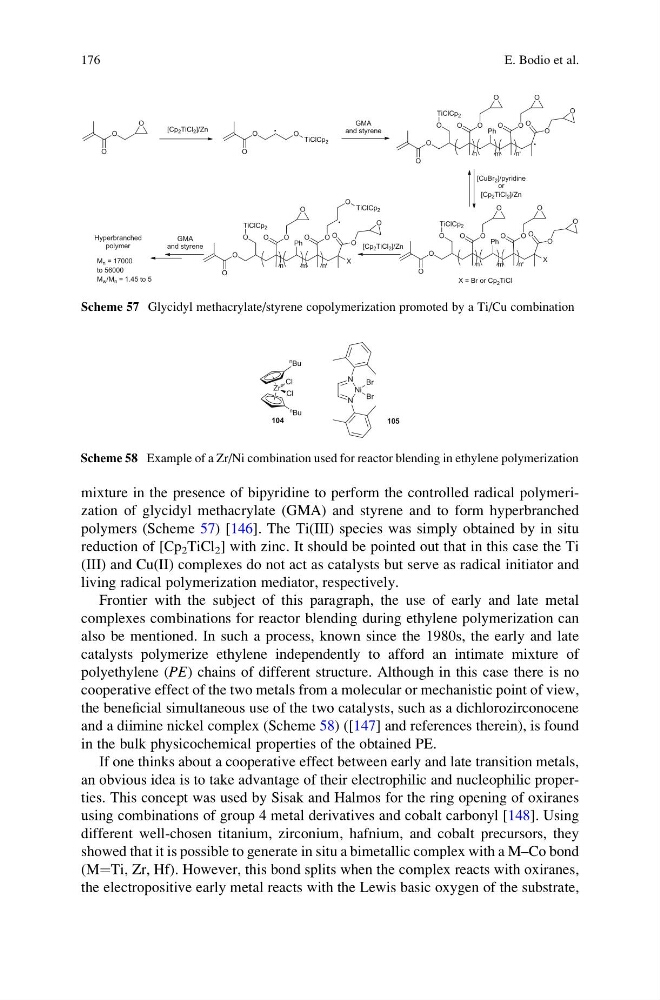
mixture in the presence of bipyridine to perform the controlled radical polymerization of glycidyl methacrylate (GMA) and styrene and to form hyperbranched
polymers (Scheme 57) [146]. The Ti(III) species was simply obtained by in situ
reduction of [Cp 2 TiCl 2 ] with zinc. It should be pointed out that in this case the Ti
(III) and Cu(II) complexes do not act as catalysts but serve as radical initiator and
living radical polymerization mediator, respectively.
Frontier with the subject of this paragraph, the use of early and late metal
complexes combinations for reactor blending during ethylene polymerization can
also be mentioned. In such a process, known since the 1980s, the early and late
catalysts polymerize ethylene independently to afford an intimate mixture of
polyethylene (PE) chains of different structure. Although in this case there is no
cooperative effect of the two metals from a molecular or mechanistic point of view,
the beneficial simultaneous use of the two catalysts, such as a dichlorozirconocene
and a diimine nickel complex (Scheme 58) ([147] and references therein), is found
in the bulk physicochemical properties of the obtained PE.
If one thinks about a cooperative effect between early and late transition metals,
an obvious idea is to take advantage of their electrophilic and nucleophilic properties. This concept was used by Sisak and Halmos for the ring opening of oxiranes
using combinations of group 4 metal derivatives and cobalt carbonyl [148]. Using
different well-chosen titanium, zirconium, hafnium, and cobalt precursors, they
showed that it is possible to generate in situ a bimetallic complex with a M–Co bond
(M¼Ti, Zr, Hf). However, this bond splits when the complex reacts with oxiranes,
the electropositive early metal reacts with the Lewis basic oxygen of the substrate,
O
O
O
[Cp 2 TiCl 2 ]/Zn
O
O
O
TiClCp 2
GMA
and styrene
O
O
O
TiClCp 2
O
O
O
Ph
n
m
[CuBr 2 ]/pyridine
or
[Cp 2 TiCl 2 ]/Zn
[Cp 2 TiCl 2 ]/Zn
GMA
and styrene
Hyperbranched
polymer
Mn = 17000
to 56000
M w /M n = 1.45 to 5
O
O
O
n'
O
O
O
O
O
O
TiClCp 2
O
O
O
Ph
n
m
O
O
O
n'
O
O
O
X
O
O
O
TiClCp 2
O
O
O
Ph
n
m
O
O
n'
O
O
O
X
O
TiClCp 2
X = Br or Cp 2 TiCl
Scheme 57 Glycidyl methacrylate/styrene copolymerization promoted by a Ti/Cu combination
Zr
Cl
Cl
104
n Bu
n Bu
N
Ni
N
Br
Br
105
Scheme 58 Example of a Zr/Ni combination used for reactor blending in ethylene polymerization
176
E. Bodio et al.
polymers (Scheme 57) [146]. The Ti(III) species was simply obtained by in situ
reduction of [Cp 2 TiCl 2 ] with zinc. It should be pointed out that in this case the Ti
(III) and Cu(II) complexes do not act as catalysts but serve as radical initiator and
living radical polymerization mediator, respectively.
Frontier with the subject of this paragraph, the use of early and late metal
complexes combinations for reactor blending during ethylene polymerization can
also be mentioned. In such a process, known since the 1980s, the early and late
catalysts polymerize ethylene independently to afford an intimate mixture of
polyethylene (PE) chains of different structure. Although in this case there is no
cooperative effect of the two metals from a molecular or mechanistic point of view,
the beneficial simultaneous use of the two catalysts, such as a dichlorozirconocene
and a diimine nickel complex (Scheme 58) ([147] and references therein), is found
in the bulk physicochemical properties of the obtained PE.
If one thinks about a cooperative effect between early and late transition metals,
an obvious idea is to take advantage of their electrophilic and nucleophilic properties. This concept was used by Sisak and Halmos for the ring opening of oxiranes
using combinations of group 4 metal derivatives and cobalt carbonyl [148]. Using
different well-chosen titanium, zirconium, hafnium, and cobalt precursors, they
showed that it is possible to generate in situ a bimetallic complex with a M–Co bond
(M¼Ti, Zr, Hf). However, this bond splits when the complex reacts with oxiranes,
the electropositive early metal reacts with the Lewis basic oxygen of the substrate,
O
O
O
[Cp 2 TiCl 2 ]/Zn
O
O
O
TiClCp 2
GMA
and styrene
O
O
O
TiClCp 2
O
O
O
Ph
n
m
[CuBr 2 ]/pyridine
or
[Cp 2 TiCl 2 ]/Zn
[Cp 2 TiCl 2 ]/Zn
GMA
and styrene
Hyperbranched
polymer
Mn = 17000
to 56000
M w /M n = 1.45 to 5
O
O
O
n'
O
O
O
O
O
O
TiClCp 2
O
O
O
Ph
n
m
O
O
O
n'
O
O
O
X
O
O
O
TiClCp 2
O
O
O
Ph
n
m
O
O
n'
O
O
O
X
O
TiClCp 2
X = Br or Cp 2 TiCl
Scheme 57 Glycidyl methacrylate/styrene copolymerization promoted by a Ti/Cu combination
Zr
Cl
Cl
104
n Bu
n Bu
N
Ni
N
Br
Br
105
Scheme 58 Example of a Zr/Ni combination used for reactor blending in ethylene polymerization
176
E. Bodio et al.