

4 Dual Catalysis from Early and Late Metal Complexes
As we already mentioned earlier in this chapter, there have been a huge variety of
multi-catalytic systems and cooperative effects that have been described. Among
them, examples of the simultaneous use of separated early and late transition metal
catalysts however remain somewhat scarce. Nonetheless one could use these
examples as an inspiration to design early–late heterobimetallic complexes with
the hope to encompass performances of separated systems.
Olefin polymerization is an obvious field to apply dual catalysis from early and
late metal complexes owing to the well-recognized olefin polymerization properties
of group 4/5 metal complexes (Ziegler-type catalysts) and oligomerization or
polymerization ability of some late transition metals. As an example, Bianchini
et al. reported the use of Zr/Co or Ti/Co tandem polymerization systems for the
homogeneous surface coating of multiwalled carbon nanotubes with linear
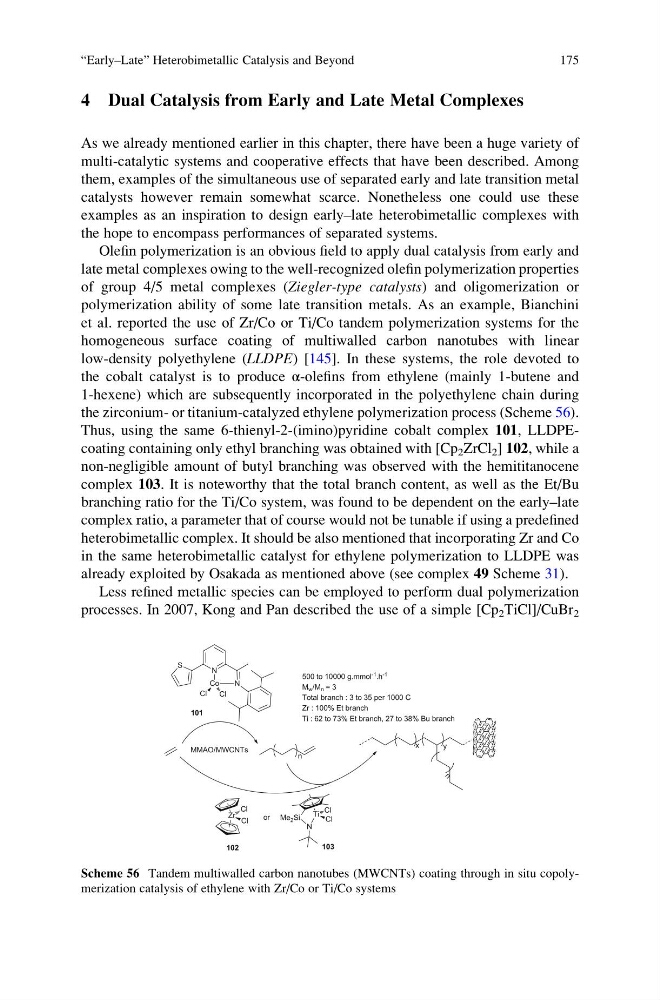
low-density polyethylene (LLDPE) [145]. In these systems, the role devoted to
the cobalt catalyst is to produce α-olefins from ethylene (mainly 1-butene and
1-hexene) which are subsequently incorporated in the polyethylene chain during
the zirconium- or titanium-catalyzed ethylene polymerization process (Scheme 56).
Thus, using the same 6-thienyl-2-(imino)pyridine cobalt complex 101, LLDPEcoating containing only ethyl branching was obtained with [Cp 2 ZrCl 2 ] 102, while a
non-negligible amount of butyl branching was observed with the hemititanocene
complex 103. It is noteworthy that the total branch content, as well as the Et/Bu
branching ratio for the Ti/Co system, was found to be dependent on the early–late
complex ratio, a parameter that of course would not be tunable if using a predefined
heterobimetallic complex. It should be also mentioned that incorporating Zr and Co
in the same heterobimetallic catalyst for ethylene polymerization to LLDPE was
already exploited by Osakada as mentioned above (see complex 49 Scheme 31).
Less refined metallic species can be employed to perform dual polymerization
processes. In 2007, Kong and Pan described the use of a simple [Cp 2 TiCl]/CuBr 2
N
N
S
Co
Cl
Cl
Zr
Cl
Cl
Ti
Cl
Cl
Me 2 Si
N
101
102
103
or
n
x
y
MMAO/MWCNTs
n
500 to 10000 g.mmol -1 .h -1
M w /M n = 3
Total branch : 3 to 35 per 1000 C
Zr : 100% Et branch
Ti : 62 to 73% Et branch, 27 to 38% Bu branch
Scheme 56 Tandem multiwalled carbon nanotubes (MWCNTs) coating through in situ copolymerization catalysis of ethylene with Zr/Co or Ti/Co systems
“Early–Late” Heterobimetallic Catalysis and Beyond
175
As we already mentioned earlier in this chapter, there have been a huge variety of
multi-catalytic systems and cooperative effects that have been described. Among
them, examples of the simultaneous use of separated early and late transition metal
catalysts however remain somewhat scarce. Nonetheless one could use these
examples as an inspiration to design early–late heterobimetallic complexes with
the hope to encompass performances of separated systems.
Olefin polymerization is an obvious field to apply dual catalysis from early and
late metal complexes owing to the well-recognized olefin polymerization properties
of group 4/5 metal complexes (Ziegler-type catalysts) and oligomerization or
polymerization ability of some late transition metals. As an example, Bianchini
et al. reported the use of Zr/Co or Ti/Co tandem polymerization systems for the
homogeneous surface coating of multiwalled carbon nanotubes with linear
low-density polyethylene (LLDPE) [145]. In these systems, the role devoted to
the cobalt catalyst is to produce α-olefins from ethylene (mainly 1-butene and
1-hexene) which are subsequently incorporated in the polyethylene chain during
the zirconium- or titanium-catalyzed ethylene polymerization process (Scheme 56).
Thus, using the same 6-thienyl-2-(imino)pyridine cobalt complex 101, LLDPEcoating containing only ethyl branching was obtained with [Cp 2 ZrCl 2 ] 102, while a
non-negligible amount of butyl branching was observed with the hemititanocene
complex 103. It is noteworthy that the total branch content, as well as the Et/Bu
branching ratio for the Ti/Co system, was found to be dependent on the early–late
complex ratio, a parameter that of course would not be tunable if using a predefined
heterobimetallic complex. It should be also mentioned that incorporating Zr and Co
in the same heterobimetallic catalyst for ethylene polymerization to LLDPE was
already exploited by Osakada as mentioned above (see complex 49 Scheme 31).
Less refined metallic species can be employed to perform dual polymerization
processes. In 2007, Kong and Pan described the use of a simple [Cp 2 TiCl]/CuBr 2
N
N
S
Co
Cl
Cl
Zr
Cl
Cl
Ti
Cl
Cl
Me 2 Si
N
101
102
103
or
n
x
y
MMAO/MWCNTs
n
500 to 10000 g.mmol -1 .h -1
M w /M n = 3
Total branch : 3 to 35 per 1000 C
Zr : 100% Et branch
Ti : 62 to 73% Et branch, 27 to 38% Bu branch
Scheme 56 Tandem multiwalled carbon nanotubes (MWCNTs) coating through in situ copolymerization catalysis of ethylene with Zr/Co or Ti/Co systems
“Early–Late” Heterobimetallic Catalysis and Beyond
175