

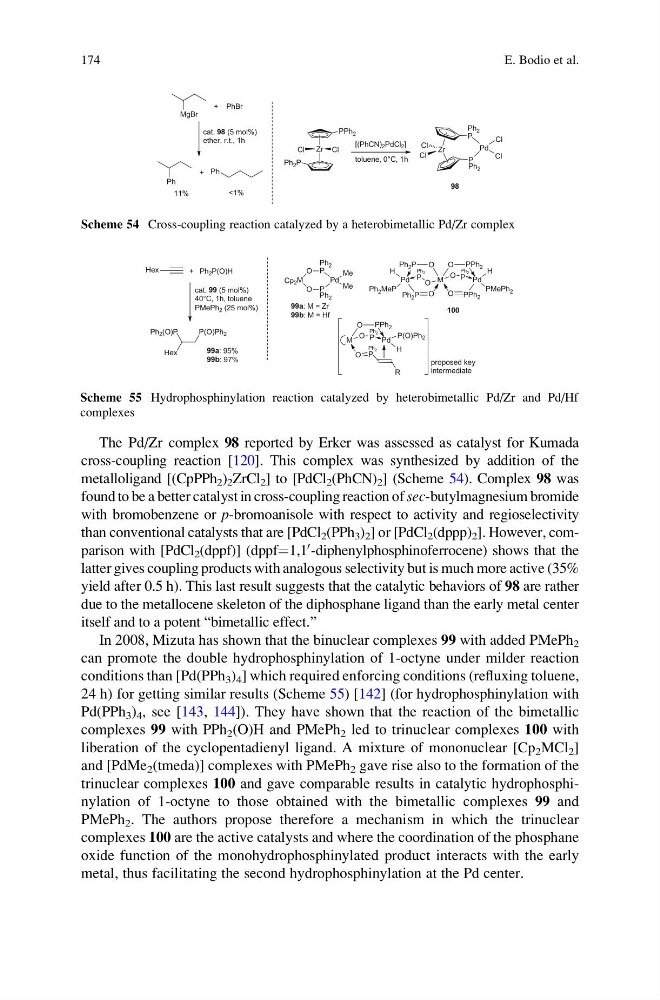
The Pd/Zr complex 98 reported by Erker was assessed as catalyst for Kumada
cross-coupling reaction [120]. This complex was synthesized by addition of the
metalloligand [(CpPPh 2 ) 2 ZrCl 2 ] to [PdCl 2 (PhCN) 2 ] (Scheme 54). Complex 98 was
found to be a better catalyst in cross-coupling reaction of sec-butylmagnesium bromide
with bromobenzene or p-bromoanisole with respect to activity and regioselectivity
than conventional catalysts that are [PdCl 2 (PPh 3 ) 2 ] or [PdCl 2 (dppp) 2 ]. However, comparison with [PdCl 2 (dppf)] (dppf¼1,1
0 -diphenylphosphinoferrocene) shows that the
latter gives coupling products with analogous selectivity but is much more active (35%
yield after 0.5 h). This last result suggests that the catalytic behaviors of 98 are rather
due to the metallocene skeleton of the diphosphane ligand than the early metal center
itself and to a potent “bimetallic effect.”
In 2008, Mizuta has shown that the binuclear complexes 99 with added PMePh 2
can promote the double hydrophosphinylation of 1-octyne under milder reaction
conditions than [Pd(PPh 3 ) 4 ] which required enforcing conditions (refluxing toluene,
24 h) for getting similar results (Scheme 55) [142] (for hydrophosphinylation with
Pd(PPh 3 ) 4 , see [143, 144]). They have shown that the reaction of the bimetallic
complexes 99 with PPh 2 (O)H and PMePh 2 led to trinuclear complexes 100 with
liberation of the cyclopentadienyl ligand. A mixture of mononuclear [Cp 2 MCl 2 ]
and [PdMe 2 (tmeda)] complexes with PMePh 2 gave rise also to the formation of the
trinuclear complexes 100 and gave comparable results in catalytic hydrophosphinylation of 1-octyne to those obtained with the bimetallic complexes 99 and
PMePh 2 . The authors propose therefore a mechanism in which the trinuclear
complexes 100 are the active catalysts and where the coordination of the phosphane
oxide function of the monohydrophosphinylated product interacts with the early
metal, thus facilitating the second hydrophosphinylation at the Pd center.
Cp 2 M
O
O
Ph 2
P
P
Ph 2
Pd
Me
Me
O
Ph 2 P
Pd
Ph 2 P O
O
Ph2
P
H
Ph 2 MeP
O
PPh 2
Pd
PPh 2
O
M
O
Ph2
P
H
PMePh 2
O
PPh 2
Pd
M
O
Ph2
P
P(O)Ph2
H
Ph2
P
O
R
proposed key
intermediate
99a: M = Zr
99b: M = Hf
100
Hex
+ Ph 2 P(O)H
cat. 99 (5 mol%)
40°C, 1h, toluene
PMePh 2 (25 mol%)
Ph2(O)P
Hex
P(O)Ph2
99a: 95%
99b: 97%
Scheme 55 Hydrophosphinylation reaction catalyzed by heterobimetallic Pd/Zr and Pd/Hf
complexes
Zr
+ PhBr
cat. 98 (5 mol%)
ether, r.t., 1h
Zr
PPh 2
Ph 2 P
Cl
Cl
[(PhCN)2PdCl2]
toluene, 0°C, 1h
98
Ph 2
P
P
Ph 2
Cl
Cl
Pd
Cl
Cl
MgBr
Ph
+ Ph
11%
<1%
Scheme 54 Cross-coupling reaction catalyzed by a heterobimetallic Pd/Zr complex
174
E. Bodio et al.
cross-coupling reaction [120]. This complex was synthesized by addition of the
metalloligand [(CpPPh 2 ) 2 ZrCl 2 ] to [PdCl 2 (PhCN) 2 ] (Scheme 54). Complex 98 was
found to be a better catalyst in cross-coupling reaction of sec-butylmagnesium bromide
with bromobenzene or p-bromoanisole with respect to activity and regioselectivity
than conventional catalysts that are [PdCl 2 (PPh 3 ) 2 ] or [PdCl 2 (dppp) 2 ]. However, comparison with [PdCl 2 (dppf)] (dppf¼1,1
0 -diphenylphosphinoferrocene) shows that the
latter gives coupling products with analogous selectivity but is much more active (35%
yield after 0.5 h). This last result suggests that the catalytic behaviors of 98 are rather
due to the metallocene skeleton of the diphosphane ligand than the early metal center
itself and to a potent “bimetallic effect.”
In 2008, Mizuta has shown that the binuclear complexes 99 with added PMePh 2
can promote the double hydrophosphinylation of 1-octyne under milder reaction
conditions than [Pd(PPh 3 ) 4 ] which required enforcing conditions (refluxing toluene,
24 h) for getting similar results (Scheme 55) [142] (for hydrophosphinylation with
Pd(PPh 3 ) 4 , see [143, 144]). They have shown that the reaction of the bimetallic
complexes 99 with PPh 2 (O)H and PMePh 2 led to trinuclear complexes 100 with
liberation of the cyclopentadienyl ligand. A mixture of mononuclear [Cp 2 MCl 2 ]
and [PdMe 2 (tmeda)] complexes with PMePh 2 gave rise also to the formation of the
trinuclear complexes 100 and gave comparable results in catalytic hydrophosphinylation of 1-octyne to those obtained with the bimetallic complexes 99 and
PMePh 2 . The authors propose therefore a mechanism in which the trinuclear
complexes 100 are the active catalysts and where the coordination of the phosphane
oxide function of the monohydrophosphinylated product interacts with the early
metal, thus facilitating the second hydrophosphinylation at the Pd center.
Cp 2 M
O
O
Ph 2
P
P
Ph 2
Pd
Me
Me
O
Ph 2 P
Pd
Ph 2 P O
O
Ph2
P
H
Ph 2 MeP
O
PPh 2
Pd
PPh 2
O
M
O
Ph2
P
H
PMePh 2
O
PPh 2
Pd
M
O
Ph2
P
P(O)Ph2
H
Ph2
P
O
R
proposed key
intermediate
99a: M = Zr
99b: M = Hf
100
Hex
+ Ph 2 P(O)H
cat. 99 (5 mol%)
40°C, 1h, toluene
PMePh 2 (25 mol%)
Ph2(O)P
Hex
P(O)Ph2
99a: 95%
99b: 97%
Scheme 55 Hydrophosphinylation reaction catalyzed by heterobimetallic Pd/Zr and Pd/Hf
complexes
Zr
+ PhBr
cat. 98 (5 mol%)
ether, r.t., 1h
Zr
PPh 2
Ph 2 P
Cl
Cl
[(PhCN)2PdCl2]
toluene, 0°C, 1h
98
Ph 2
P
P
Ph 2
Cl
Cl
Pd
Cl
Cl
MgBr
Ph
+ Ph
11%
<1%
Scheme 54 Cross-coupling reaction catalyzed by a heterobimetallic Pd/Zr complex
174
E. Bodio et al.